WorkBody Tutorial: From AI Chat to Agent in Practice
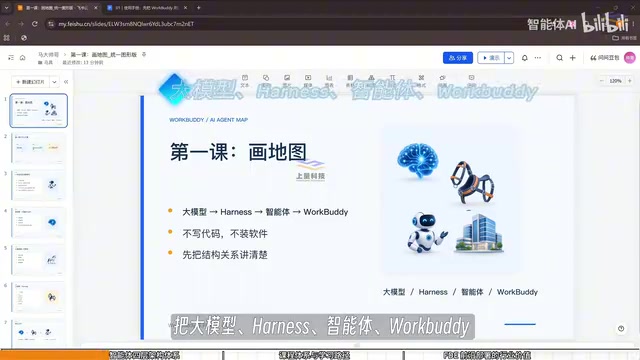
Explains the chain from LLMs to agent platforms via the "horse tack" metaphor and gives a WorkBody implementation path.
The article introduces Bilibili creator "Hailang"'s WorkBody system tutorial, outlining the complete chain from LLMs, Harness, agents, and agent platforms to FDE deployment. Core metaphor: an LLM is like a wild horse; the Harness (context management, tool calling, task loop, permission control) is the tack; only a model fitted with tack becomes an agent that can reliably work; WorkBody is the platform layer integrating multiple agents. WorkBody can call tools, operate files, and chain multi-step tasks, avoiding complex network configuration for domestic users and offering a free quota. The learning path is layered: first use WorkBody for current work, then customize a dedicated Harness agent, and only then consider the FDE professional direction. The course has ten lessons and emphasizes customizing to your own scenarios.
Many people still think of AI as a "you ask, it answers" chat box, but AI that can truly do work for you is an agent that can call tools, operate files, and chain multiple steps together. Bilibili creator "Hailang" (海浪) has released a WorkBody system tutorial that aims to clearly explain the chain of "LLM → Harness → Agent → Agent Platform → FDE deployment" and walk users through applying WorkBody to real work scenarios.
One Map to Clarify Four Concepts: LLM, Harness, Agent, WorkBody
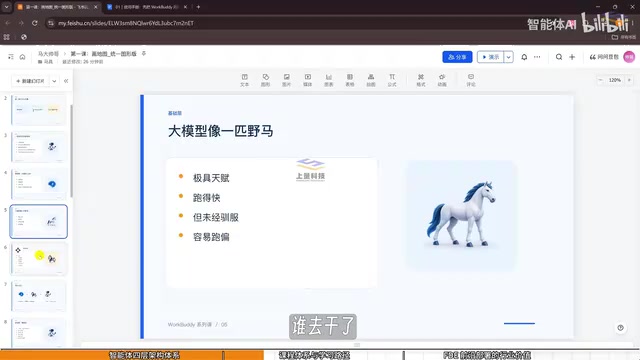
The course doesn't rush into plugins and deployment at the start; instead, it first builds a framework for learners. The creator uses a metaphor: an LLM is a wild horse—you can't ride it before it's tamed. To make it travel a thousand miles a day delivering mail, you need a saddle, reins, stirrups, and a whip—these "tack" items are the Harness (whose original English meaning is horse tack).
In the AI context, tack refers to engineering control-layer capabilities such as context management and memory, tool calling (Skill), the task loop, and permission control (e.g., switching between expert mode and normal chat mode). Only when an LLM is fitted with this "tack" can it reliably do work and become an agent.
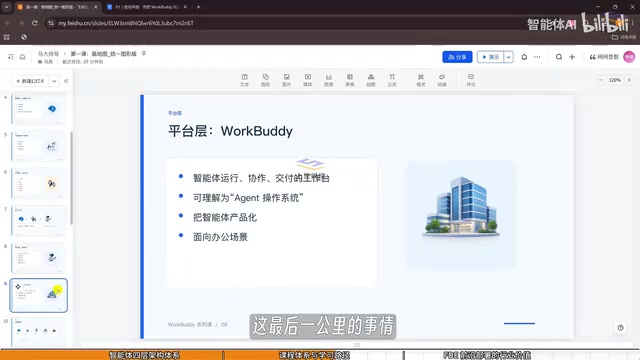
One layer up is an agent platform like WorkBody. A single agent solves a single problem, while a platform integrates a large number of agents that can collaborate to solve complex problems. The creator compares it to "large-unit operations" rather than "single-soldier operations." The problem this layer solves isn't "can it do it" but "can it do it at scale."
Context management and memory are key capabilities in the Harness: an LLM itself is stateless, and each call can only see the current input. To keep an agent coherent across multi-step tasks, the Harness needs to trim historical conversations, intermediate results, and tool return content and re-inject them into the context window, using vector retrieval or summary compression to break through window-length limits. The task loop (Agent Loop) refers to the agent repeatedly executing the closed loop of "observe—think—act": the model first decides which tool to call, the Harness executes the tool and returns the result, and the model then decides the next step based on that, until the task is complete or a termination condition is triggered. Permission control ensures this loop runs within safe boundaries, for example by distinguishing read-only operations from write operations and requiring manual confirmation before high-risk actions. Together, these mechanisms determine whether an agent can reliably complete long-chain tasks.
What WorkBody Can Do: From Document Processing to Automated Office Work
According to the tutorial, WorkBody is an AI agent that can actually execute tasks. What sets it apart from traditional chat tools is that it doesn't just understand requirements and answer questions—it can also call tools, operate files, execute tasks, and even chain multiple steps into a complete workflow. Document writing, material organization, spreadsheet processing, data analysis, and automated office work are all within its capabilities.
For domestic users, two features lower the barrier: first, no need to wrestle with a complex network environment; second, it offers a free usage quota. This lets zero-foundation users get started first and then gradually go deeper. The creator spent three months organizing the knowledge system, researching advanced features, and designing practical cases. The course covers a complete path from download and installation, environment configuration to basic features, advanced techniques, and then real-world scenario cases.
The tutorial emphasizes not just "how to click each feature" but core techniques such as task decomposition, tool calling, and workflow building. In other words, what you learn is the method, not the buttons.
How Three Types of People Use It: Scenario-Based Approaches for Teachers, Lawyers, and Professionals
The course gives several specific professional scenarios: teachers can use it to make PPTs, write lesson-prep drafts, and review homework; lawyers can use it to screen risk points and find legal support points; content creators and professionals can use it to improve daily work efficiency. The common thread in these examples is that the tasks have clear inputs and outputs, decomposable steps, and high repeatability—exactly the range agents are good at handling.
Going one layer up, users can customize their own Harness "tack" to build a dedicated agent. This is no longer "using a tool" but "building a tool." The creator also reminds viewers that not everyone needs to head toward FDE, but learning WorkBody can at least help tackle a lot of the tedious work in your job.
FDE: The Role That Bridges the Last Mile of AI Implementation
The course spends considerable time on FDE (Forward Deployed Engineer). According to the creator, from LLMs to Harness, to agents, to platforms like WorkBody, there are many checkpoints and connection points that need to be bridged, and the people handling the "last mile" are FDE engineers.
FDE requires two kinds of capabilities: on the technical side, understanding the underlying principles and having a toolkit on hand; on the communication side, being able to quickly structure a company's business, produce solutions that fit the requirements, and then bridge the gaps between LLMs, Harness, agents, and platforms. The creator mentions that this role is highly sought after at both big tech companies and mid-sized companies and is "a necessary stage as LLMs move into all kinds of industries"—this is a single-source observation, but it aligns with the widespread industry sense that AI implementation talent is in short supply.
For learners, the path is layered: the minimum requirement is to learn WorkBody and use it to solve the work at hand; a step higher is to customize your own Harness and dedicated agent; only further up is heading toward the FDE professional direction.
FDE (Forward Deployed Engineer) as a role was first popularized by enterprise data companies such as Palantir. Its model is to station engineers at customer sites to directly interface with business requirements and complete system implementation, rather than delivering remotely from headquarters. In the AI context, FDE responsibilities are similar: go deep into enterprises to sort out processes and data, determine which links are suitable to hand over to LLMs and agents, and then complete customization of prompts, tool interfaces, permission policies, and platform configuration. Compared with traditional implementation consultants, FDE is more engineering-oriented and needs to be able to read and write code, debug APIs, and evaluate model output quality; compared with pure algorithm engineers, FDE is closer to the business and can translate vague requirements into executable system solutions. The growing popularity of this role reflects the fact that there are still many customization gaps between AI capabilities and real business needs.
Course Structure and Learning Suggestions
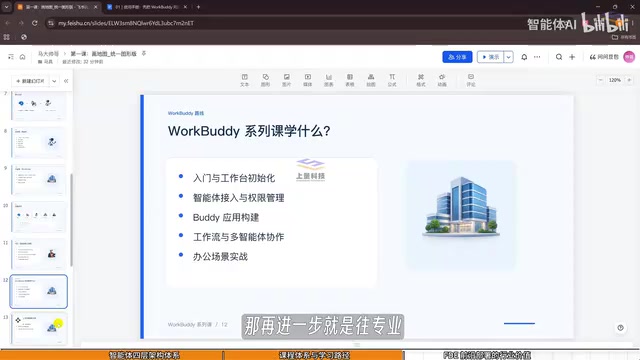
The WorkBody series has ten lessons in total, starting from installation and covering connectors, expert skills, automation, Feishu communication, remote control, and more. The creator suggests customizing based on your current work and life scenarios to truly save time. Follow-up content includes Harness customization, FDE deployment, and AI commercialization.
The course also recommends a book—Cybernetics. The creator believes that listening to this book first before understanding the theory of the Harness will play a guiding, high-level role. This suggestion suits readers who want to go deeper, but it's not mandatory for users who just want to use WorkBody to improve efficiency.
The value of the entire tutorial lies in the fact that it doesn't mystify agents but instead explains the engineering control layer clearly with the plain metaphor of "horse tack." For zero-foundation users, this is a feasible path from "knowing how to chat with AI" to "knowing how to get work done with AI."
One-line Summary
Using the "horse tack" metaphor to explain the chain from LLMs to agent platforms, and providing a WorkBody implementation path.
Paragraph Summary
The article introduces Bilibili creator "Hailang"'s WorkBody system tutorial, outlining the complete chain from LLMs, Harness, agents, and agent platforms to FDE deployment. The core metaphor is: an LLM is like a wild horse, the Harness (context management, tool calling, task loop, permission control) is the tack, and only a model fitted with tack becomes an agent that can reliably do work, while WorkBody is the platform layer integrating multiple agents. WorkBody can call tools, operate files, and chain multi-step tasks; for domestic users it avoids complex network configuration and offers a free quota. The learning path is layered: first use WorkBody to solve the work at hand, then customize a dedicated Harness agent, and only then consider the FDE professional direction. The course has ten lessons and emphasizes customizing to your own scenarios.
Related articles

Hero or Luck? Technical Reflections Sparked by an Arizona Grandfather Finding a Missing Toddler in the Desert
An Arizona grandfather finding a missing toddler in the desert hits Hacker News. This article analyzes emergency search, drone thermal imaging, child location devices, and community collaboration, exploring the boundaries of technology and human effort in extreme environments, while noting the material's limitations.

Run Agentic Coding on Mac with One Command: The Localcode Open-Source Tool
Localcode is an open-source agentic coding tool for Mac that launches with a single command. This article examines its local, open-source, minimal-install positioning, who it suits, and the information gaps to consider before adoption.

Lean Formalization of Masullo Manuscript: Progress Map Sparks Discussion
A public progress map for a Lean formalization project of Alessandro Masullo's manuscript sparks Hacker News discussion on formalization costs, collaboration, and AI-assisted proving.