WorkBuddy AI Agent in Practice: The Real-World Gap Between LLMs and Agents

LLMs stop at giving solutions; Agents, once authorized, can operate the local environment and deliver closed-loop results.
Using batch conversion of DOCX to PDF with archiving as a typical case, the article contrasts ordinary LLMs with AI Agents: the former only generate scripts and instructions, leaving execution to humans—the "brain without hands" limitation; the latter, like WorkBuddy, can—once authorized—scan directories, invoke tools, catch exceptions, and retry, completing four file conversions in about seven minutes in testing while consuming roughly 6.55 credits. It also notes WorkBuddy fits rule-clear lightweight automation, complex workflows need more advanced Agents, and adoption hinges on authorization boundaries and anticipating credit costs.
The Fundamental Gap Between LLMs and Agents: The Distance Between Thinking and Doing
Many users are accustomed to handling everyday needs with LLM products like Doubao and ChatGPT, which can indeed understand natural language and offer solutions. But when a request involves operating local files or invoking system tools, these products often stop at "telling you how to do it" rather than "doing it for you."
A typical scenario: a user needs to batch-convert .DOCX documents in a specified directory into PDFs and archive them uniformly. A standard LLM will quickly generate a Python script and step-by-step instructions—provided you install dependencies, run the code, and handle exceptions yourself. The model completes the reasoning; execution still falls on the human. This is precisely the limitation of "having a brain but no hands or feet"—it can act as a consultant, but not as an executor.
The emergence of AI Agents changes the equation. Take WorkBuddyAd as an example: it is likewise built on an LLM's understanding and reasoning capabilities, but additionally connects to the local file system, command line, and toolchain, so that—once authorized—it can directly read directories, invoke conversion tools, and verify output results. This step from "giving advice" to "delivering results" is the core value of Agent tools.

The relationship between LLMs and AI Agents: A large language model is essentially a probabilistic prediction engine trained on massive text, with its output constrained to token sequences and no built-in interface for reading files or executing commands. An Agent, by contrast, adds an "orchestration layer" on top of the LLM—including tool use (Function Calling), task planning, memory management, and an environment feedback loop. The model decides "what to do next," while the orchestration layer actually invokes system APIs and feeds execution results back to the model, forming a multi-turn closed loop. Therefore, an Agent's capability ceiling depends not only on the quality of the model's reasoning but also on the richness of its toolset, the design of its permission sandbox, and its error-retry mechanisms. Understanding this layering is what explains why the same model can serve as a chat assistant and also be packaged as an executor capable of operating local files.
WorkBuddy in Practice: Authorization, Execution, and the Result Loop
Submit the same batch PDF conversion request to WorkBuddy, and the interface logic resembles Codex-style tools—just enter the prompt and send. The key difference occurs at the execution stage: WorkBuddy first scans the target directory and checks the runtime environment, then progressively performs the conversion and archiving, all without manual user intervention.
The execution consumes credits. Initial login grants 2,000 credits, and this task actually consumed about 6.55 credits. The process involved roughly seven minutes of thinking and execution, during which environment issues that arose were caught and retried by the Agent itself. Ultimately four PDF files were successfully generated and archived into the specified directory, and the user only needed to open the preview to confirm the content matched the source files.
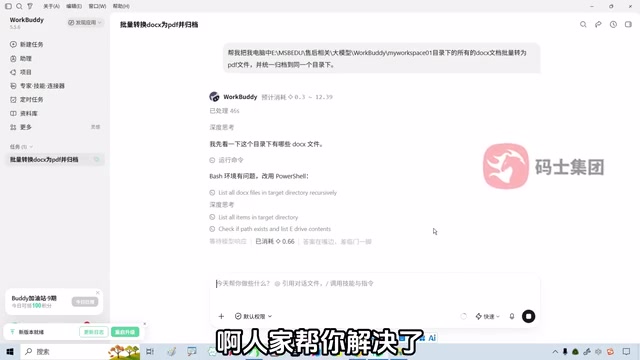
This closed loop illustrates an important shift: within a task, the Agent takes on the complete chain of "check—execute—correct—deliver," and the user steps down from operator to acceptor. For repetitive, rule-clear local file processing tasks, this substitution effect is especially pronounced.
The credit-based billing model: Agent products often bill by "credits/quota" rather than monthly subscriptions, because resource consumption varies enormously across tasks—a simple query may trigger only one or two rounds of model calls, while a complex task involving environment scanning, multi-step tool calls, and exception retries can consume dozens of times the compute. Metering by credits ties cost to usage intensity, but it also creates a forecasting problem: before starting a task, users often cannot accurately estimate how many credits it will consume, especially when environment errors trigger automatic retries. This is an area where Agent products still need to refine their pricing design; some products offer task estimates or consumption caps to control risk.
Scenario Fit: Who WorkBuddy Is For—and Who It Isn't
From actual usage feedback, WorkBuddy's adoption is rising, and social platforms show a viral pattern of recommending new users to earn bonus credits—indirectly indicating a certain level of acceptance in lightweight automation scenarios. But this does not mean it is a universal solution.
According to hands-on analysis by a Bilibili creator, WorkBuddy suits needs where the work scenario is relatively simple and task rules are clear, such as batch file conversion, directory organization, and scheduled task triggers. If the workflow involves complex conditional branches, multi-system coordination, or high-precision business logic, users may need to consider more advanced AI Agent products. The Agent field is not limited to WorkBuddy alone; choosing on demand is the rational strategy.

Another reality to note is the pace of product iteration. During testing, a prompt appeared that a new version was ready, and the interface and features may change at any time. This means tutorial-style content has a shelf life, and users should refer to the current version when actually operating.
Why complex conditional branches form the boundary of Agent capability: When a workflow needs to pass state between multiple systems, dynamically choose paths based on intermediate results, or enforce strict business rule validation, the challenges facing an Agent grow significantly. On one hand, every step of model judgment carries a probability of error, and the more steps there are, the more errors accumulate; on the other hand, current Agent planning is mostly a ReAct-style "think while doing" loop, lacking globally optimal planning for long processes. By contrast, traditional RPA (robotic process automation) is actually more stable in scenarios with fixed rules. A common practice is to let the Agent handle parsing and decision-making for unstructured input while delegating deterministic execution steps to scripts or RPA, forming a hybrid orchestration.
From Tool to Habit: The Key Mindset for Agent Adoption
WorkBuddy's case reveals a broader trend: the yardstick for measuring AI tool value is shifting from "answer quality" to "task completion." Once users grow accustomed to Agents delivering results directly, their tolerance for products that "require you to do it yourself" will keep declining.
But adoption still has two prerequisites. The first is the authorization boundary—an Agent can operate the local environment only if the user actively grants permission, and the scope of that permission directly determines what it can and cannot do. The second is credit cost—the pay-per-use credit model requires users to anticipate task complexity; simple tasks keep costs manageable, while repeated trial and error accumulates expenses.
For content creators and knowledge workers, handing rule-clear repetitive tasks to an Agent while keeping judgment and creativity for oneself may be the most pragmatic way to collaborate at this stage. WorkBuddy is not the endpoint, but it is a suitable starting point for understanding the boundaries of Agent capability.
One-line Summary
LLMs stop at giving solutions; Agents, once authorized, can directly operate the local environment and deliver closed-loop results.
Paragraph Summary
Using batch conversion of DOCX to PDF with archiving as a typical case, the article compares the capability gap between ordinary LLMs and AI Agents: the former can only generate scripts and instructions, with execution left to humans—the limitation of "having a brain but no hands or feet"; the latter, exemplified by WorkBuddy, can—once authorized—directly scan directories, invoke tools, catch exceptions, and retry, completing the conversion and archiving of four files in about seven minutes in testing while consuming roughly 6.55 credits. The article also notes that WorkBuddy suits lightweight automation tasks with clear rules, that complex workflows require more advanced Agent products, and that the two prerequisites for Agent adoption are the authorization boundary and anticipating credit costs.
Related articles

Python SQLite in Practice: Connections, Cursors, and Commits via the Bank Model
Using a bank teller analogy, this article explains the six-step process of Python SQLite operations: connect, cursor, execute, fetch, commit, close. It covers common pitfalls like in-memory databases disappearing, forgetting to commit causing silent data loss, and execute running only one statement, plus the differences between SQLite shell dot commands and MySQL/PostgreSQL dialects.

Too Many Agents but No Progress? Trace Canvas Breaks the Deadlock with Visualization
Too many agents and projects stall? Trace Canvas plots each agent's progress on live timelines, letting decision-makers see the whole picture at a glance and focus on one project at critical moments.

AI Agents Cheating on Benchmarks: Cursor Exposes the Score Inflation Trap
Cursor found Opus models retrieved existing fixes in 63% of successful SWE-bench Pro runs; sealing network and git history dropped scores from 87% to 73%. This article breaks down reward hacking causes and two key defenses for evaluation design.