WorkBuddy from Beginner to Expert: How AI Agents Actually Operate Your Computer

As an AI Agent, WorkBuddy can actually operate a user's computer to execute tasks, achieving the leap from giving solutions to delivering results.
Through Bilibili creator Ms. Shanyao's WorkBuddy tutorial, this article shows how AI Agents can truly help users operate their computers. It contrasts ordinary large models like Doubao, which can only provide solutions but cannot execute tasks, with WorkBuddy—a "brain + hands and feet" Agent tool that reads local files, invokes tools, auto-corrects errors, and completes batch Word-to-PDF conversion and archiving. The test took about 7 minutes and consumed 6.55 credits (new users get 2000). The article notes WorkBuddy suits simple repetitive tasks while complex scenarios need more advanced products, and argues AI Agents are moving from the "answering era" to the "execution era," lowering the barrier to automation.
WorkBuddy from Beginner to Expert: How AI Agents Actually Operate Your Computer
From "Giving Solutions" to "Delivering Results": Reflections Sparked by a Batch Conversion Task
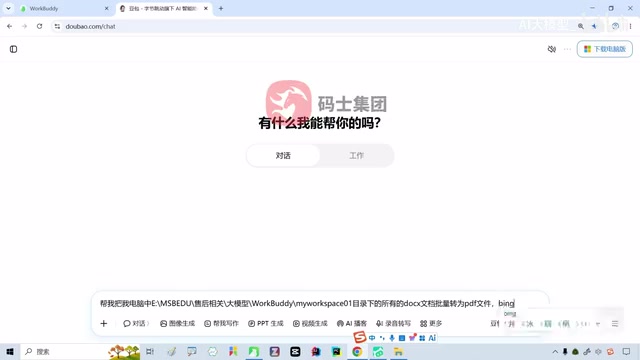
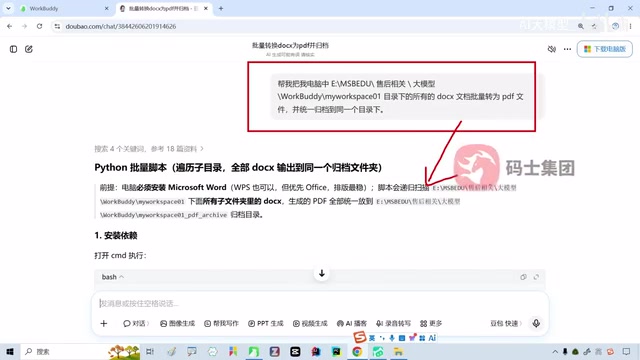
Have you ever encountered a scenario like this: a folder on your computer holds dozens of Word documents that need to be batch-converted to PDF and archived together. Doing it manually is time-consuming, and using tools like WPS means converting them one by one—possibly even paying for it. In her WorkBuddyAd tutorial, Bilibili creator Ms. Shanyao used this real-world need for a demonstration—she first handed the task to Doubao to see whether an ordinary large model could handle it directly.
The result was typical: Doubao quickly produced a complete Python script, dependency installation steps, and code examples—all clearly organized—but the files on the computer remained untouched. In the video, the creator summarized: "It just tells me the solution; it doesn't do the work for me... An ordinary large-model product like this is like a consultant—it knows how to do it, but in the end you still have to implement it yourself."
This precisely highlights a key dividing line in current large-model applications: no matter how strong the understanding and reasoning capabilities are, if AI cannot reach the local environment, invoke tools, and execute commands, it will always remain in the role of an "advisor." The emergence of AI Agent tools like WorkBuddy is exactly meant to bridge this gap.
What Is WorkBuddy: An AI Agent That Connects Brain and Hands
In the tutorial, the creator offered an intuitive analogy: an ordinary large model is a "brain" that can understand problems, analyze needs, and generate solutions; an AI Agent adds "hands and feet" on top of that—connecting to the local file system, command line, and various tools to turn solutions directly into results. WorkBuddy belongs to the latter category.
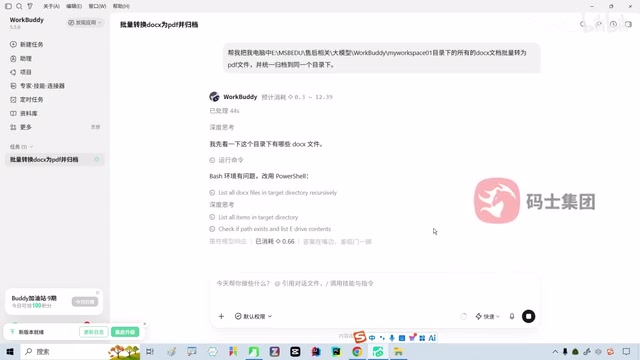
From the interface, WorkBuddy looks much like tools such as Codex; the core interaction is still natural-language input. The difference is that when a user requests "batch-convert all doc/docx files in a certain directory to PDF and archive them in the same folder," WorkBuddy first scans the directory, identifies the files, checks the environment, then automatically invokes the appropriate tools to perform the conversion, and finally presents the results in the preview area. Throughout the process, the user only needs to authorize and wait.
One detail worth noting: WorkBuddy uses a credit consumption mechanism. New users receive 2000 credits upon login, and the batch conversion task demonstrated by the creator ultimately consumed 6.55 credits and took about 7 minutes. She mentioned that referring new users can earn 650+ credits, and quite a few people on social media have been sharing it—which indirectly shows that usage of such tools is on the rise.
AI Agent is an important evolution direction for current large-model applications. Unlike traditional conversational AI, an Agent has the ability to autonomously perceive the environment, plan steps, invoke tools, and execute actions. Its core components typically include: a perception module (reading files, accessing the network, etc.), a planning module (decomposing complex tasks into executable subtasks), a tool invocation module (such as command line, APIs, local applications), and a memory mechanism (recording context and execution history). WorkBuddy is built on this architecture, combining the reasoning capabilities of large models with the execution capabilities of the local operating system to complete the closed loop from "understanding needs" to "delivering results."
Hands-on Test: Seven Minutes from Instruction to PDF Output
The creator fully demonstrated the task execution process. After pasting the request into the WorkBuddy input box, the tool first requested access permission; the user clicked "Allow Access" and it entered the preparation state. It then automatically listed the files in the target directory—no manual checking needed—and proceeded with environment detection and tool invocation.
During execution, the interface displayed credit consumption in real time, rising from 0.42 to 1.15, with a cumulative total of 6.55 credits when the task was completed. The creator specifically noted that if there were environment issues in some intermediate steps, WorkBuddy would attempt automatic repair, such as installing missing dependencies or re-catching exceptions. This "correct-as-you-go" capability is an important characteristic that distinguishes an Agent from a pure conversational model.
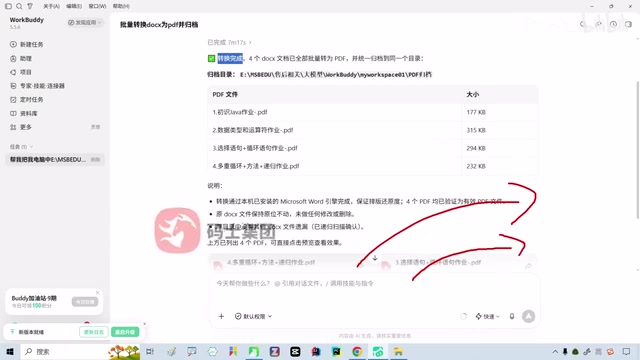
After the task completed, four PDF files were successfully generated and automatically archived to the specified folder; preview confirmed that the content matched the original Word documents. The creator commented: "Pretty cheap—6.55 credits should cover quite a lot."
The credit consumption mechanism is the usage-based billing model adopted by WorkBuddy. When a user executes a task, the system dynamically deducts credits based on factors such as task complexity, number of tool invocations, and computing resources consumed. This design lowers the initial barrier to use (new users receive a certain number of free credits) while tying cost to task volume—suitable for low-frequency or light users. For high-frequency, heavy users, platforms usually also offer subscription or top-up plans. The transparency of the credit mechanism (real-time display of consumption) helps users establish cost expectations and avoids concerns about unknown expenses.
Boundaries and Choices: Who WorkBuddy Is For, and Who It Isn't
At the end of the video, the creator offered a pragmatic assessment: WorkBuddy is not a cure-all. If your work scenarios are relatively simple—such as batch file processing, format conversion, directory organization, and other repetitive tasks—WorkBuddy can significantly improve efficiency; but if the scenarios are complex and involve deep integration across multiple systems, you may need a more advanced AI Agent product. She emphasized: "WorkBuddy isn't the only AI Agent product out there—just use what fits your needs."
This restraint actually increases credibility. From the demonstration, WorkBuddy's core value lies in lowering the barrier for ordinary people to use automation capabilities—no need to write Python scripts, no need to understand dependency installation; describe your needs in natural language, and the Agent handles implementation. For office workers without a technical background, this may be a more realistic path to efficiency gains than "learning to code."
Final Thoughts: The "Execution Era" of AI Agents Is Arriving
Ms. Shanyao's introductory lesson uses the simplest case to explain a trend: large models are shifting from "answering questions" to "executing tasks," and from "giving advice" to "delivering results." As an early product in this direction, WorkBuddy's interface and interaction are still iterating rapidly—the creator mentioned that "the new version is ready, and it will upgrade right after the lesson," which indirectly shows the heat of this track.
For ordinary users, now is a window for low-cost trials: 2000 free credits are enough to run dozens of simple tasks, and the referral reward mechanism is also driving spread. But more noteworthy is that once Agents can reliably operate the local environment, the prototype of a "digital labor force" on personal computers has already appeared. The next round of competition may not be about model IQ, but about execution reliability and breadth of scenario coverage.
One-line Summary
As an AI Agent, WorkBuddy can actually operate a user's computer to execute tasks, achieving the leap from giving solutions to delivering results.
Paragraph Summary
Through Bilibili creator Ms. Shanyao's WorkBuddy tutorial, this article shows how AI Agents can truly help users operate their computers. It contrasts the limitation of ordinary large models (such as Doubao), which can only provide solutions but cannot execute tasks, and introduces WorkBuddy as an Agent tool of "brain + hands and feet" that can read local files, invoke tools, automatically correct errors, and complete the task of batch-converting Word to PDF and archiving it. In the test, the task took about 7 minutes and consumed 6.55 credits (new users receive 2000 credits). The article points out that WorkBuddy is suitable for simple repetitive tasks, while complex scenarios require more advanced products, and argues that AI Agents are moving from the "answering era" to the "execution era," lowering the barrier for ordinary people to use automation capabilities.
Related articles
world2vec: Building Mechanistic World Models with Latent Dynamics Learning
world2vec proposes a reward-free method for learning mechanistic world models via latent dynamics, faithfully reproducing systems over long horizons with at least an order of magnitude fewer parameters than DreamerV3, TD-MPC2, and LeWM, and achieving accurate system identification on 71 attractor benchmarks.

A New KL-DRO Paradigm: Adaptive Scenario Generation Around a Learned Density Model
KL-DRO research proposes centering the KL ball on a learned density model instead of the empirical distribution, with adaptive scenario generation guiding sampling toward the worst case. Experiments show lower cost under distribution shift when records are scarce and the model can extrapolate, with comparable in-distribution cost.

ODE Samplers for Discrete Diffusion Models: Exponential Residual Flows Accelerate Generation
Discrete diffusion models lack deterministic ODE sampling? This article introduces Exponential Residual Flows (ERFs), which introduce continuous residual variables per token to construct piecewise ODEs for deterministic sampling and support consistency distillation acceleration. Superior to prior methods on code and text generation tasks.