WorkBuddy Getting Started Guide: How Domestic AI Agents Can Do the Work for You

WorkBuddy is a China-friendly AI agent that autonomously operates your computer to complete office tasks — not just give advice.
This article explores the shift from "chat-style" AI to AI Agents, using WorkBuddy as a prime example. Unlike traditional LLMs that only output text suggestions, AI agents can directly control your computer, invoke software, and execute complete workflows within user-authorized boundaries. WorkBuddy is positioned as a China-friendly alternative to Codex, with key advantages including zero technical setup, deep integration with domestic tools like WeCom, free daily usage quotas, a built-in skill marketplace, and multi-agent parallel collaboration. All operations require user authorization, and high-risk commands are automatically blocked. The article also notes the content carries clear promotional intent and recommends real-world testing before drawing conclusions.
From Q&A Tool to Digital Employee: The Paradigm Shift in AI-Powered Work
For the past few years, most people's experience with AI has been limited to a "question and answer" model — you ask, it outputs copy, plans, or suggestions. This kind of interaction never really escapes the chat window: AI gives you ideas, but all the actual execution still falls on you.
Take a Word document with chaotic formatting and misplaced punctuation. A typical large language model can only tell you how the layout should look — you still have to make every adjustment yourself, step by step. In other words, traditional AI does the talking; you do the doing.

WorkBuddyAd represents a different approach — the AI Agent. Its core value isn't text output; it's the ability to directly control your computer, invoke office software, and plan workflows within user-authorized boundaries, ultimately delivering complete results. This type of tool is more like a full-time digital employee than a passive chatbot. The distinction between traditional AI and an agent is actually straightforward: can it autonomously execute tasks and deliver tangible results, rather than just giving advice?
The fundamental difference between an AI Agent and a traditional large language model lies in its closed-loop "perceive–decide–act" capability. A traditional LLM stops at generating text output, while an agent also has a Tool Use layer: it can control the mouse and keyboard, read and write local files, call APIs, and dynamically adjust its next action based on execution results. This loop of "think then act, observe then think again" is academically known as the ReAct (Reasoning + Acting) framework. Because agents can interact bidirectionally with the real environment, they can upgrade from "answering questions" to "completing tasks" — which is the technical basis for the "digital employee" analogy.
What WorkBuddy Is: A Domestically Adapted Alternative to Codex
According to the Bilibili tutorial this article is based on, WorkBuddy can be understood as a "China-friendly version" of Codex. The two share similar interfaces and operational logic, but WorkBuddy has been extensively adapted for users in China — no complex configuration required, modest hardware demands, and a free usage tier.
Its most critical differentiator is direct integration with office software commonly used in China. Tasks that previously required constant switching between multiple apps — organizing materials, generating documents, analyzing spreadsheets, handling repetitive operations — can now potentially be handed off to it as a unified workflow.
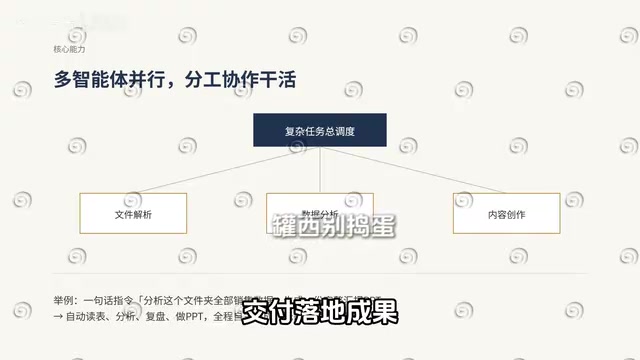
One capability that gets repeatedly emphasized is multi-agent parallel collaboration. When faced with a complex task, WorkBuddy automatically breaks down the process and dispatches multiple "digital employees" to handle different parts — file parsing, data analysis, content creation, and so on. For example, if you tell it to analyze all the sales data in a specific folder, it can independently complete the review, summarize the findings, and generate a report PPT — all without you manually switching between applications. Beyond document processing, the tutorial also demonstrates a fully automated PPT with animations produced by WorkBuddy, showing that its output isn't limited to text-based tasks.
Multi-Agent parallel collaboration is a significant architectural concept in AI engineering today. The core idea is to break a complex task into subtasks, distribute them to specialized sub-agents for concurrent processing, and have an Orchestrator consolidate the results. This is similar in spirit to the microservices architecture in software engineering: specialized division of labor outperforms a single large model trying to do everything, in terms of both quality and efficiency. In real office scenarios, "file parsing," "data analysis," and "content writing" each demand different model strengths — a multi-agent split lets you invoke the most suitable model or tool for each step, rather than forcing a general-purpose model to perfectly handle every part.
Why Beginners Should Consider It First: Four Core Advantages
The tutorial breaks down why WorkBuddy suits zero-experience users across several dimensions. Here are the four main takeaways.
Low Barrier to Entry and Office Ecosystem Compatibility
Extremely low barrier is the first selling point. Zero-experience users simply need to search for the official website, download, and install it. The local deployment process is straightforward, with no technical expertise required.
The second point is deep integration with China's office ecosystem. The platform's "connectors" are authorization gateways for linking various office applications, including tools like WeCom (Enterprise WeChat). Once authorized, it can automatically sort through chat content, organize meeting notes, and help manage work messages — making AI a genuine part of your daily workflow rather than something you access separately.
Cost and Extensibility
Accessible pricing is the third advantage. New users receive points upon registration, with daily free quotas available that should cover most light office use cases. Compared to overseas agents that typically require paid subscriptions and heavy usage to see real value, this is much more user-friendly for everyday professionals.
The fourth point is extensibility. The platform has a built-in Chinese Skill marketplace where pre-built professional skill plugins can be installed with one click, expanding AI's office capabilities on demand. It also includes expert agents covering roles like development, HR, operations, sales, and administration — callable with a single click to handle specialized work in those domains.
For more advanced users, two additional features are worth noting: multi-model switching, which supports several domestic large language models that can be swapped based on business needs; and MCP Service extension interfaces, which allow integration with custom business tools to expand the AI's working scope.
Safety Mechanisms: Authorization and High-Risk Blocking
An agent that can directly control your computer is powerful — but that power comes with risk. The tutorial specifically highlights WorkBuddy's safety design: all file access, software reading, and software operations require user authorization, and high-risk operations are automatically intercepted, fundamentally preventing data leakage and accidental operations.

This "full control + high-risk command blocking" mechanism provides a necessary psychological safeguard for users worried about handing over computer control to an AI. After all, the prerequisite for letting AI work autonomously is that you can always set and enforce its behavioral boundaries.
WorkBuddy vs. Codex: Usability vs. Flexibility
The tutorial also offers an honest comparison: agents like Codex offer greater flexibility, but require professional groundwork such as setting up a code environment — a very high barrier that isn't suitable for beginners. WorkBuddy makes trade-offs among usability, low cost, and localization, sacrificing some of the flexibility that power users might want in exchange for an experience that everyday professionals can get up to speed with quickly.
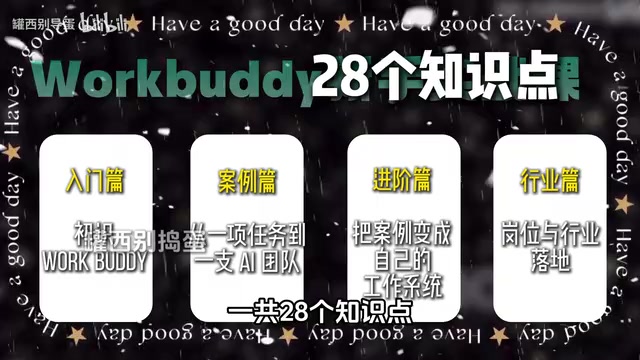
One important caveat: this content is essentially an introduction and product pitch for a paid practical course, and carries obvious promotional intent. Things like "28 knowledge points" and "four-module blue paper" companion materials are more about driving engagement and traffic than delivering neutral value. When evaluating this content, treat it as an entry point for understanding what this category of tools can do — not as an objective product review. The tool's actual performance should be judged based on real testing within your own work context.
OpenAI Codex is an AI system built around code generation capabilities, originally targeting developers and requiring a local environment like Python to function fully. Comparing it to WorkBuddy is more about shared product positioning — "letting AI autonomously complete complex operations" — than a direct architectural equivalence. Such comparisons are common in popular tech content because they help new audiences quickly build a reference frame, but they can also obscure meaningful differences in technical approach: Codex leans toward code execution and development assistance, while WorkBuddy focuses on GUI control and office workflow automation. Their actual use cases don't fully overlap.
Final Thoughts
The AI Agent direction that WorkBuddy represents does point toward the next stage of office automation — AI that no longer just offers suggestions, but genuinely takes over repetitive, time-consuming operations. For everyday professionals with no technical background, locally adapted, low-barrier tools like this lower the cost of trying AI. But no matter how capable the tool, the prerequisite is that you're willing to put in the practice and actually integrate it into your workflow — not just bookmark it and forget it.
Related articles

The Touchscreen MacBook and Apple's Delightful Mess: A Deliberate Gamble
The Vergecast unpacks the touchscreen MacBook Pro's launch logic, the ProLed naming controversy, the iPad squeezed between iPhone and Mac, and how Apple stays competitive with premium hardware in the AI era.

Fifty Years Studying Power: Robert Caro's Writing and Insights on Power
Robert Caro reflects on 50 years studying power: Lyndon Johnson's persuasion and leverage, Robert Moses's transformation from idealist to ruthless builder, the dilemmas of large-scale construction, and his methods of compressing themes and solitary focus in biography writing.

Can a $20,000 Robot Do Your Chores? The Test Results Are Surprising
A YouTube test video shows how a $20,000 robot responds to commands like washing dishes, turning off lights, taking out trash, and feeding the dog. This article analyzes its real capability boundaries, the state of voice interaction technology, and how far household robots are from mainstream adoption.