WorkBuddy+Skills: A Hands-On Introduction to AI-Led Automated Testing

AI testing is shifting from assisted to led, and WorkBuddy's low barrier makes it the top entry point.
Based on Bilibili creator "Baili"'s tutorial, this article outlines AI's role shift in testing from "assisted" to "led." In assisted mode, AI only helps locate elements and generate code, boosting efficiency roughly 1-2x; in led mode, AI directly operates the interface and plans workflows autonomously, reaching 10x+ efficiency. The author argues Tencent's WorkBuddy is the top teaching choice due to zero-config installation, controllable workspace permissions, and direct Tencent ecosystem integration. The article further breaks down the agent's six-step loop—task decomposition, environment perception, reasoning and decisions, result validation, integration and delivery, and memory consolidation—and uses the metaphor of "brain, hands and feet, skills" to explain how large models, agents, and Skills collaborate, noting WorkBuddy is the foundation carrying it all.
WorkBuddy+Skills: From AI-Assisted to AI-Led Automated Testing
AI's role in testing is undergoing a fundamental shift. Over the past few years, AI has mostly played an "assistant" role—helping you locate elements and generate parts of the code. But according to the judgment of Bilibili creator "Baili" (who describes himself as a co-founder of Marshall with years of testing and development experience) in his tutorial, starting in 2026, nearly every company is transitioning toward "AI-led testing," covering the full range of scenarios including functional, API, automation, and performance testing. This tutorial series spans three days: day one focuses on the relationship between agents and models, day two covers Web automation, and day three covers API automation. This article is based on that tutorial, explaining why WorkBuddy—an agent tool from Tencent—has become the top choice for AI testing, and how large models, agents, and Skills work together.
From AI-Assisted to AI-Led: Where the Efficiency Gap Comes From
The creator uses "driver assistance vs. autonomous driving" as an analogy for the two modes. Under AI-assisted testing, AI only helps you locate elements and generate snippets, boosting efficiency by roughly one to two times. Under AI-led testing, the AI directly operates the interface—there's no longer any concept of "locating elements"—and efficiency can reach more than 10x. This difference stems from a fundamental change in working mode: in the assisted mode, humans still drive the process; in the led mode, AI plans and drives the entire testing workflow autonomously.
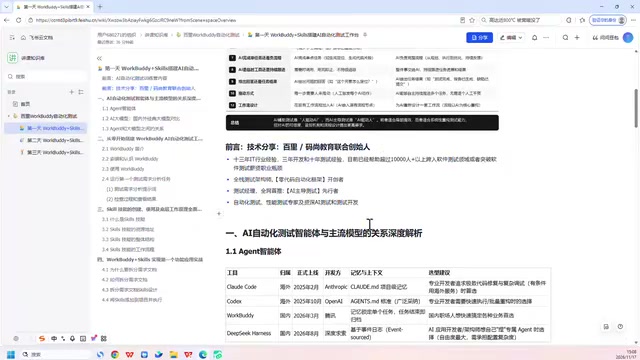
The impact of this shift on testing practitioners is profound—if AI can autonomously handle element interaction, result validation, and test case generation, the core value of test engineers will shift toward designing test strategies, defining acceptance criteria, and reviewing AI output. The creator emphasizes in the tutorial that this transformation has, since this year, spread to nearly all companies.
Element locating is the core step of traditional UI automation testing. Frameworks like Selenium and Playwright require developers to first find target elements on the page—buttons, input fields, and so on—via ID, XPath, CSS selectors, or image recognition, and then perform actions like clicking and typing on them. Once the UI is redesigned, loads dynamically, or spans iframes, the locators break, and maintenance costs are high. In the AI-led mode, agents interact directly with the interface through visual understanding or page-structure perception, bypassing the explicit selector layer—hence no concept of "locating elements." This is one of the technical roots of the leap from one-to-two-times to ten-times-plus efficiency: what's saved is not just the time spent writing locator code, but also a large amount of maintenance overhead from repeatedly debugging whenever the UI changes.
Why WorkBuddy: Out-of-the-Box and Direct Ecosystem Integration
The creator compared the evolution timelines of domestic and overseas agents: overseas agents (such as Cloud Code and Codex) emerged successively in 2025 and, after months to a year of refinement, were adopted by many companies in the first half of this year; domestic agents began to emerge in the second half, with WorkBuddy launching in March this year and DeepSeekAd's Hannes in August. Choosing WorkBuddy as the teaching tool is mainly based on three points:
Zero-configuration barrier. Unlike Cloud Code, which requires command-line mode, connecting a model, configuring dialogs, and installing an environment, WorkBuddy can be downloaded directly from the official website as an installer for your system (Mac, Windows, Linux). On Windows it's an exe file—just click "Next, Next" to finish installing, with no model connection or environment configuration needed.
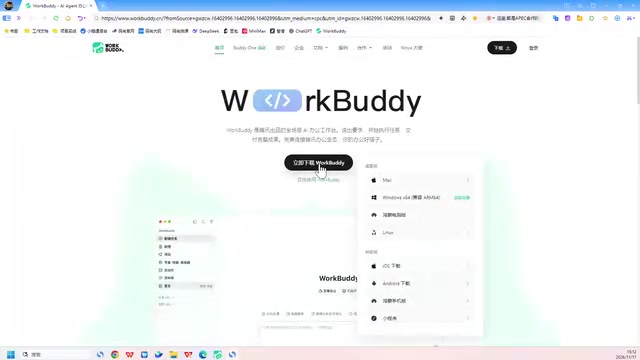
Controllable security. WorkBuddy introduces the concept of a "workspace": one workspace corresponds to one project, and you can control whether a project is allowed to access local resources—particularly important for testing projects involving sensitive data.
Direct Tencent ecosystem integration. Because it's developed by Tencent, WorkBuddy can connect directly to WeCom (Enterprise WeChat), DingTalk, Tencent Meeting, Tencent Docs, and more, meaning the same tool can be reused for office and development scenarios beyond testing. Plus, it has been updated for six or seven months since launching in March, with frequent version iterations (the creator mentioned a new version had just been released before the lesson), so its features are relatively complete. It is currently the top choice for companies—and the top choice for learning AI testing.
An AI Agent is fundamentally different from a plain large-model conversation. The large model itself only generates output based on input; it holds no state and does not proactively call external tools. An agent, by contrast, is a system that wraps planning, tool invocation, memory, and an execution loop around the large model. It can break a user's goal into steps, autonomously decide when to call the browser, database, API, or file system, and adjust subsequent actions based on intermediate results. The industry often summarizes this architecture as "LLM + planning + memory + tool use." Cloud Code, Codex, and WorkBuddy all fall into this category; the differences lie in the degree of encapsulation, the tool ecosystem, and the deployment form. Understanding this is essential to seeing why an agent can "directly operate the interface" rather than merely generate code snippets.
How an Agent Works: The Six-Step Loop
Understanding how an agent operates is a prerequisite for using it well. The creator breaks the agent's workflow into six steps:
- Task understanding and decomposition: Upon receiving a requirement, first understand the task and break it into a list of subtasks.
- Environment perception: Determine whether it can query the database, call APIs, or read/write local files—performing a feasibility assessment first.
- Reasoning, decision-making, and tool invocation: Through large-model reasoning, decide which tools to call and how to execute.
- Result validation and correction: Validate execution results and correct any issues.
- Integration and delivery: Output deliverables such as MD files, test cases, and automation code.
- Memory consolidation: Record the steps taken to build project experience, so that future operations check memory before executing.
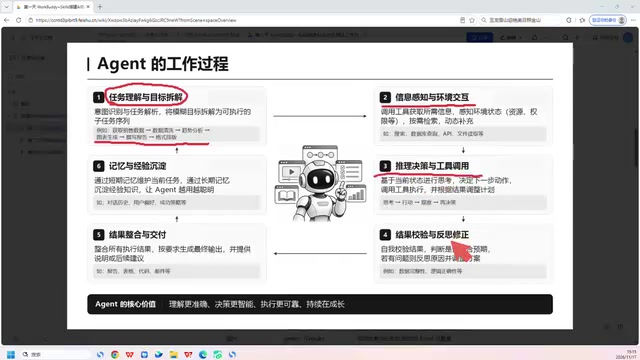
This loop shows that an agent isn't simply "calling a model once"—it's an executor with state management and experience accumulation. The memory mechanism makes it smoother and smoother to use within the same project.
Large Models, Agents, Skills: Brain, Hands and Feet, and Capabilities
The tutorial uses an intuitive metaphor to explain the relationship among the three: the large model is the brain (responsible for thinking—e.g., ChatGPT, Claude, Gemini, and domestically DeepSeek, Qwen, Zhipu, etc.), the agent is the hands and feet (responsible for execution), and Skills are the expertise (determining what professional things this person can do).
With only a brain and no hands or feet, one can think but not act; with a brain plus hands and feet, you have a "person," but this person's skills are generalized; to make it do professional work, you must give it skills. In AI automated testing, the division of labor is: the large model understands instructions and analyzes and judges the next step; Skills specify the goals, required materials, and delivery requirements; tools perform external operations such as reading/writing, retrieval, and saving; and the agent combines the model, skills, and tools to advance the task. WorkBuddy itself carries the conversation, workspace, permissions, and execution records—it is the foundation for all of this.
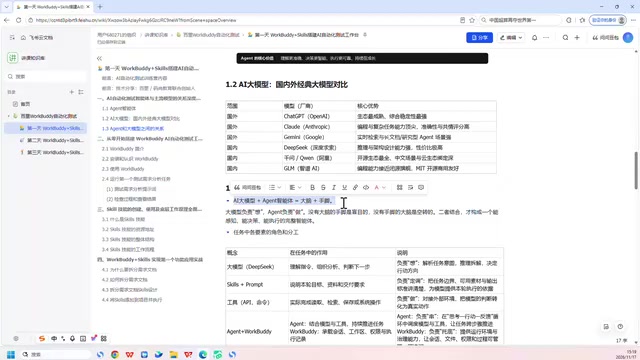
In other words, WorkBuddy is the carrier of that "person," the model is its brain, Skills are its professional capabilities, and tools are the hands it reaches out with. Only by understanding this relationship can learners starting from zero understand what each step is doing when configuring the model and writing Skills later on.
Skills in an agent system typically refer to a reusable encapsulation of capabilities for a specific task, often in the form of Markdown descriptions, scripts, or tool descriptions. They differ from low-level tools (such as reading/writing files or making HTTP requests) in that they tell the agent "in what scenario, following what steps, and producing what format"—essentially codifying the operating manual of a domain expert. The value of Skills lies in giving general-purpose agents professional behavior: the same set of models and tools, paired with different Skills, can respectively handle Web automation, API testing, performance stress testing, and other tasks. This also explains the tutorial's metaphor that "skills determine what professional things this person can do"—model capability is general-purpose, and Skills are the key lever for specialization.
Final Thoughts
The value of this tutorial isn't in teaching a specific operation, but in establishing a cognitive framework for AI testing: AI-led testing is not "faster assistance" but a restructuring of the working mode. With its low barrier to entry, direct ecosystem integration, and controllable permissions, WorkBuddy is a suitable entry point for stepping into this mode today. The hands-on Web automation and API automation sessions over the next two days are where this framework will be put to the test. For testing practitioners, shifting early from "operator" to "strategy designer" may be the most worthwhile investment in this round of transformation.
Related articles

Nothing CMF Buds 2A Drops to $17.89 on Black Friday: A New Low for ANC Earbuds
Nothing CMF Buds 2A wireless earbuds Black Friday deal: just $17.89 on Amazon, about $11 off retail and a record low. ANC earbuds at an entry-level price.

When AI Creation Gets Accused of "Spitting": Hacker News Heats Up Over the Glaude Controversy
A Hacker News post, "Spitting in the Face of Glaude," sparks debate on AI creation transparency and attribution ethics. This analysis examines the blurred creator identity behind the controversy and offers practical advice for AI content production.

Akai Embraces Custom Firmware: MPC Sample 1.4 Lets Users AI-Program Their Sampler
Akai embraces the modding community with MPC Sample 1.4 firmware, supporting vibe-coded custom firmware and effects. We analyze the impact of this open strategy on music hardware and AI-assisted programming.