WorkOS Vault Local Encryption Explained: How Envelope Encryption Protects Sensitive Data
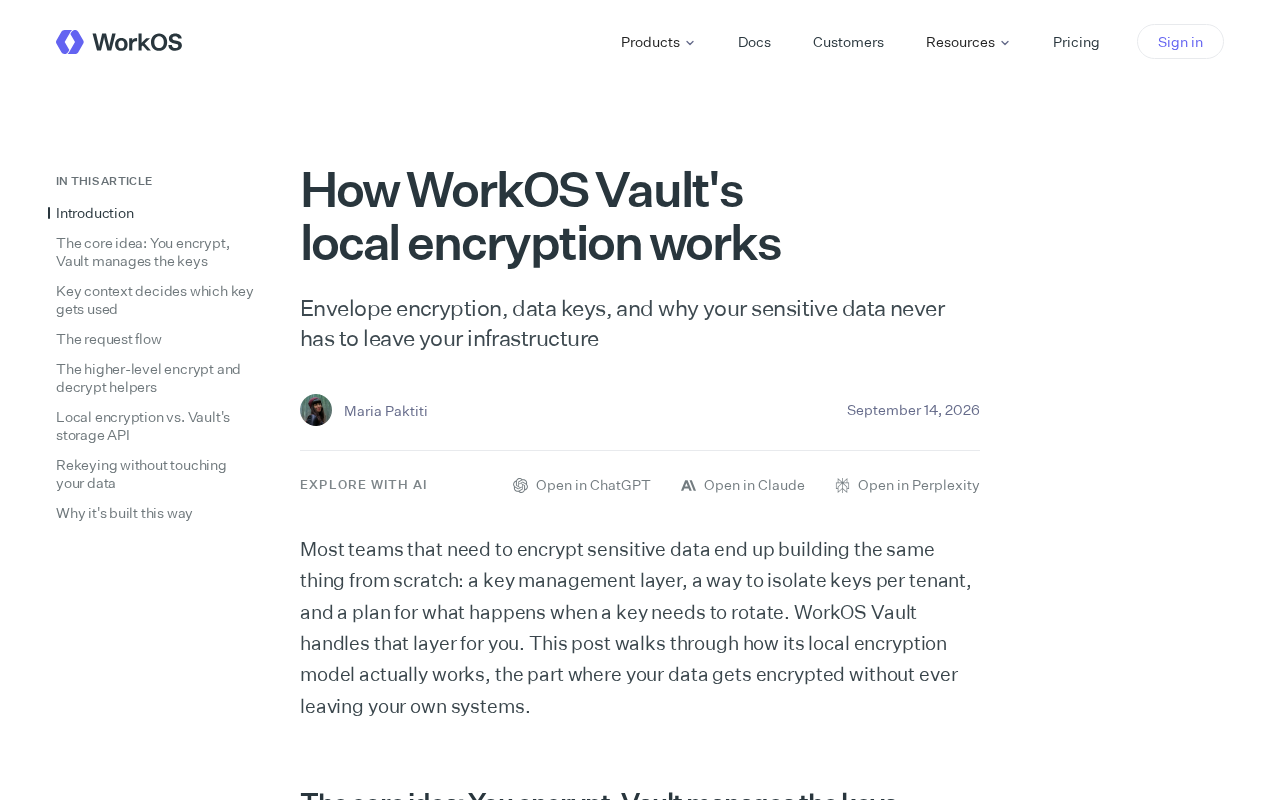
WorkOS Vault uses envelope encryption to keep sensitive data local while delegating key management externally.
WorkOS Vault introduces a local encryption approach based on Envelope Encryption that cleanly separates key management from data storage. Using a two-tier key structure — a Data Key for fast local encryption of business data, and a KEK (Key Encryption Key) managed by an external service — plaintext data never leaves your own infrastructure. The external service only ever sees encrypted key material, not actual content. This architecture balances encryption performance with risk isolation while significantly reducing data-residency compliance concerns under regulations like GDPR and HIPAA.
The Core Idea Behind WorkOS Vault Local Encryption
As data security grows increasingly critical, every engineering team faces the same challenge: how to protect sensitive information without sacrificing convenience. WorkOS Vault addresses this with a local encryption approach worth paying attention to — keeping sensitive data within your own infrastructure at all times, without ever sending plaintext to a third-party service.
The key concept behind this approach is Envelope Encryption. It's not a WorkOS invention — it's a well-validated, widely adopted pattern in cloud security. Understanding how it works helps clarify an important distinction: the difference between "key custody" and "data custody." You can leverage an external service to manage your keys while ensuring your actual business data never leaves your internal network.
How Envelope Encryption Actually Works
Envelope encryption is built around a two-tier key hierarchy. The first tier is the Data Key, which directly encrypts your actual sensitive data — user credentials, API keys, personally identifiable information, and so on. The second tier is the master key (commonly called the KEK, or Key Encryption Key), whose sole responsibility is to encrypt and decrypt that Data Key.
This layered design produces an elegant result: the Data Key — which holds the real power to decrypt your content — is itself stored in encrypted form. The master key that unlocks it can be managed by an external key management service. In other words, even if encrypted data falls into the wrong hands, without the master key there's no way to recover the Data Key, and therefore no way to decrypt anything meaningful.
Why Use a Data Key Instead of Encrypting Directly?
You might ask: why not just use a single key to encrypt everything? The advantage of envelope encryption lies in its balance between performance and security. Generating a unique Data Key for each record or dataset isolates risk — a single compromised key doesn't expose the entire dataset. At the same time, encrypting large volumes of data is handled locally by the Data Key, which is fast. Interactions with the external service are limited to encrypting and decrypting the much smaller Data Key itself, keeping network overhead and latency to a minimum.
Why Sensitive Data Never Has to Leave Your Infrastructure
One of the most important aspects of the WorkOS Vault approach is that plaintext data never has to leave your own environment. With traditional cloud encryption services, you often need to send raw data to an external platform for encryption and decryption — a process that introduces trust risk and compliance exposure in its own right.
With local encryption, encryption and decryption operations happen on your own servers. The external service is only involved in wrapping and unwrapping the Data Key — it only ever sees an encrypted key, never your actual business data. For use cases governed by regulations like GDPR or HIPAA, this "data stays in-boundary" architecture significantly reduces compliance complexity and minimizes the data's exposure surface during transit.
Value for Both Developers and Compliance
From an engineering perspective, this model lets teams enjoy the convenience of a managed key service — no need to build complex key rotation or audit infrastructure in-house — while retaining full sovereignty over their data. Key lifecycle management, access controls, and audit logging are handled by a specialized service, while the physical location of the data remains entirely under your control. This separation of responsibilities is especially critical for organizations that need to pass security audits.
Why This Pattern Matters in Practice
As AI applications and SaaS services increasingly handle sensitive user information, "who can see the plaintext" is becoming a core consideration in vendor selection. WorkOS Vault's local encryption approach represents a more deliberate security philosophy: narrowing the trust boundary to the key layer, rather than the entire data flow.
For product teams building systems that handle sensitive data, understanding the principles behind envelope encryption enables more informed architectural decisions. Whether you're building from scratch or adopting an existing solution, the paradigm of "data stays local, keys stay managed" is a reliable approach that balances security, compliance, and engineering efficiency.
Related articles
Xi Jinping Proposes Open Source AI Cooperation Zone Among BRICS Nations
Xi Jinping proposed an open source AI cooperation zone at the BRICS summit. Analyzing the strategic intent, open source rationale, and global AI governance implications.
Swift-Qwen3.8-27B: 58% Fewer Thinking Tokens, Nearly 2x Faster Inference
UkisAI open-sources Swift-Qwen3.8-27B, cutting thinking tokens by 58% and boosting inference speed 1.95x via overthinking token penalties and on-policy distillation — with under 1% accuracy loss.

Netflix Partners with Sega: Crazy Taxi Movie and New Sonic Animated Series on the Way
Netflix announces three Sega game adaptations: a Crazy Taxi movie, a new Sonic animated series with edge, and a live-action film based on RGG Studio's Stranger Than Heaven.