Worktrunk: A Git Worktree CLI Built for Parallel AI Agent Workflows

Worktrunk wraps Git worktrees in Rust to provide isolated working directory management for parallel AI agents.
Worktrunk is a command-line tool written in Rust that addresses working directory conflicts when multiple AI coding agents operate on the same repository. Built on Git worktrees, it wraps creation, listing, and removal operations into CLI commands tailored to AI workflows, giving each agent its own independent branch and directory to avoid context loss, file lock conflicts, and confusion from uncommitted changes. With nearly 10,000 GitHub stars and 115 new stars in a single day, it reflects real demand for workflow isolation in multi-agent development. The article analyzes its design orientation and typical use cases (local multi-agent development, code review and experimentation), and notes that the project is still early-stage with a small community and an ecosystem yet to mature, recommending trials in small-scale projects first.
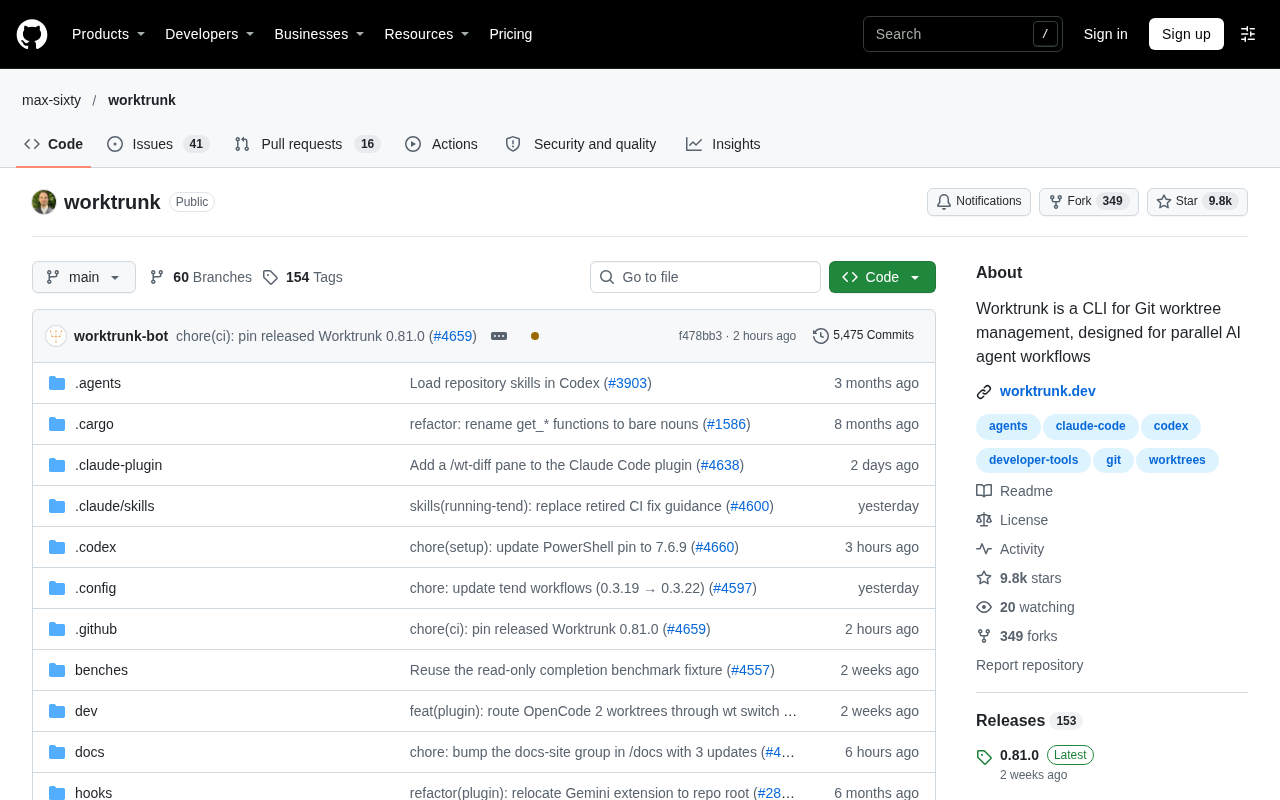
When multiple AI coding agents (such as Claude Code, Cursor Agent, etc.) work on the same repository simultaneously, traditional Git branch switching becomes a bottleneck. Worktrunk is a command-line tool written in Rust, purpose-built for parallel AI agent workflows, aiming to solve this pain point using Git's worktree mechanism. The project has already garnered nearly 10,000 stars on GitHub, with 115 new stars today, demonstrating strong developer demand for this kind of tool.
Why do we need a dedicated worktree management tool?
Git worktrees allow multiple working directories to be checked out from the same repository, each corresponding to a different branch, thereby avoiding context loss and file conflicts caused by frequent branch switching. However, the native git worktree command still requires manual management of paths and branch names when creating, listing, and removing worktrees—not smooth enough for scenarios where multiple agents need to run simultaneously. Worktrunk's core idea is to wrap these operations into CLI commands that better fit AI workflows, letting developers quickly assign an independent worktree to each agent.
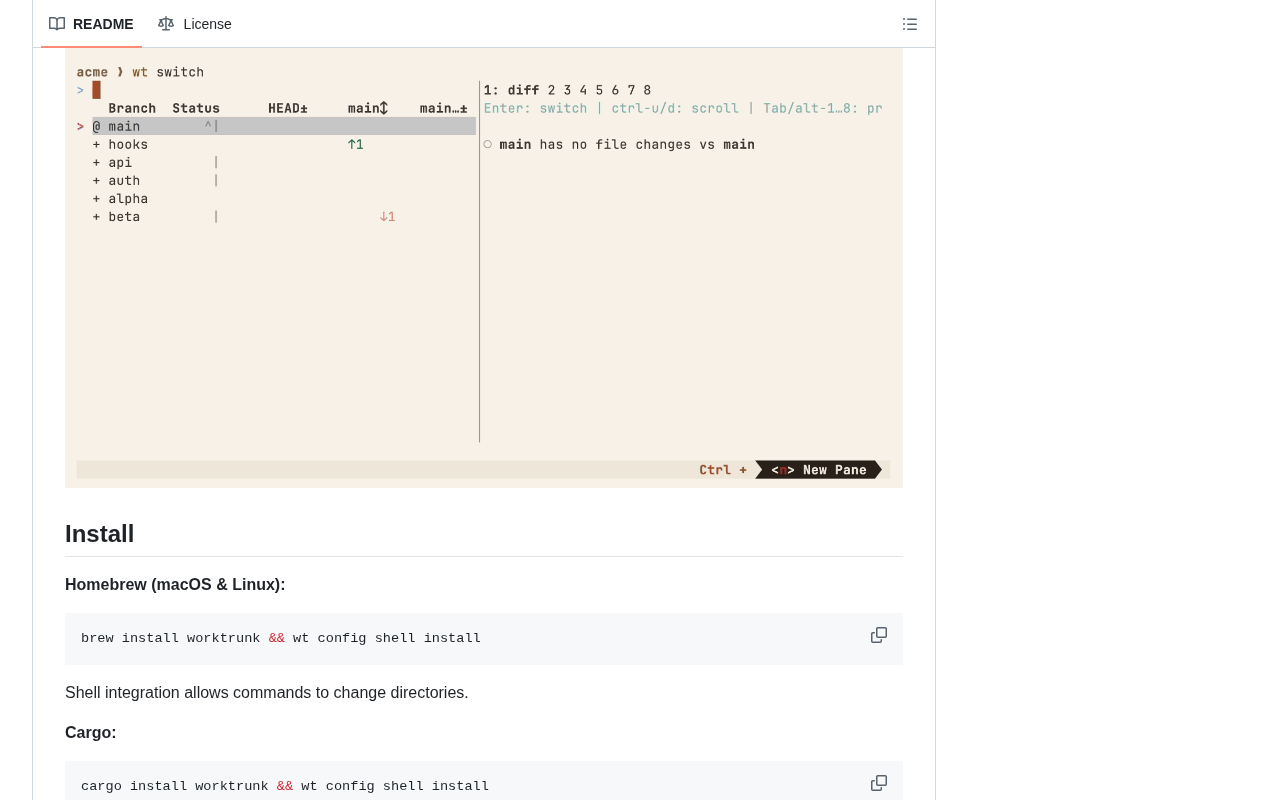
According to the project description, Worktrunk's design goal is to make isolation and collaboration between parallel agents simple. Developers no longer need to manually run git worktree add and remember each worktree's path; instead, they use unified commands to create, switch, and clean up. This abstraction lowers the management cost of multi-agent development environments, making it especially suitable for scenarios that require testing multiple code modification plans simultaneously.
Git worktree is a feature introduced in Git 2.5 that allows a single repository to be associated with multiple working directories, each checking out a different branch. Compared with the traditional git clone, worktrees share the underlying .git object store, so creation is extremely cheap, disk usage is small, and switching between branches requires no re-downloading of history. Typical commands include git worktree add <path> <branch>, git worktree list, and git worktree remove <path>. Worktree metadata is recorded in the .git/worktrees/ directory, and each worktree has its own independent HEAD and index. Note that by default the same branch cannot be checked out by two worktrees at once, which naturally provides a constraint for the "one agent, one branch" isolation model.
Core features and design orientation
Worktrunk is implemented in Rust, which means it offers high execution efficiency and cross-platform capability. Judging from its positioning, it does not aim to replace Git but rather to provide a convenient interface layer for AI workflows on top of Git worktrees. Its features cover worktree creation, listing, and removal, and may include designs that integrate with agent processes (for example, launching an independent agent session for each worktree).
Public information so far has not detailed its specific command set and extensibility, but it can be inferred that Worktrunk revolves around the paradigm of "assigning a worktree to each task or agent." For teams that need to run multiple coding agents in parallel, this kind of tool can reduce manual coordination costs, naturally isolate code changes between agents, and prevent them from interfering with each other.
Rust's popularity in the CLI tool space is largely due to its zero-cost abstractions, deterministic performance without garbage collection, and cross-platform compilation via Cargo. Compared with Python/Node script-based CLIs, Rust binaries start faster (millisecond-level), do not depend on a runtime environment, and require only a single executable for distribution. This also explains why many developer tools in recent years (such as ripgrep, fd, bat, and delta) have chosen Rust. The trade-off is a steeper language learning curve, longer compile times, and the need for community contributors to be familiar with concepts such as ownership and lifetimes. For tools like Worktrunk that need to frequently invoke subprocesses and handle filesystem paths, Rust's std::process and error handling mechanisms (Result/?) can lead to more robust behavior.
Use cases and potential limitations
Worktrunk's most direct use case is local multi-agent development: developers can launch multiple AI coding assistants at the same time, each modifying code in an independent worktree, and then merge the results at the end. This is far safer than having multiple agents share the same working directory, which easily leads to file lock conflicts and confusion with uncommitted changes.
Another scenario is code review and experimentation. Developers can create an independent worktree for each experimental change and validate multiple plans in parallel without affecting the main branch. However, Worktrunk is still in an early stage, with a relatively small community (about 349 forks), and its documentation and ecosystem are still being built. Whether it supports Windows and whether it integrates deeply with mainstream IDEs remain to be seen.
AI coding agents typically run as processes or sessions and have the ability to read and write files, execute commands, and commit code. When multiple agents share the same working directory, several typical conflicts arise: uncommitted changes overwritten by another agent, lock file contention (such as package-lock.json), build caches polluting each other, and inconsistent Git index states. Worktree isolation cuts off these couplings at the filesystem level, so each agent sees an independent and clean checkout. But isolation also brings new problems—merge strategies, duplicated overhead for dependency installation, and sharing references across worktrees (such as node_modules or Rust's target directory) require additional design, which is exactly where tools like this can add further value.
Positioning from multiple perspectives
The project description and screenshots on GitHub are currently the main sources of information; no independent technical reviews or in-depth community analyses have been seen yet. Judging from the star growth trend, Worktrunk hits a real gap in the AI programming toolchain: as the number of agents increases, working directory management shifts from a marginal issue to a core bottleneck. If the project can continue to improve its command design and error handling, it has the opportunity to become an infrastructure component in parallel AI workflows.
For developers exploring multi-agent collaboration, Worktrunk is worth watching. At this stage, however, it is advisable to try it first in small-scale projects and evaluate its compatibility with existing Git hooks and CI processes. The project's use of Rust also means a relatively higher barrier to contribution, and the ecosystem may expand more slowly than script-based language projects.
Conclusion
Worktrunk repackages the mature Git worktree mechanism to serve the new needs of parallel AI agent development. Its emergence reminds us that AI programming requires not only smarter models but also smoother toolchains. As the number of agents grows, tools like Worktrunk that focus on workflow isolation are likely to become more common.
Related articles
 Tech Frontiers
How Do You Stop AI Agent Emails From Sounding Like AI? One Developer's Solution
AI agent emails always sound like AI? A developer shares reright: a rewrite step that validates numbers, names, and links, preventing humanizers from tampering with key info. Test data and integration details inside.
 Tech Frontiers
Starlink Mobile: SpaceX's Carrier Ambitions and the 5G Deployment Challenge
SpaceX plans to make Starlink Mobile a mainstream carrier, deploying thousands of direct-to-cell satellites and building a terrestrial 5G network to challenge AT&T, Verizon, and T-Mobile. This article analyzes its dual-track strategy, 5G deployment challenges, and the competitive landscape.
 Tech Frontiers
OpenAI Raises Another $11 Billion, Valuation Hits $1.25 Trillion
OpenAI has raised an additional $11 billion in a new funding round at a valuation of $1.25 trillion. The deal is not yet closed and is expected to be completed in the coming weeks, further consolidating its leading position in AI.