World Editing: How AI Is Redefining the Boundaries of Executable World Modification

New paper defines "world editing" as a distinct AI capability and benchmarks it on Minecraft and Terraria mods.
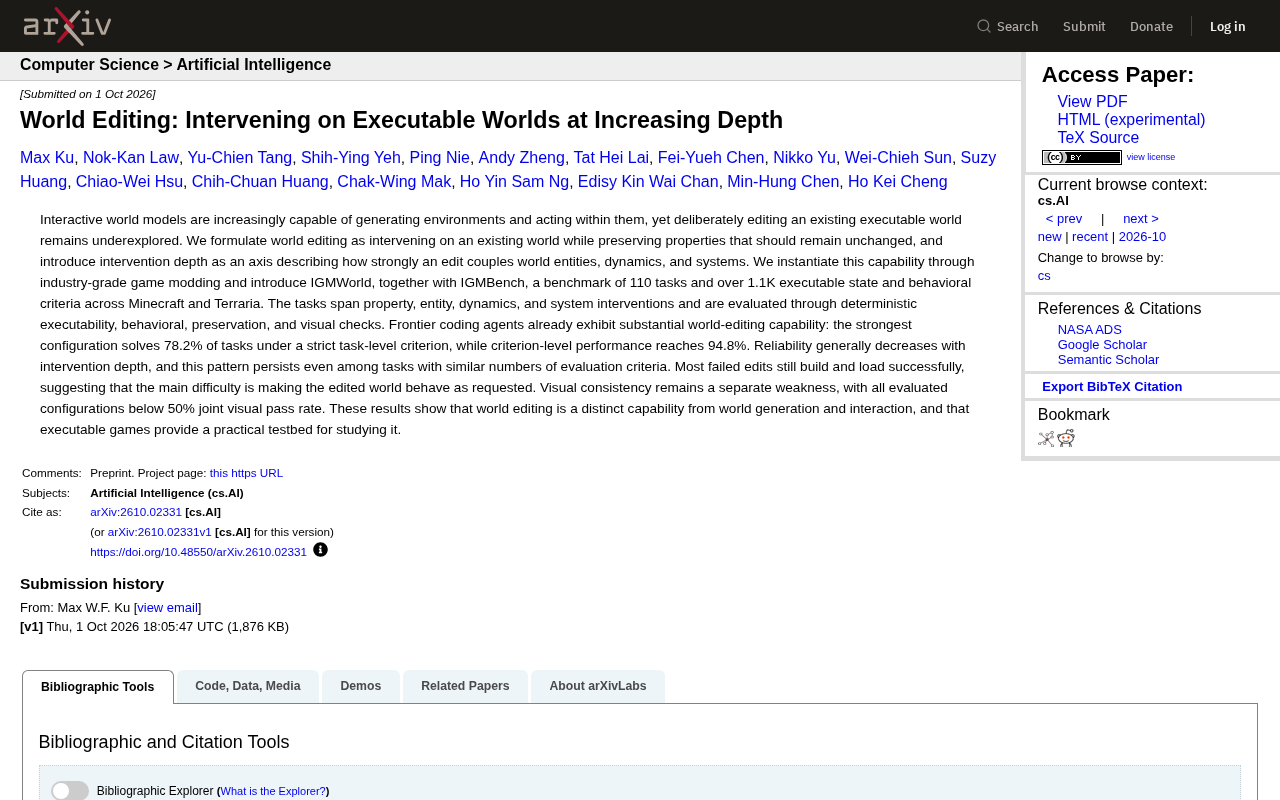
The arXiv paper *World Editing* formally defines world editing as a third AI capability distinct from world generation and interaction, focused on making precise interventions in existing executable worlds while preserving unchanged properties. It introduces the concept of "intervention depth" across four levels — property, entity, dynamics, and system — and builds IGMBench on Minecraft and Terraria (110 tasks, 1,100+ criteria). Frontier coding agents achieve a 78.2% task-level pass rate, but reliability degrades with depth, failures cluster at the behavioral level, and visual consistency is a universal weak point with all configurations scoring below 50%.
From World Generation to World Editing: A Neglected Capability Dimension
Interactive World Models have advanced rapidly in recent years, enabling not just the generation of virtual environments but also the execution of actions within them. Yet one critical capability has consistently been overlooked by researchers — how to purposefully edit an already-existing executable world. A new arXiv paper, World Editing: Intervening on Executable Worlds at Increasing Depth, addresses this gap with a systematic definition and evaluation framework.
The paper defines "world editing" as: intervening on an existing world while preserving the properties that should remain unchanged. In other words, editing is not about tearing down and rebuilding — it's about making precise local changes while maintaining global consistency. This stands as a fundamentally distinct capability from "world generation" (creating from scratch) and "world interaction" (acting within a world).
Interactive World Models are a class of generative models capable of simulating dynamic environments and responding to agent actions. They have seen breakthrough progress in game AI, embodied intelligence, and video generation. Their defining characteristic is "executability" — rather than producing static content, these models maintain a continuously running virtual world that reacts to actions. Landmark works include Google DeepMind's Genie series (which can generate interactive game environments from a single image) and diffusion model-based alternatives to traditional game engines. The emergence of such models has made it conceivable for AI to understand and manipulate the underlying logic of a world — which is precisely why the absence of robust world editing capability is so noteworthy.
Intervention Depth: A New Axis for Measuring Edit Complexity
The paper's most central concept is intervention depth, which describes how strongly a given edit is coupled to the entities, dynamics, and systems within a world. Greater depth means the modification triggers more cascading dependencies.
The research team categorizes tasks into four levels by intervention depth:
- Property intervention: Modifying an attribute value of an entity — the shallowest coupling
- Entity intervention: Adding, removing, or replacing objects in the world
- Dynamics intervention: Altering the rules and behavioral logic governing how the world operates
- System intervention: Deep modifications involving the interplay of multiple systems — the strongest coupling
This layered taxonomy is valuable because it transforms the vague notion of "edit difficulty" into a quantifiable, comparable research axis. The deeper the intervention, the harder it becomes to make new behaviors take effect without breaking the existing world — and that is precisely where the challenge lies.
IGMWorld and IGMBench: Using AAA Games as a Testing Ground
To make abstract capabilities empirically testable, the team operationalizes world editing as game modding — the practice of modifying industrial-grade games — and introduces the IGMWorld system along with the IGMBench evaluation benchmark.
IGMBench is substantial in scale:
- Covers two classic executable games: Minecraft and Terraria
- Contains 110 tasks
- Defines over 1,100 executable state and behavioral verification criteria
- Tasks span all four intervention categories: property, entity, dynamics, and system
The evaluation dimensions are also carefully designed, using four categories of deterministic checks: executability, behavioral, preservation, and visual. This means a successful edit must not only run correctly, but also behave as intended, leave unrelated features intact, and remain visually consistent — a multi-layered quality gate.
The key advantage of using real games as a test platform is that game worlds are inherently "executable": edit outcomes can be deterministically verified rather than relying on subjective judgment.
Game modding refers to the practice of modifying game content, rules, and behavior by writing scripts or configuration files without altering the core game engine. Both Minecraft and Terraria have mature modding ecosystems: Minecraft relies on frameworks like Forge/Fabric and is primarily written in Java, while Terraria supports C# mod development via tModLoader. The critical advantage of these two platforms is that their world states and entity behaviors can be programmatically read and asserted with determinism, transforming "did the edit succeed?" into automatically verifiable test cases rather than subjective human ratings. This allows IGMBench's 1,100+ criteria to be executed with a rigor comparable to software unit testing.
Real-World Performance of Frontier Coding Agents
The experimental results reveal both the capabilities and shortcomings of current frontier coding agents.
The strongest configuration solved 78.2% of tasks under the strict task-level criterion, while the more lenient criterion-level pass rate reached 94.8%. This indicates that models already possess meaningful world editing capability — they are far from unusable.
However, several key patterns deserve careful attention:
Reliability decreases with intervention depth. The deeper the edit, the lower the success rate — and this trend holds even when controlling for tasks with similar numbers of evaluation criteria. This confirms that difficulty genuinely stems from coupling depth itself, not merely from task complexity.
Failures occur at the behavioral level, not the build level. Most failed edits still successfully build and load — meaning the code runs, but the world's actual behavior does not change as required. The real challenge is making the edited world "behave correctly," not just "compile successfully."
Visual consistency is an independent weak point. Across all evaluated configurations, the combined visual pass rate fell below 50%. Visual correctness and functional correctness follow two separate capability curves, and current models are clearly weaker on the visual dimension.
The paper's "task-level" and "criterion-level" evaluation metrics represent two different granularities of pass rate. Criterion-level pass rate measures the proportion of individual checks satisfied (e.g., "has the drop rate of a specific item changed?"), while task-level pass rate requires all criteria under a task to be simultaneously satisfied. The gap between 78.2% and 94.8% reveals a common AI failure pattern: models can fulfill most sub-requirements of a task but struggle to satisfy all constraints simultaneously in complex tasks. This "locally correct, globally failing" phenomenon is analogous in software engineering to "some unit tests pass but integration tests fail" — a meaningful signal for assessing the practical usability of AI in real-world system modification.
Why This Research Deserves Attention
The significance of this paper goes beyond introducing a new benchmark. It makes a clear case that world editing is a capability distinct from both world generation and world interaction. Researchers have often assumed that strong generative capability implies strong world-control capability, but editing tasks expose real gaps in models' ability to "preserve invariants" and reason about "deep coupling."
For AI coding and agent research, this offers a pragmatic testing direction: executable game mods come with built-in deterministic verification mechanisms, making it far easier to measure progress than with open-ended generation tasks. As AI agents are increasingly deployed to modify existing codebases and systems, the ability to "edit precisely without breaking existing functionality" will become critically important — and this research provides exactly the quantitative yardstick needed to measure that capability.
Future directions worth watching include: how to improve reliability for deep interventions, how to close the visual consistency gap, and whether this evaluation paradigm can be extended beyond games to real-world software system editing.
Related articles

Chain of Thought Isn't Just for AI: How Humans Can Use CoT to Improve Thinking Quality
Chain of Thought isn't just a prompt trick for large models. Starting from a Hacker News discussion, this article analyzes why CoT works for human thinking too, breaks down actionable ways to transfer it, and highlights the key differences between human CoT and machine CoT.
Cloudflare Teams Up with OpenAI: Closi…
Cloudflare Teams Up with OpenAI: Closing the Loop from Vulnerability Discovery to Defense with AI
Cloudflare uses OpenAI Daybreak to investigate security vulnerabilities and generate reviewable remediation plans, while developers use Codex to boost coding efficiency and quality.

Orca Multi-Agent Orchestration in Practice: A Guide to Parallel Collaboration with Claude and Codex
Orca is Stable AI's free open-source agent workbench supporting 34 agents like Claude Code and Codex in parallel. Learn its Git worktree isolation, multi-model orchestration, and mobile management.