World Labs Unveils Atlas: A Universal World Model for Controllable 3D Video Generation
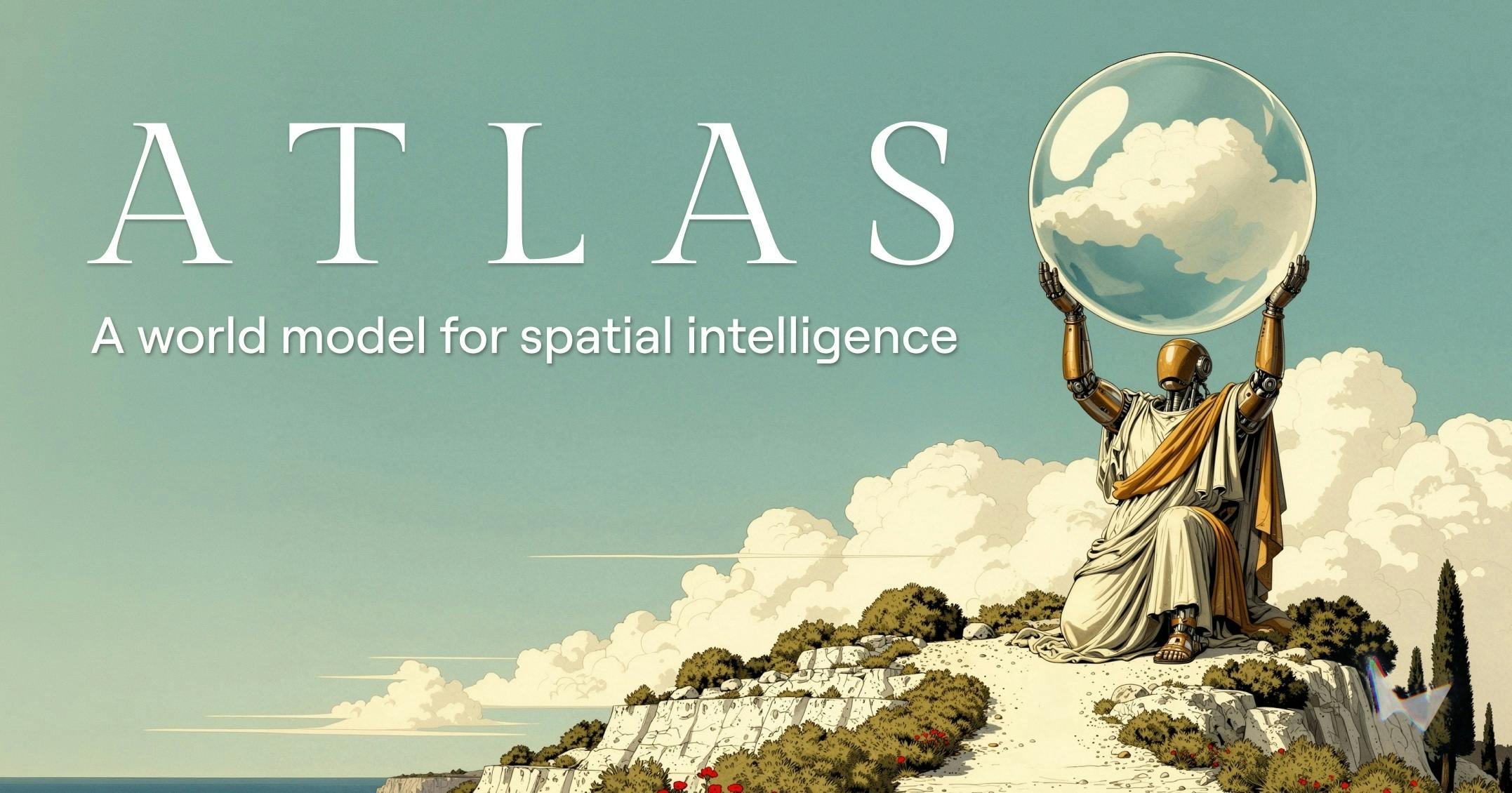
World Labs unveils Atlas, a multimodal world model generating controllable 1440p 3D video from text, images, and 3D data.
World Labs has released Atlas, an omni world model that transforms text, images, videos, and 3D data into controllable high-definition video up to 1440p and one minute long. Key features include precise camera control, 3D scene reconstruction from few photos, and space-time simulation for robotics—marking a shift from 2D content generation to true spatial intelligence.
A New Milestone in World Models
World Labs, founded by AI pioneer Fei-Fei Li, recently launched Atlas—its omni world model. The product debuted on Product Hunt to widespread attention, climbing to #4 on the daily leaderboard and spanning three categories: Developer Tools, Artificial Intelligence, and 3D Modeling.
Atlas's core concept can be summed up in one sentence: transform text, images, videos, and 3D data into controllable, high-definition video. It's not just another text-to-video tool, but an attempt to build a "world model" capable of understanding and simulating the real physical world—the very goal World Labs has pursued since its founding.
What Is a "World Model"?
Unlike traditional generative AI, world models aim to make machines truly "understand" how three-dimensional space and time operate, rather than merely fitting patterns at the pixel level.
The deeper meaning of world models: World models are a frontier concept in AI, first proposed by researchers like Jürgen Schmidhuber in reinforcement learning. They refer to models that internally represent environmental dynamics and predict future states. Unlike traditional end-to-end neural networks, world models attempt to learn the underlying rules of environments—including spatial relationships, physical properties, and temporal causality. This enables AI not just to "react," but to "reason" and "plan." In computer vision, world models specifically refer to models that understand 3D spatial structure, object motion patterns, and physical constraints. They don't simply memorize pixel patterns, but build an internal understanding of the real world.
Fei-Fei Li has long emphasized that Spatial Intelligence is a critical path toward artificial general intelligence. Academic background of spatial intelligence: Spatial intelligence is a core concept Li has championed in recent years. She believes it's the foundation of human and animal intelligence, and a necessary step toward AGI. Humans begin constructing an understanding of three-dimensional space from infancy—the position, shape, motion trajectories, and interrelationships of objects. This ability allows us to navigate complex environments, manipulate objects, and predict others' behavior. In multiple public talks in 2024, Li emphasized that while current AI systems excel at 2D image recognition, they lack true understanding of 3D space. Achieving spatial intelligence requires integrating computer vision, graphics, robotics, and cognitive science, enabling AI systems to "see" and "manipulate" the 3D world like humans. World Labs was founded precisely to transform this academic vision into deployable technology.
Atlas is the productization of this philosophy—giving AI the ability to model, reconstruct, and simulate the three-dimensional world.
Core Capabilities of Atlas
According to official materials, Atlas as an "omni" model can accept various input modalities and produce unified outputs. Here are its key capabilities.
Multimodal Input, Unified Video Output
Atlas's most prominent feature is input diversity. Pure text descriptions, static images, existing video clips, or 3D assets can all serve as input sources. The model integrates these heterogeneous data types and ultimately generates video content at resolutions up to 1440p and durations of up to one minute.
This capability is particularly noteworthy. Most mainstream text-to-video models (like Sora, Runway) still have significant limitations in duration and resolution, while Atlas directly targets one-minute 1440p HD output, reflecting World Labs' deep technical expertise in long-term temporal consistency.
Technical challenges of long-term temporal consistency: "Long-term temporal consistency" in video generation refers to maintaining coherence in content, style, and physical laws over extended time spans. This is a core challenge for current generative video models. Short videos (a few seconds) are relatively easy because frame-to-frame changes are limited, and models can maintain consistency through short-range dependencies. But when videos extend to tens of seconds or even a minute, accumulated errors lead to object deformation, scene drift, and style shifts. Solutions include: longer temporal modeling windows (like spatiotemporal Transformers), hierarchical generation strategies (generating keyframes first, then interpolating), explicit physical constraints or 3D representations (ensuring geometric consistency), and larger-scale data and computation. Atlas's claim to support one-minute 1440p output means it has made significant progress in combining long-term temporal modeling with high-resolution generation—a key metric for evaluating its technical level.
Camera Control: Manipulate Viewpoints Like Real Cinematography
"Camera control" is Atlas's key differentiator from ordinary video generation tools. Users can not only determine video content but also control viewpoint movement like operating a real camera—push, pull, pan, tilt, and even orbit around scenes.
Behind this capability is the model's deep understanding of 3D spatial structure. Only when a model internally constructs a 3D representation of a scene can it maintain geometric consistency from arbitrary viewpoints. This is precisely the essential difference between a "world model" and a "video generation model."
Underlying principles of camera control technology: Camera control capability relies on the model's explicit or implicit understanding of scene 3D structure. Traditional video generation models (like early GANs) operate only in pixel space and cannot guarantee geometric consistency across viewpoints. To achieve controlled camera movement, models must internally construct 3D scene representations—possibly point clouds, meshes, voxels, or neural implicit representations. When users specify camera trajectories (like "push forward" or "rotate around object"), the model needs to project the 3D representation to new viewpoints and generate corresponding 2D image frames. This requires the model to understand not just "what it looks like" but also "what it would look like from another angle." In recent years, the combination of Transformer architectures with 3D attention mechanisms, along with training on large-scale multi-view data, has made this capability possible. Atlas's camera control marks an important leap in video generation from "fitting appearance" to "understanding structure."
Complete Scene Reconstruction from Just a Few Photos
Another core capability of Atlas is reconstructing complete 3D scenes from just a few photographs. This aligns with the direction of 3D reconstruction technologies like Neural Radiance Fields (NeRF) and Gaussian Splatting, but Atlas integrates them into a unified generative framework.
Neural Radiance Fields (NeRF) and Gaussian Splatting explained: Neural Radiance Fields (NeRF) is a revolutionary 3D reconstruction technique proposed by a UC Berkeley team in 2020. It uses neural networks to represent scenes as continuous volumetric functions, capable of reconstructing high-quality 3D scenes from a small number of 2D images and supporting novel view synthesis from arbitrary viewpoints. NeRF's breakthrough lies in implicit representation—no need for explicit meshes or point clouds; the neural network "memorizes" the scene's geometry and appearance. However, NeRF's rendering speed is relatively slow. Gaussian Splatting, which emerged in 2023, explicitly represents scenes using numerous 3D Gaussian spheres, achieving real-time rendering while maintaining high quality. Both technologies are mainstream 3D reconstruction solutions today. Atlas's integration of similar capabilities into a unified framework marks the transition of 3D reconstruction from research tool to practical product.
Users need only provide a few photos from different angles, and the model can infer the complete scene structure, enabling free-viewpoint browsing and video generation.
Space-Time Simulation for Robotics
Beyond content creation, Atlas has a more forward-looking application: providing space-time simulation for robotics.
Robotics training has long faced challenges of scarce real-world data and high trial-and-error costs. With a high-fidelity world model, physically plausible scenes and interaction data can be generated at scale in virtual environments, accelerating robot learning and validation. Atlas's ability to model spatiotemporal laws of the physical world directly addresses this pain point.
Development trajectory of Embodied AI: Embodied intelligence refers to AI systems with physical bodies capable of perceiving and acting in the real world—robots are the most typical form. Traditional AI research focused on purely digital tasks (like chess, Q&A), while embodied intelligence must handle the complexity of the real physical world—uncertainty, continuous states, real-time feedback, etc. In recent years, with advances in deep learning and reinforcement learning, embodied intelligence has regained prominence. But robot training faces enormous challenges: real-world data collection is expensive, dangerous scenarios are hard to test, and physical trial-and-error is inefficient. Therefore, high-fidelity world models become critical—they can generate large amounts of physically plausible training data in virtual environments, allowing robots to complete most learning before deployment. DeepMind's robotics projects and Tesla's FSD simulation system are all moving in this direction. Atlas aims to provide universal space-time simulation infrastructure.
This also explains why World Labs positions Atlas as a "world model" rather than purely a creative tool—its ultimate goal is to become infrastructure for Embodied AI.
Industry Significance and Future Outlook of Atlas
From Content Generation to Spatial Intelligence
Atlas's launch marks generative AI's progression from 2D planes to 3D space. Over the past two years, text, image, and video generation have successively exploded, and the next frontier is clearly modeling and simulating complete 3D worlds. World Labs, with Li's academic influence and substantial capital backing, is attempting to establish first-mover advantage in this track.
Still Early Stage, Awaiting Validation
It must be objectively noted that Atlas is currently in Early Access, with relatively limited public technical details. Actual generation quality, physical consistency, and generalization capabilities await further independent verification. The 116 votes on Product Hunt indicate initial community recognition, but the real test will come from large-scale practical applications.
Practical Value for Developers and Creators
For developers, Atlas's positioning as a "developer tool" suggests it may open APIs or SDKs, allowing third parties to integrate spatial intelligence capabilities into their own applications. For content creators, controllable camera movement and one-minute HD output significantly lower the technical barrier for professional-grade video production.
Regardless of final implementation results, the direction Atlas represents—unifying multimodal input, understanding 3D space, simulating the physical world—is a necessary path for AI toward higher-level intelligence. This product launch by Fei-Fei Li and World Labs deserves sustained industry attention.
Related articles

Why Does the Tesla Roadster Need to Fly? A Deep Dive into Musk's Wild Demo
Tesla's Roadster launch showed wall-climbing, upside-down driving, and flying stunts—but The Vergecast notes the demo car may lack a battery, the Rocket version is invite-only and not street-legal, and the website terms don't guarantee delivery. After nine years of delays, why does this car still need to exist?

AI Is Not a Replacement: Human-AI Collaboration Through the Lens of Factory Root Cause Analysis
Starting from factory root cause analysis, this article explains how AI accelerates evidence chain construction rather than replacing human experts, exploring the pragmatic implementation logic and business value of 'AI supporting people rather than replacing them.'

AI Agent Decision Auditing: Building an Evidence Chain in Regulated Workflows
Starting from a Reddit discussion, this article analyzes three core issues in AI agent decision auditing within regulated workflows: what fields audit records should contain, how to handle feedback latency for erroneous decisions, and how to continuously calibrate LLM judge consistency with human judgment.