WPF Recreation of Google Jules: A Desktop Exploration of AI Agents
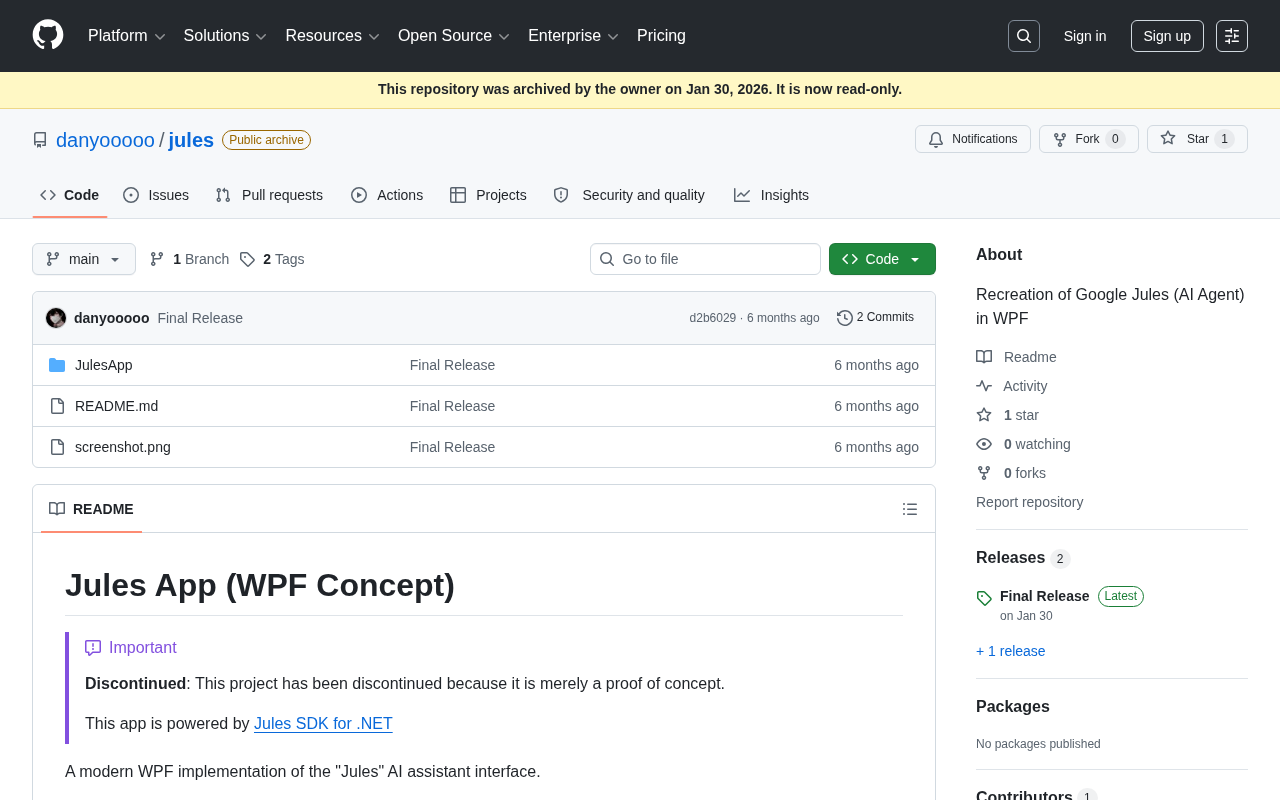
An early-stage C# open-source project recreating Google's Jules AI Agent with WPF, exploring desktop AI for .NET developers.
The open-source project danyooooo/jules attempts to recreate Google's AI Agent Jules using WPF and C#, porting its cloud-based async coding capabilities to the native Windows desktop. The article examines WPF's advantages over Electron/web solutions in memory usage, system integration, and UI experience, and argues that the core value of such "recreation" projects lies in learning and validation — helping developers understand AI Agent mechanics while providing a reference for private deployments. Currently at a very early stage (1 star, 0 forks), it serves better as a technical exploration sample than a production solution. The author also notes that desktop Agents can address cloud Agents' shortcomings around data privacy, offline availability, and system-level integration.
A Small Open-Source Project Worth Watching
An open-source project called danyooooo/jules has appeared on GitHub with a straightforward premise: recreate Google's AI Agent product Jules using WPF (Windows Presentation Foundation). Written in C#, the project is in its early stages with very few stars or forks.
Despite its modest size, this project reflects an interesting trend — more and more developers are experimenting with bringing cloud-based AI Agent capabilities into local desktop application frameworks. For developers who are comfortable in the .NET ecosystem and prefer a native Windows desktop experience, this represents a compelling technical path.
Google Jules is an asynchronous AI programming agent for developers, launched by Google in 2024. Integrated into GitHub workflows, it can automatically read Issues, write code, and submit Pull Requests — all without requiring real-time developer involvement. It represents a classic example of AI Agents evolving from "conversational assistants" to "autonomous task executors" — capable of independently completing multi-step tasks in the background rather than simply answering questions. Understanding this context helps clarify the core interaction paradigm that danyooooo/jules aims to recreate: a complete loop of task submission, asynchronous processing, and result delivery.
Why Choose WPF for an AI Agent
Google Jules itself is an asynchronous AI Agent focused on programming tasks, designed to handle code-related work automatically in the cloud. The danyooooo/jules project takes a different approach: rebuilding a similar interactive experience using WPF on the Windows desktop.
As Microsoft's mature desktop UI framework, WPF excels at building complex rich-client interfaces, with powerful data binding, style customization, and animation capabilities. Using it to host an AI Agent's conversation interface, task management, and result display can genuinely produce a polished, native application experience. Compared to Electron- or web-based solutions, WPF applications often have advantages in memory usage and system integration.
This technology choice also signals that the C#/.NET developer community is actively exploring ways to integrate large language models and Agent capabilities into traditional desktop software — not just staying within the browser or command-line tool space.
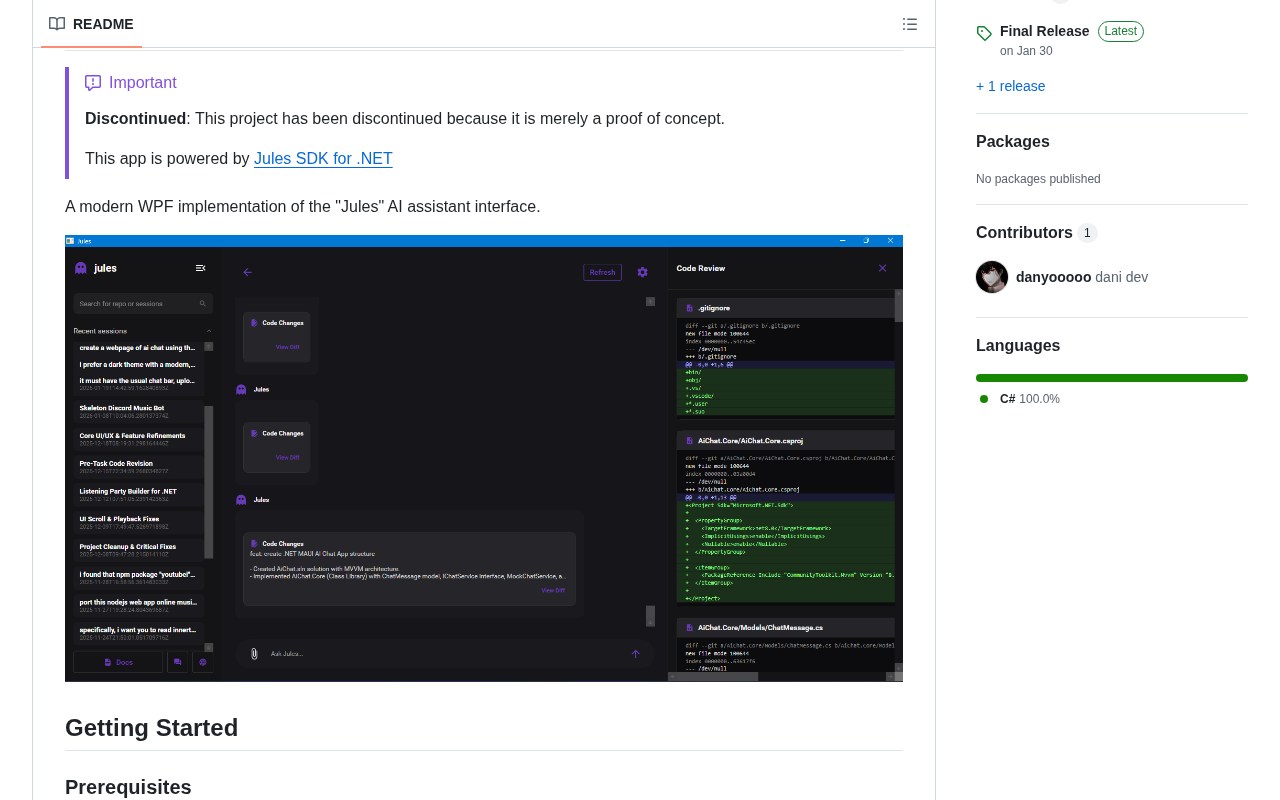
WPF (Windows Presentation Foundation) is the desktop UI framework Microsoft introduced with .NET Framework 3.0 in 2006. It uses XAML as a declarative language for describing interfaces and relies on DirectX as its rendering backend, with hardware acceleration support. Compared to the older WinForms, WPF introduced the MVVM (Model-View-ViewModel) architectural pattern, cleanly separating UI logic from business logic — making it well-suited for AI chat-style applications that require frequent data updates. WPF has since been migrated to modern .NET platforms including .NET 6/7/8 and continues to be actively maintained, remaining one of the mainstream options for native Windows desktop development.
The Value and Limitations of Recreation Projects
This kind of "recreation" project is not uncommon in the open-source community. Their core value typically lies not in surpassing the original, but in learning and validation: by manually rebuilding the interaction logic of a mature product, developers gain deeper insight into how AI Agents work, while also producing a reference implementation for local or private deployments.
That said, it's important to be realistic about the limitations. The project currently has only 1 star and 0 forks, placing it at a very early stage where completeness, stability, and documentation all remain to be seen. It's better suited as a sample for technical exploration and learning rather than a production-ready solution. For developers interested in how WPF and AI Agents can be combined, it offers a lightweight starting point.
Some Thoughts on Desktop AI Applications
As AI Agents move from experimentation into real-world deployment, "where they run" becomes a critical question. Cloud-based Agents make it easy to allocate compute resources and push unified updates, but they face inherent drawbacks around data privacy, offline availability, and system-level integration. Desktop Agents are well-positioned to address exactly these gaps.
Projects like danyooooo/jules may be small, but they represent a meaningful direction: bringing Agent capabilities down into the user's local environment, letting AI work more closely with the operating system and local workflows. If more open-source efforts like this emerge in the future, they could help shape a new ecosystem for desktop AI applications. For readers focused on the practical engineering deployment of AI, early-stage projects like this are well worth keeping an eye on.
Related articles
Insufficient Source Material: A Tweet With No Substantive Content
A single tweet reading 'Available until the goblins notice.' with two unexpanded links provides no substantive content to write an article from.
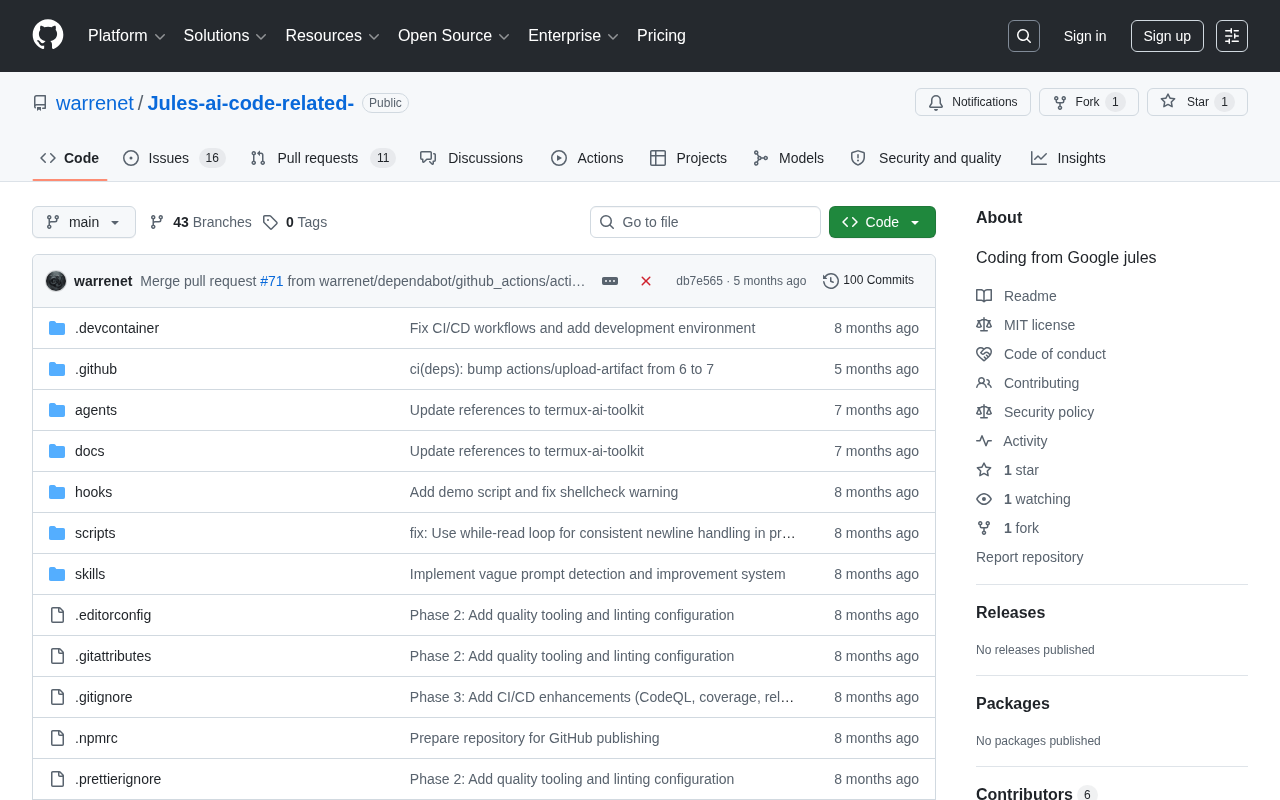
Google Jules AI Coding Assistant: A Quick Look at an Open-Source Practice Repo
A look at a small GitHub repo centered on Google Jules, an autonomous AI coding agent. Explores what Jules does, the repo's practical value, and how to evaluate early-stage AI tool projects.
GitHub Project Overview: prateek0221/jules — Critically Lacking Information
The GitHub repo prateek0221/jules has only 1 star, no code, and no README. We review available info and provide background on Google's Jules AI coding agent.