WriterDeck: Building a Distraction-Free Writing Device with Hardware DIY

WriterDeck is a minimalist hardware device designed for writing, achieving deep focus through physical constraints.
WriterDeck is a minimalist writing-dedicated device built on single-board computers like Raspberry Pi. By stripping away distracting features like web browsing and social media at the hardware level, it preserves only a pure text input experience to help writers achieve deep focus. The topic sparked heated discussion on Hacker News, reflecting the desire to combat the attention economy and return to creative essentials, while embodying the intersection of Maker culture and writing culture, and a broader trend toward single-purpose devices.
What is WriterDeck?
In this age of digital distractions, more and more writers are searching for tools that let them focus purely on the written word. WriterDeck is the product of exactly this philosophy — a minimalist computing device designed specifically for writing, stripped of all the distracting features found on modern computers, preserving only the purest text input experience.
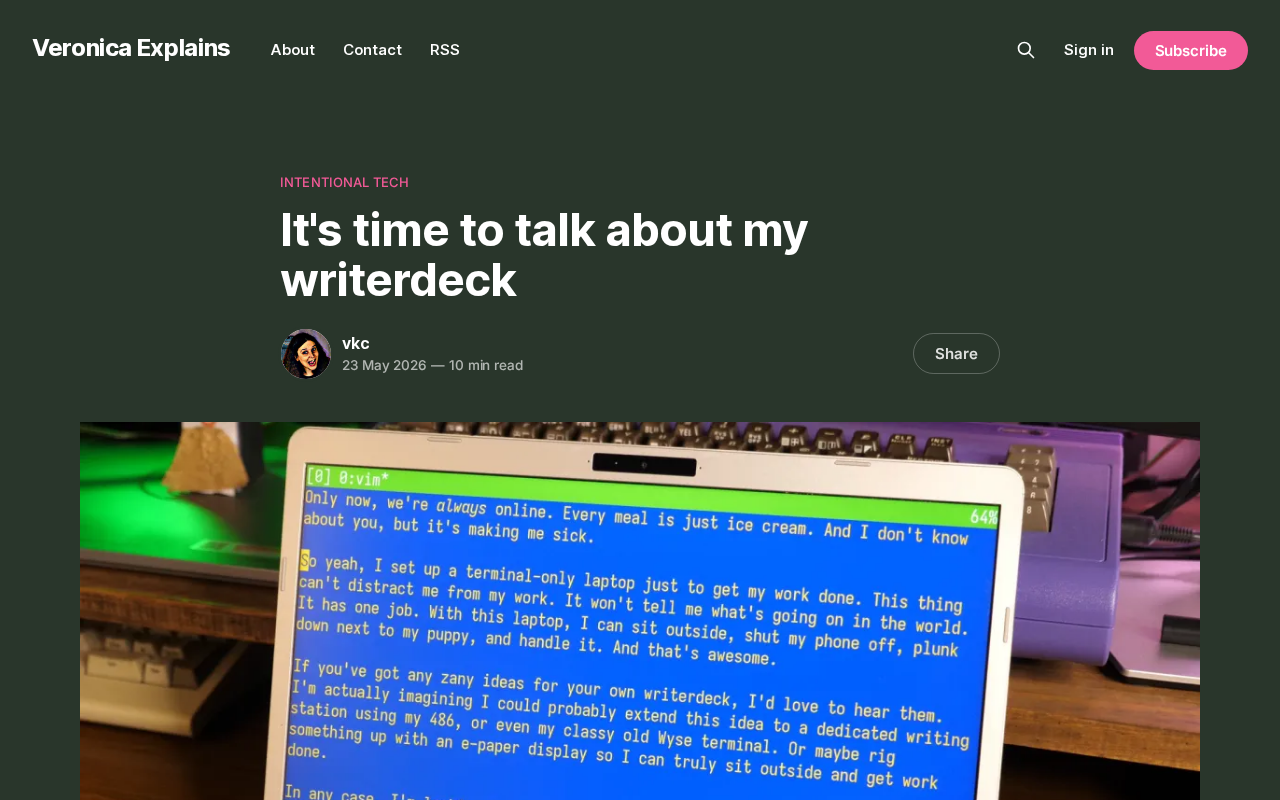
Tech blogger Veronica recently shared her experience building her first WriterDeck. The post earned 374 points and 219 comments on Hacker News, sparking an in-depth discussion in the tech community about the topic of "focus tools."
WriterDeck's Design Philosophy: Less is More
Achieving True Focus Through Hardware Constraints
WriterDeck's core idea is to achieve focus at the hardware level — something software alone cannot accomplish. Unlike installing a "focus writing" app on a regular computer, WriterDeck physically eliminates distraction sources like web browsing, social media, and messaging.
The advantage of this approach is clear: when the only device in front of you can do nothing but accept typed text, your brain won't generate the impulse to "switch windows and check your phone" — because that option simply doesn't exist. This is a classic strategy of using environmental design to change behavior, far more effective than relying on willpower alone.
This design philosophy aligns closely with the theory of Deep Work. Computer science professor Cal Newport systematically articulated this concept in his 2016 book of the same name: the ability to focus without distraction on cognitively demanding tasks is the most critical yet scarcest competitive advantage for knowledge workers. Newport's research shows that knowledge workers average less than 4 hours of true deep work per day, and frequent context switching (such as checking email or scrolling social media) causes "attention residue" — even after switching back to the original task, part of the brain's resources remain stuck on the previous one, significantly reducing work quality. WriterDeck forcibly eliminates the possibility of context switching through physical means, safeguarding deep work states at the hardware level.
Common WriterDeck Hardware Configurations
WriterDecks are typically built using one of several approaches:
- Single-board computers like Raspberry Pi: Low cost (achievable for under $100), extremely low power consumption, and highly customizable. The Raspberry Pi was launched by the UK-based Raspberry Pi Foundation in 2012, integrating a complete computer system onto a credit-card-sized circuit board. The latest Raspberry Pi 5 is priced at approximately $35-80, features an ARM architecture processor, and supports the full Linux ecosystem. These devices typically consume 2-10 watts, far less than a laptop's 15-45 watts, enabling battery life of dozens of hours. Beyond Raspberry Pi, the community also commonly uses alternatives like Orange Pi and Libre Computer.
- Small e-ink or LCD displays: Reducing visual fatigue, with e-ink screens offering a reading experience closer to paper. E-Ink technology was developed at MIT's Media Lab in the 1990s, displaying images by flipping electrically charged black and white particles within microcapsules. It only consumes power when the image changes, with near-zero power draw for static displays. Compared to LCD screens, e-ink displays offer superior readability in sunlight and emit no blue light, significantly reducing eye fatigue during extended writing sessions. Their refresh rate is typically only 1-2Hz with slight ghosting, but this has virtually no impact on pure text input scenarios.
- Mechanical keyboards: Providing excellent typing feel, which is crucial for extended writing sessions
- Minimal Linux systems: Typically running a stripped-down Linux distribution with only text editors like Vim or nano installed
Why Did WriterDeck Spark Such Heated Discussion in the Tech Community?
A Hardware Practice Against the Attention Economy
The 219 comments indicate this topic struck a nerve with many people. To understand this resonance, we need to first understand the Attention Economy as context: economist Herbert Simon proposed in 1971 that in an age of information abundance, human attention becomes the truly scarce resource. Modern tech companies understand this deeply — Facebook, TikTok, YouTube, and similar platforms employ large numbers of behavioral psychologists and neuroscientists specifically to design product mechanisms that trigger dopamine release — infinite scrolling, red notification badges, like buttons — these designs essentially convert user attention into advertising revenue.
Against this backdrop, programmers and writers understand the value of "deep work" better than anyone, yet are also more susceptible than anyone to being distracted by technology itself. WriterDeck represents a counter-cultural tech practice: rather than using more technology to solve problems created by technology, it uses less technology to return to the essence of creation.
The Intersection of Maker Culture and Writing Culture
Building a WriterDeck is itself a fun hardware DIY project. Maker culture emerged in the mid-2000s, marked by the launch of Make magazine in 2005 and the first Maker Faire in 2006. It blends hacker ethos, open-source culture, and traditional craftsmanship, advocating "making things yourself" rather than merely consuming products. The popularization of 3D printing (especially the 2009 RepRap open-source printer project) dramatically lowered the barrier to personal manufacturing, making it feasible for ordinary hobbyists to design and print custom enclosures. The WriterDeck community on Reddit's r/writerDeck has accumulated thousands of members sharing build plans, enclosure design files (STL format), and system configuration scripts, forming an active knowledge-sharing ecosystem.
This makes WriterDeck a meeting point between Maker culture and writing culture, attracting both hardware enthusiasts and content creators, specifically involving:
- Embedded systems and single-board computer knowledge
- 3D-printed enclosure design
- Linux system trimming and customization
- Ergonomics and portability considerations
Who is WriterDeck For? A Practical Analysis
Ideal Users
WriterDeck is best suited for the following types of people:
- Long-form writers: Novelists, bloggers, and technical documentation authors who need hours of uninterrupted focus
- Easily distracted creators: Those who know their self-control is limited and need external physical constraints to maintain focus
- Tech enthusiasts who enjoy the DIY process: The building process itself is a form of creative pleasure
Limitations to Consider
Of course, WriterDeck has clear limitations:
- Cannot handle writing tasks that require real-time research
- Syncing files to your main computer requires extra steps (USB drive or LAN transfer)
- Not well-suited for work requiring complex formatting or layout
- Building and maintaining one requires some Linux and hardware knowledge
WriterDeck and the Return of Single-Purpose Devices
The popularity of WriterDeck reflects a deeper trend: people are realizing that while general-purpose computing devices are powerful, specialized devices can actually provide a better experience for certain specific tasks. This follows the same logic as the recent rise of devices like the Kindle e-reader and reMarkable e-paper notebook — Kindle has sold over 90 million units since its 2007 launch, and reMarkable tablet sales grew over 300% between 2020-2022. These figures indicate consumers are willing to pay for devices that "do one thing well."
This phenomenon can be explained psychologically through Affordance theory: a device's physical form suggests and constrains user behavior. A device with only a keyboard and a text editor continuously reinforces the cognitive frame of "this is for writing," thereby reducing the psychological friction of behavior switching. This is fundamentally different from installing focus software on a regular computer — the latter always carries the possibility of bypassing restrictions.
Related articles
 Product Reviews
The Programmer's Desk Setup Guide: Building a Workspace That Feels Like Home
Discover how programmers build productive, comfortable workspaces. From multi-monitor setups to ergonomic design, explore the desk philosophy that drives focus and flow.
 Product Reviews
Qoder vs Cursor Real-World Comparison: Which $20/Month AI IDE Is Better?
Hands-on comparison of Qoder vs Cursor AI IDEs: Agent autonomy, human interaction count, and architecture decisions. Qoder needed only 2 interactions vs Cursor's 8.
 Product Reviews
Cursor Cloud Agent Demo: Eliminating Bottlenecks Across the Entire Software Development Lifecycle
Deep analysis of Cursor's Cloud Agent demo showing how cloud VMs, automated test artifacts, and a full-chain control plane systematically eliminate human bottlenecks across the software development lifecycle.