X Money Fully Explained: Musk's Super App Financial Ambitions Come to Life

X Money launches as Musk's financial play to transform X into a WeChat-like super app.
X Money has officially launched on Product Hunt, combining high-yield savings (industry-leading APY), X Card cashback spending, and instant P2P transfers. The product represents a critical step in Musk's long-held vision of transforming X into a Western super app akin to WeChat. However, it faces significant challenges including complex US state-by-state financial licensing, user trust concerns following platform instability, and fierce competition from entrenched players like Venmo, Cash App, and Zelle.
What Is X Money?
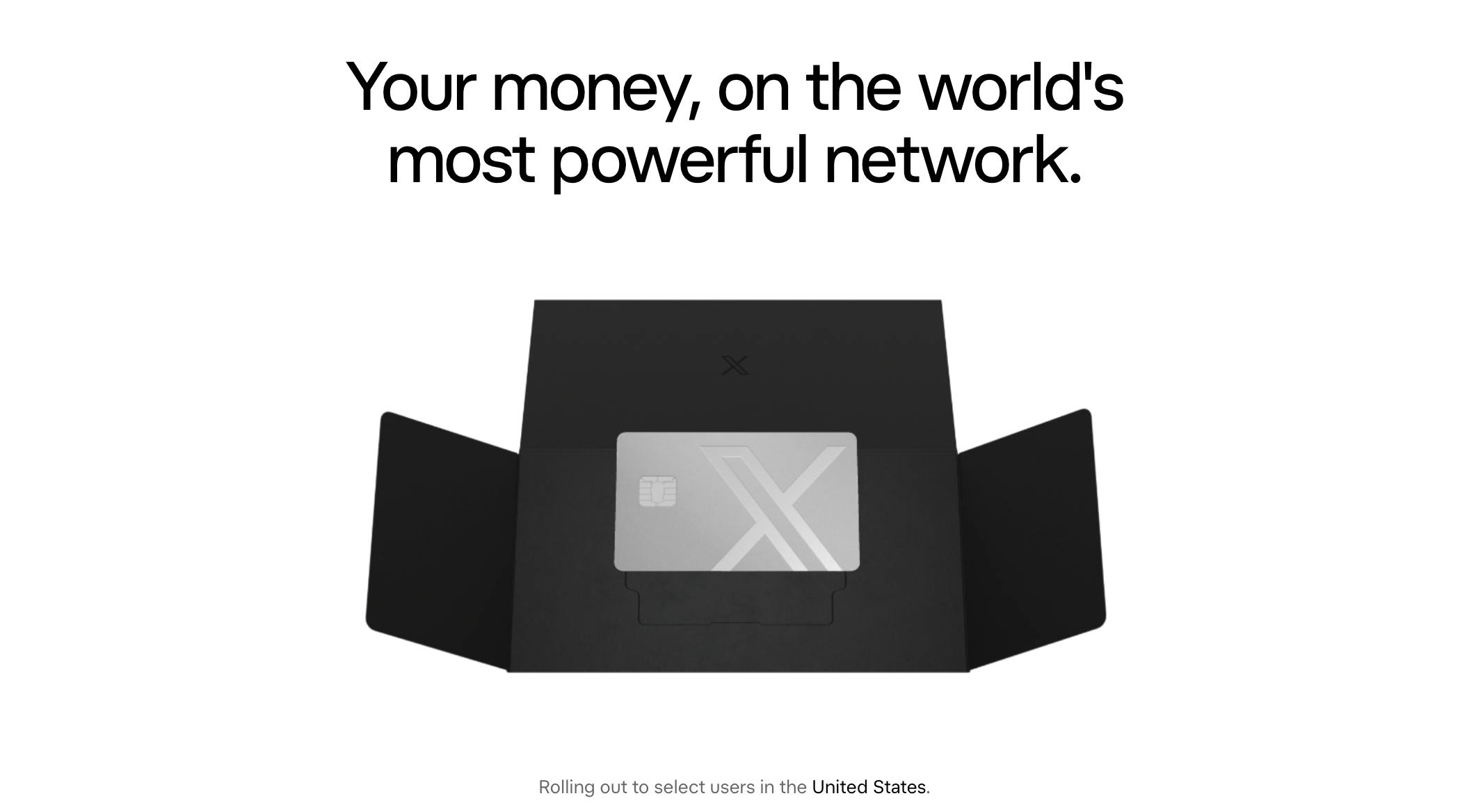
Recently, X (formerly Twitter) officially launched its highly anticipated financial product on Product Hunt — X Money. Its tagline is concise yet ambitious: "Your money, on the world's most powerful network." The product currently sits at #8 on the daily charts with 101 votes, categorized under Fintech, Twitter, and Money.
Based on the official description, X Money's core positioning is an "all-in-one" financial app: one app for everything your money can do. Its specific features span three major pillars — earning industry-leading APY, spending with X Card to earn cashback, and sending money instantly on X.
This launch marks another substantive step forward in Musk's "Everything App" vision. Since acquiring Twitter and rebranding it as X in 2022, Musk has repeatedly emphasized his goal of building a super app similar to China's WeChat — integrating social networking, payments, shopping, and communications into a single platform. The super app concept originated in Asian markets, with WeChat being the most iconic example — starting as an instant messaging service, it gradually integrated mobile payments (WeChat Pay), e-commerce (Mini Programs), lifestyle services, and content platforms, amassing over 1.3 billion monthly active users and becoming the infrastructure of China's digital life. Similar examples include Alipay, India's Paytm, and Southeast Asia's Grab and Gojek. However, super app attempts in Western markets have rarely succeeded, primarily because the regulatory environment is more fragmented and stringent, users have privacy concerns about concentrating too much data on a single platform, and mature leading products in each vertical have already formed user habit barriers. Musk's X is attempting to break this curse, and X Money is the most critical financial piece of this strategy.
Breaking Down X Money's Three Core Features
Industry-Leading APY
X Money's first selling point is "industry-leading APY" — offering competitive annual percentage yields on user deposits. APY (Annual Percentage Yield) is a standardized metric for measuring actual returns on savings or investments, factoring in compound interest effects, which makes it typically slightly higher than the nominal interest rate (APR). In the US, traditional big bank savings accounts have long offered APY rates hovering between 0.01%-0.5%, while emerging Fintech platforms (such as Marcus by Goldman Sachs, Ally Bank, and SoFi) can offer 4%-5% high-yield savings products through lower operational costs.
This effectively transforms the X platform into an entry point similar to a money market account or high-yield savings product. A Money Market Account is a financial product that sits between savings accounts and investment accounts, typically investing in short-term Treasury bills, commercial paper, and other low-risk assets to provide users with returns higher than regular savings. For X Money to deliver "industry-leading APY," it needs to build the corresponding fund management infrastructure, investing user deposits into safe short-term investment instruments to capture the yield spread. For X, with its hundreds of millions of active users, even a small fraction depositing funds on the platform could form a substantial capital pool.
X Card Cashback Spending
The second feature is X Card — a payment card that offers cashback on everyday purchases. This is similar to mainstream credit/debit card cashback models, essentially binding users' payment behavior to the X ecosystem through spending incentives. The launch of X Card means X is extending from online payments to offline spending scenarios, connecting the complete user value chain from "spending time on the platform" to "spending money with the platform's card."
Instant Transfers (P2P Payments)
The third and most socially-oriented feature enables instant transfers between friends on the X platform. This directly competes with P2P payment tools like PayPal's Venmo and Cash App. The US P2P payment market is already highly mature — Venmo has over 90 million users and is known for its social payment experience; Cash App also has over 50 million monthly active users and has expanded into stock trading and Bitcoin transactions; Zelle, jointly launched by America's seven largest banks, processed over $800 billion in transactions in 2023.
In this highly saturated market, X Money's differentiating advantage lies in its social graph — the existing follower relationships and interaction contexts users have on X can naturally trigger payment needs, such as tipping creators, paying for content, and splitting bills among friends. This is a contextual advantage that pure financial tools cannot replicate.
It's worth noting that Musk himself is a co-founder of PayPal. In 1999, Musk founded X.com, an internet bank aimed at providing comprehensive online financial services including savings, loans, insurance, and investments. In 2000, X.com merged with Peter Thiel's Confinity (which owned the PayPal product). After the merger, the company experienced internal power struggles, Musk was replaced as CEO, and the company ultimately developed under the PayPal brand before being acquired by eBay for $1.5 billion in 2002. Musk has stated multiple times that PayPal only achieved a fraction of his original vision — he had envisioned a complete financial operating system, not merely a P2P payment tool. In 2017, Musk repurchased the X.com domain from PayPal, and after acquiring Twitter in 2022, renamed it X. The launch of X Money is, in a sense, a continuation and restart of his unfinished dream from 25 years ago.
Strategic Significance: From Social Platform to Super App
The launch of X Money is far more than simply adding a feature — it's a core component of X's business model transformation.
For years, Twitter/X has been heavily dependent on advertising revenue, and the advertising business experienced significant volatility after Musk's acquisition. Building a financial business can open an entirely new, stickier revenue stream for X. The user retention and monetization capabilities of financial services are typically far higher than those of purely ad-driven social platforms.
More importantly, payment functionality is the "glue" of a super app. WeChat's success demonstrates that once users become accustomed to completing payments, transfers, and wealth management within a single platform, their dependency on and time spent on that platform increases significantly, in turn driving the commercial value of the entire ecosystem. WeChat Pay launched in 2013 and achieved explosive growth through Chinese New Year red envelope campaigns. Today it has penetrated virtually all online and offline consumption scenarios in China, becoming an inseparable piece of infrastructure in the WeChat ecosystem. X Money aims to replicate this path — using payments as an entry point to gradually build a complete financial ecosystem encompassing wealth management, lending, insurance, and more.
Challenges and Concerns Facing X Money
Despite the grand vision, the challenges facing X Money are equally significant.
Regulatory compliance is the primary hurdle. Financial businesses in the US are subject to extremely strict regulation. X needs to obtain Money Transmitter Licenses state by state and meet a series of compliance requirements including AML (Anti-Money Laundering) and KYC (Know Your Customer). US financial regulation operates under a dual federal-state framework, with money transmitter licenses issued and managed independently by each state. Except for Montana, all remaining 49 states plus Washington D.C. and US territories require businesses engaged in money transfer to hold this license. Completing all license applications typically takes 12-24 months and costs millions of dollars. Additionally, licensed institutions must meet minimum net worth requirements, submit surety bonds, undergo periodic audits, and establish comprehensive BSA/AML (Bank Secrecy Act/Anti-Money Laundering) compliance systems. According to public reports, X has obtained relevant licenses in multiple states through its subsidiaries, but full compliance remains an ongoing and costly process.
User trust is the second major test. Entrusting funds to a social platform requires users to establish sufficient trust. Compared to traditional banks and mature Fintech products (such as Cash App and Venmo), X still needs to prove itself in terms of financial security and data protection. Particularly after Musk's acquisition, X underwent massive layoffs (including the Trust and Safety team), frequent changes to platform rules, and other events that have left some users questioning the platform's stability and security. Financial operations demand far higher system stability and data security than social features, and any fund security incident could cause irreversible brand damage.
Market competition is equally fierce. The P2P payment space has long been occupied by players like Venmo, Cash App, and Zelle, and the high-yield account market has numerous Fintech companies and banks participating. Apple's Apple Savings (in partnership with Goldman Sachs), launched in 2023, attracted nearly $1 billion in deposits within just four days of going live, demonstrating the enormous potential of tech giants crossing into finance — but it also means X Money faces not only traditional financial institutions but also tech companies with equally massive user bases. Whether X Money can achieve differentiated breakthrough through its social attributes remains to be seen.
Conclusion
The launch of X Money is an important milestone in bringing Musk's "Everything App" blueprint to reality. It combines a social network's traffic advantage with financial services' monetization capabilities, theoretically offering enormous potential. However, crossing from social platform to finance is no smooth road — the triple tests of regulation, trust, and competition will determine whether X Money becomes a disruptive super application or yet another ambitious concept that struggles to materialize. For observers tracking Fintech and tech giants' ecosystem strategies, X Money is undoubtedly one of the most worth-watching products.
Related articles

Cursor Can Now Control Your Computer: AI Agents Can Drive Desktop Apps for Testing
Cursor adds desktop control: AI agents can drive desktop apps like the iOS Simulator to test their own features. We analyze the impact on dev workflows, possible technical approaches, and reliability concerns.

Vibecoding a Custom Inference Engine: High Hopes, Harsh Reality
A Reddit developer shares the real experience of vibecoding a custom inference engine: running GGUF Q4 models in the browser with WebGL2 and GLSL, only to fall into tokenizer debugging hell. This article analyzes the engineering challenges of browser-side LLM inference and why cloning llama.cpp is the more rational choice.

How High Are Anthropic's Early Investor Paper Returns Ahead of IPO?
Anthropic's early investor paper returns draw attention ahead of IPO. This article analyzes sources of book gains, capital structure, pre-IPO games and risks, and implications for the AI startup ecosystem.