X Subscription Overhaul: Should Cursor Pro and SuperGrok Users Switch?

X's new subscription bundles Grok and Cursor, but third-party models cost extra; migration depends on which models you actually use.
X launched a five-tier subscription system bundling Grok, GrokBot, Cursor, and X blue checkmark benefits. The key catch: Cursor quota only covers Grok models, while Claude, GPT, and other third-party models are charged separately at API prices from the first call. The article offers migration advice by usage multiplier and user type: heavy Grok users can compare total costs before switching; Cursor users relying on Claude/GPT should keep standalone plans; those who only need the blue checkmark needn't upgrade. Before switching, confirm your bill name to avoid passive migration.
X (formerly Twitter) recently launched a brand-new subscription system called "The X Subscription," bundling Grok, GrokBot, Cursor, along with X blue checkmark and ad-free benefits into a single bill. For users who already subscribe to Cursor Pro or SuperGrok, there's really only one core question: stick with the old plan, or migrate to the new tiers? Based on Bilibili creator Xingyou's breakdown, this article clarifies the differences between old and new plans and the switching costs.
What the New Subscription System Looks Like
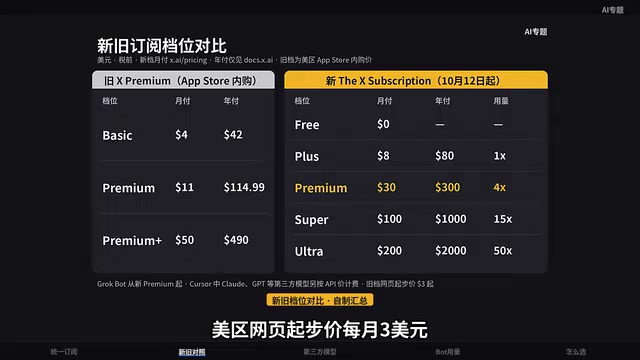
The new plans come in five tiers: Free, Plus at $8/month, Premium at $30/month, Super at $100/month, and Ultra at $200/month. Annual payment options are also available. The original X Premium was divided into three tiers—Basic, Premium, and Premium+—starting at around $3/month on the web; SuperGrok was a separate subscription. Official statements make clear that existing subscriptions can continue to be used, and switching is optional—existing users aren't forced to migrate.
The correspondence between old and new tiers: the new Plus is priced the same as old X Premium, with basic Grok included as a bonus; the new Premium officially covers old SuperGrok, Cursor Pro, and X benefits close to old Premium+, which the company says previously totaled about $90/month combined. GrokBot is available starting from the Premium tier—Plus doesn't include it.
Grok is a large language model developed by xAI, integrated into the X platform for content generation, Q&A, and image understanding. SuperGrok is a standalone subscription tier for individual users, offering higher usage limits and priority access to new models, previously requiring separate payment. GrokBot, meanwhile, is a bot form designed for automation scenarios, allowing Grok to run continuously on specific tasks or workflows—suitable for users who need batch processing or integrated calls. Bringing SuperGrok and GrokBot into a unified subscription means xAI is expanding model capabilities from social platform features into standalone developer/productivity tools, and bundling with third-party tools like Cursor to reduce users' selection costs through subscription packaging.
The Key Catch: Cursor Quota Doesn't Cover Third-Party Models
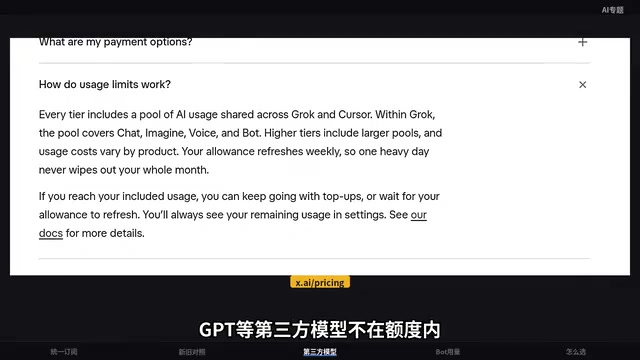
This is the core variable determining whether to switch. Cursor's included usage within the subscription shares a quota pool with Grok, refreshed weekly, but this quota only covers Grok models. Third-party models like Claude and GPT are not included—they're charged separately at official API prices from the very first call, requiring separate prepaid credit top-ups. In other words, the $30 Premium does not include third-party model costs in Cursor.
If your current Cursor Pro is mainly used for Claude or GPT, you must factor these costs in separately before switching. For such users, keeping a standalone Cursor plan usually makes the accounting clearer.
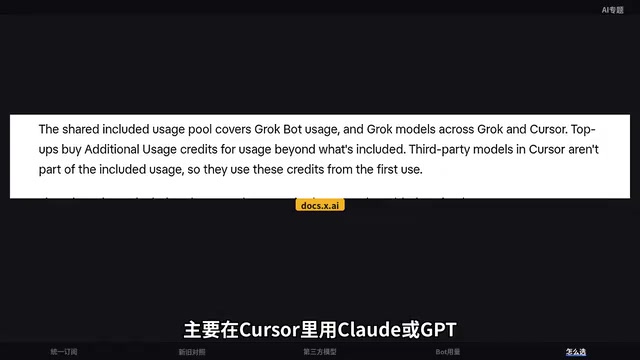
Cursor is an AI coding editor based on VS Code, with subscription tiers including Free, Pro (about $20/month), and Business. The Pro subscription includes a certain amount of "fast request" quota and allows connecting third-party models like Claude and GPT within the editor; beyond the quota, you pay per usage or switch to a slower queue. Cursor's billing system and model providers' API pricing are two independent mechanisms: the subscription fee covers editor features and built-in quota, while token costs from calling third-party models are typically passed through by Cursor at API prices. Therefore, when Cursor is bundled as a benefit into the X subscription, you need to distinguish "editor access rights" from "model call fees"—the former may be covered, while the latter still depends on whether the specific model is in the quota pool.
Usage Multipliers and Priority
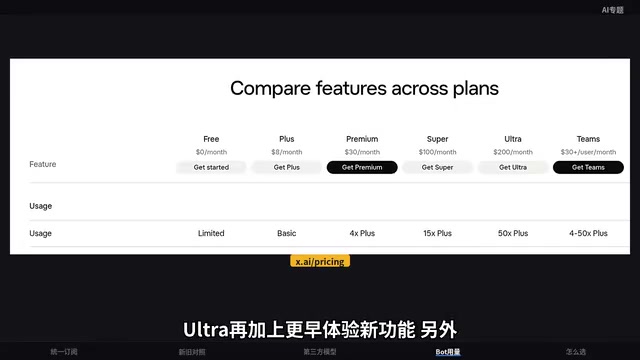
Taking Plus as the baseline, Premium offers about 4x usage, Super about 15x, and Ultra about 50x. Super adds peak-hour priority access, and Ultra further adds earlier access to new features. Users who need GrokBot must choose at least Premium or above. Additionally, in-app purchases through the App Store are usually more expensive than web: Basic, Premium, and Premium+ in-app cost about $4, $11, and $50/month respectively—the checkout page is final.
Four Types of Users, Four Choices
Mainly using Grok, and also wanting GrokBot, fewer ads, and a blue checkmark: Compare your current total cost of separate payments against the new Premium's $30—switch if the total is lower.
Mainly using Claude or GPT in Cursor: The subscription doesn't cover third-party models; keeping a standalone Cursor plan is usually clearer.
Only want the blue checkmark and ad-free experience, rarely use Grok: If old X Premium is still renewable, there's no need to upgrade to $30; the new Plus at $8/month includes basic Grok but no GrokBot.
Currently subscribed separately and everything works well: You can wait until the next billing cycle and compare against the official pricing page once more before deciding.
One more step before switching—don't skip it: confirm whether your bill says old X Premium or The X Subscription, to avoid being migrated without your knowledge.
Summary
The essence of this merger is consolidating scattered AI and social benefits into a single bill, simplifying management with a unified quota pool. It's convenient for heavy Grok users, but may mean extra costs for Cursor users who rely on Claude/GPT. The criterion isn't how good the new tiers look—it's which models you actually call and how much you use them.
One-line Summary
X's new subscription bundles Grok and Cursor, but third-party models require separate payment—whether to migrate depends on which models you actually call.
Paragraph Summary
X launched a five-tier subscription system bundling Grok, GrokBot, Cursor, and X blue checkmark benefits. The key catch: Cursor quota only covers Grok models, while third-party models like Claude and GPT are charged separately at API prices from the first call. The article offers migration advice by usage multiplier and user type: heavy Grok users can compare total costs before switching; Cursor users relying on Claude/GPT should keep standalone plans; those who only need the blue checkmark needn't upgrade. Before switching, confirm your bill name to avoid passive migration.
Related articles

Python 3.15 New Feature: Is the sentinel Type Better Than None?
Python 3.15 adds the sentinel type, using named unique sentinel objects to replace None and bare object(), resolving confusion among missing values, explicit emptiness, and invalid input while avoiding type hint failures.

Deep Learning's Three Architectures and the Universal Approximation Theorem: A Complete Guide to MLPs, CNNs, and Transformers
Explaining the inductive bias differences among MLP, CNN, and Transformer, the existence meaning of the Universal Approximation Theorem (UAT), and the role of Taylor expansion in approximation analysis, while clearing up common misconceptions.

GitLab Emergency Patch Release: Analysis of Critical Security Fixes
GitLab releases critical patch 19.5.1, sparking 355 points of discussion on Hacker News. This article analyzes the background, upgrade steps for self-hosted instances, and verification points to help DevOps teams respond quickly to security updates.