xAI Adapter Update in AI SDK: A Patch Release Driven by Dependency Chain
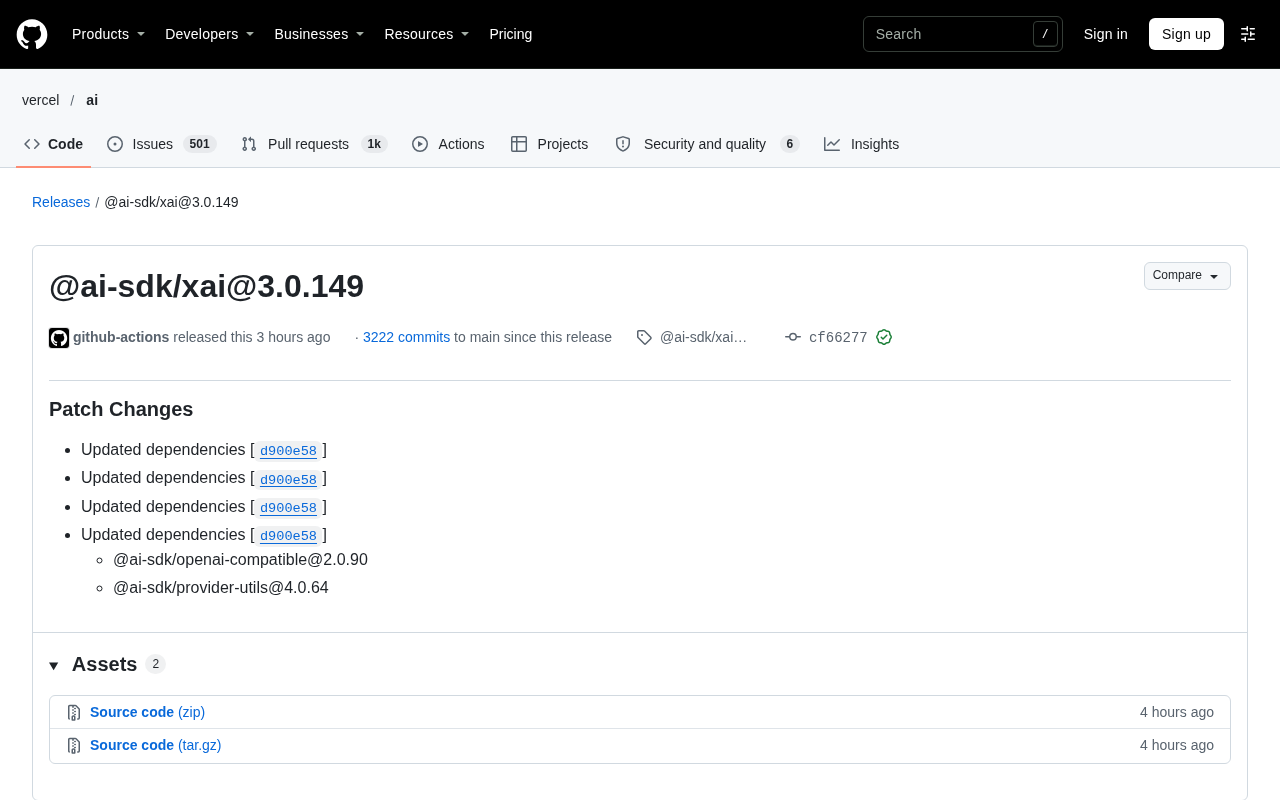
@ai-sdk/xai releases patch 3.0.149, mainly syncing underlying dependency updates.
The xAI adapter package `@ai-sdk/xai` in Vercel's AI SDK ecosystem has released version 3.0.149, a standard patch release focused on dependency syncing: upgrading `@ai-sdk/openai-compatible` to 2.0.90 and `@ai-sdk/provider-utils` to 4.0.64, both introduced by the same commit. The adapter itself adds no new features or specific bug fixes. The article notes that such dependency-driven patches are very common in AI SDK's monorepo, but because the shared utility layer handles request construction, response parsing, and streaming, underlying upgrades may still bring subtle changes in request behavior, error handling, and chunking logic. Developers should focus regression testing on streaming output and error branches after upgrading. The patch number reaching 149 also reflects AI SDK's high-frequency iteration pace in quickly following model API changes, with releases automated by github-actions and carrying verified signatures.
The AI SDK ecosystem under Vercel has seen another version iteration. @ai-sdk/xai has released version 3.0.149. Judging from the version number and changelog, this is a standard patch release (Patch Changes), with the core action being dependency updates.
What exactly changed in this update
According to the release records on GitHub, the changes in @ai-sdk/xai@3.0.149 are highly focused: dependency updates. The log lists four dependency update entries, all pointing to the same commit (d900e58), involving two upstream packages:
@ai-sdk/openai-compatible@2.0.90@ai-sdk/provider-utils@4.0.64
In other words, the xAI adapter itself did not introduce new features or fix specific bugs; it simply synced its underlying dependencies to newer versions. This kind of "dependency-driven" patch release is very common in multi-package monorepos like AI SDK.
AI SDK is an open-source TypeScript toolkit launched by Vercel for uniformly integrating various large model providers into applications. It uses a monorepo structure: the core package ai provides unified APIs such as generateText and streamText, while each provider corresponds to a separate adapter package, such as @ai-sdk/openai, @ai-sdk/anthropic, and @ai-sdk/xai. These adapters all rely on an abstract @ai-sdk/provider interface specification, which decouples upper-layer calling code from specific providers—when switching models, you only need to swap the adapter, and the business logic barely changes. This layered design is also why patch releases for individual adapters often just sync shared dependencies: what truly defines the behavioral contract is the middle-layer provider interface and utility packages.
Patch Changes follow the Semantic Versioning (SemVer) specification. The third digit in the version number MAJOR.MINOR.PATCH increments to indicate backward-compatible bug fixes or internal adjustments, without introducing new features or breaking existing APIs. With release tools like Changesets, when a package in the monorepo changes, the affected dependent packages are automatically calculated and patch versions are generated for them. Therefore, releases like 3.0.149, where the patch number is high and the change content is merely "dependency updates," are essentially chained release results automatically derived by the build system based on the dependency graph, rather than deliberately designed functional iterations.
Why a dependency update is worth paying attention to
Looking at this release alone, it is indeed unremarkable. But within the AI SDK architecture, dependency updates often imply potential behavioral changes.
@ai-sdk/provider-utils is the shared utility layer for all provider adapters in AI SDK, responsible for request construction, response parsing, streaming processing, and other foundational capabilities. @ai-sdk/openai-compatible is a general adaptation layer for providers compatible with the OpenAI interface. xAI's API is designed to closely follow OpenAI's interface specification, so reusing the openai-compatible layer to connect to it is a reasonable engineering choice.
When these two underlying packages are upgraded, the upper-layer adapter's actual request behavior, error handling, and streaming response chunking logic may all be subtly adjusted. For developers who directly integrate xAI into their applications, it is worth checking whether there are subtle differences in streaming output and error branch behavior after upgrading.
OpenAI-compatible interfaces have become the de facto industry standard: a large number of model providers (xAI, DeepSeekAd, Together, Groq, local vLLM, etc.) offer HTTP APIs consistent with the /v1/chat/completions structure, where fields such as messages, tools, stream, and temperature can be reused directly. @ai-sdk/openai-compatible is precisely the general adaptation layer designed for such providers; developers only need to pass in baseURL and apiKey to connect, without rewriting request logic for each vendor. But compatibility does not mean complete consistency—each vendor's streaming chunk format, error codes, finish_reason values, and incremental assembly of tool calls often differ subtly. The general layer often needs conditional branching for individual vendors, which is the fundamental reason why upgrades to the shared layer may affect upper-layer behavior.
Streaming refers to the model returning tokens as they are generated, rather than waiting until generation is complete before responding. In AI SDK, data chunks are received at the underlying level via SSE (Server-Sent Events), and a parser in @ai-sdk/provider-utils is responsible for splitting the raw byte stream into structured events (text deltas, tool call deltas, end events, etc.), which are then converted by the upper layer into a unified fullStream for consumption. Once the parser's chunk boundary handling or buffering strategy is adjusted, the perceived first-token latency, delta granularity, and even the shape of error objects on abnormal interruption may change. Therefore, it is necessary to perform regression verification on the streaming path after upgrading.
Information in the version number
The version number 3.0.149 itself also reveals the project's pace. The patch number has reached 149, indicating that the xAI adapter maintains high-frequency, small-step iterations under the 3.x major version—consistent with AI SDK's overall strategy of "quickly following changes in each model API." Whenever a provider interface adjusts, the adapter must release a version to keep up, and the rapid accumulation of patch numbers is a direct reflection of this pace.
The release was completed by the github-actions bot, and the commit carries a GitHub verified signature, indicating that this release pipeline is automated. For users, this means the stability and traceability of version releases are guaranteed.
Practical advice for developers
If you have pinned the version of @ai-sdk/xai in your project, the risk of this patch upgrade is low, but it is still recommended to run integration tests related to xAI after upgrading, focusing on streaming conversations and abnormal returns. If your project's dependency locking is looser, automatically upgrading to 3.0.149 is usually safe as well—such dependency-sync patches rarely introduce breaking changes.
What is more worth cultivating as a habit is: pay attention to the dependency chains of AI SDK provider packages, not just your direct dependencies. Version drift in the shared utility layer is sometimes the real source of behavioral changes.
Summary
@ai-sdk/xai@3.0.149 is a typical dependency-sync patch, with no new features and no explicit bug fix notes. Its value lies in maintaining consistency between the xAI adapter and the AI SDK's underlying toolchain. For applications built on AI SDK, keeping such patches up to date in a timely manner is a practical way to avoid pitfalls during future major version upgrades.
Related articles

Skykea Showdown: A Hilarious Variety Show Experience of a Minecraft Airship Building Competition
Skykea Showdown is a Minecraft airship building racing variety show. This article analyzes its two-phase build + hole race format, airship mod lift physics, secret mission design, and team confrontation dynamics—ideal for game content creators.

Did the US Midterms Vote No to AI Data Centers? A Map Reveals the Truth
After the US midterms, media claimed voters rejected AI data centers, but a map shows restrictive votes are concentrated in a few Ohio townships, affecting less than 1% of US towns—the national anti-AI wave is exaggerated.

ApexW Optimizer Benchmark: Matches 8-bit AdamW in Unsloth with Lower Memory Usage
Developer shares benchmark of ApexW optimizer in Unsloth: ApexW 8bit has lower optimizer state memory (47.101 MB) and slightly better final loss than 8-bit AdamW, but similar speed. Needs independent reproduction.