xAI Releases Grok 4.7: Upgrades to Multi-Turn Conversation and Creative Capabilities

xAI releases Grok 4.7 as a minor iterative update, sparking HN debate on rapid LLM iteration and rational model evaluation.
xAI has released Grok 4.7, continuing its high-frequency minor-version release strategy. The announcement quickly trended on Hacker News with over 220 comments. The Grok series differentiates itself through real-time X platform data access, while this update is seen as focused on reasoning and context refinement rather than architectural breakthroughs. Community reactions are split — some view rapid iteration as xAI actively closing the gap with OpenAI and Anthropic, while others remain skeptical about the actual gains and benchmark validity. The article recommends practitioners build a rational evaluation framework grounded in third-party benchmarks, real-world user feedback, and concrete business results.
Grok 4.7 Arrives: Another Rapid Iteration from xAI
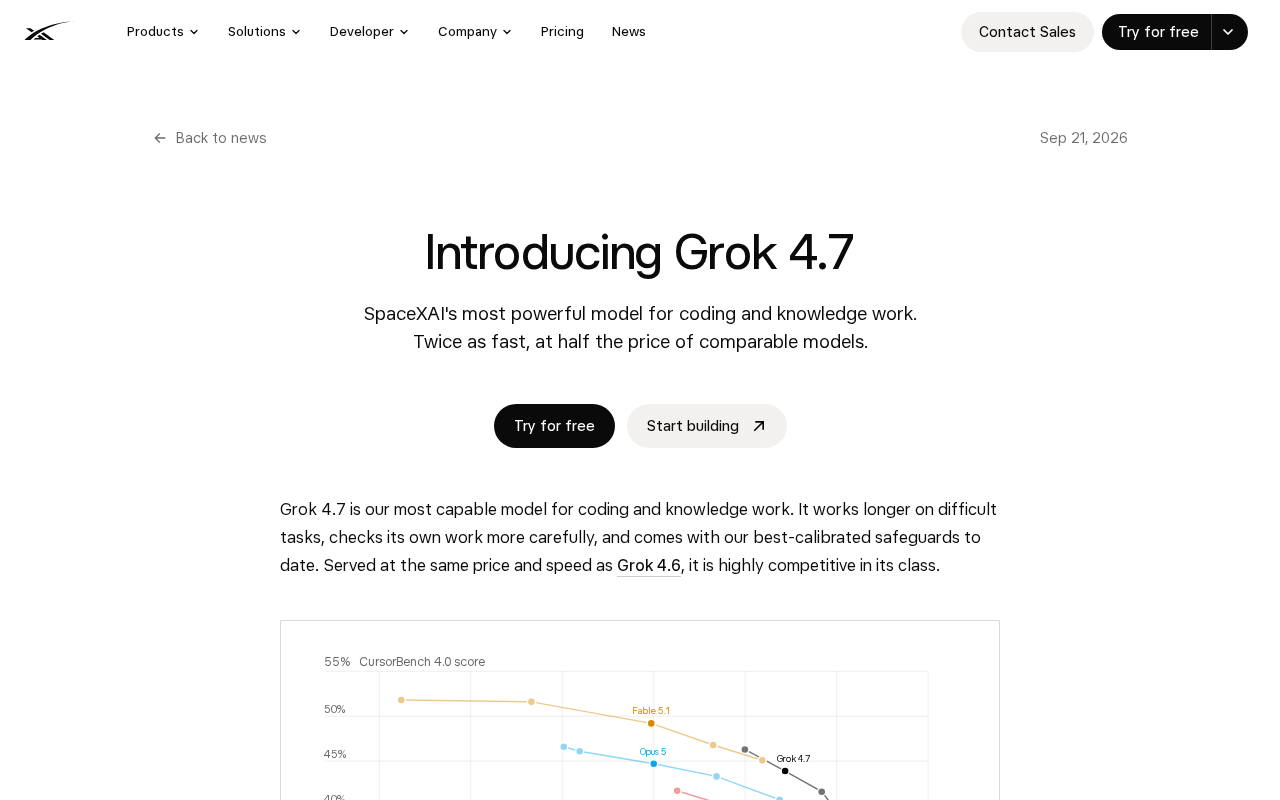
xAI recently published a new model version, Grok 4.7, on its official website. The announcement quickly climbed to the top of Hacker News, drawing 281 upvotes and over 220 comments. As yet another minor version update in the Grok series, Grok 4.7 continues xAI's characteristic high-frequency release cadence — and once again has the community debating its actual capabilities.
The version number alone signals that this isn't a ground-up architectural overhaul, but rather a round of refinement and optimization built on the Grok 4 foundation. This incremental, decimal-point update strategy reflects xAI's effort to close the gap with top-tier players like OpenAI, Anthropic, and Google through dense, rapid iteration.
The Competitive Logic Behind Frequent Version Releases
In today's LLM race, release frequency is itself a signal. Leveraging the massive real-time data from X (formerly Twitter) and the substantial compute resources available across Musk's portfolio of companies, xAI is pushing model updates at a notably aggressive pace. The launch of Grok 4.7 indicates that the team continues to invest in dimensions like reasoning ability, conversational coherence, and creative expression.
From a product positioning standpoint, the Grok series has consistently emphasized deep integration with the X platform and access to real-time information — a key differentiator compared to some competitors. Minor version updates typically focus on patching existing weaknesses: context retention, response consistency, and performance improvements on specific tasks.
xAI's access to real-time X platform data is technically significant. Most mainstream LLMs — such as GPT-4 and Claude — have training data cutoff dates and cannot perceive recent events. Grok, through API integration with X, can retrieve tweets, news, and discussions posted just minutes ago during a conversation. This "real-time Retrieval-Augmented Generation" (Real-time RAG) capability gives it a built-in advantage for current events Q&A and trending topic analysis that closed-source competitors find difficult to replicate. However, real-time data also introduces noise and misinformation challenges — content on X is not rigorously filtered, so how the model screens out low-quality information while maintaining factual accuracy remains a core challenge this architecture must continuously address.
Community Reaction: Enthusiasm and Skepticism in Equal Measure
The 200+ comments on Hacker News demonstrate that the developer community is paying close attention to Grok 4.7 — though reactions are far from unanimous. On one hand, the rapid iteration is seen as a positive sign that xAI is actively pursuing the industry's top tier. On the other hand, voices have emerged questioning just how much a minor version update actually improves things, and how Grok 4.7 truly performs on standardized benchmarks.
This coexistence of enthusiasm and skepticism is practically a given at every frontier model launch. For users, version number jumps are worth noting, but what ultimately matters is how reliable the model is in real-world use cases — hard metrics like code generation, long-document handling, and factual accuracy.
The "standardized benchmarks" the community refers to are a set of public evaluation suites used to compare LLM capabilities across the board. Common ones include: MMLU (Massive Multitask Language Understanding), HumanEval (code generation), MATH (mathematical reasoning), and HellaSwag (commonsense reasoning). Their strength lies in reproducibility and comparability; their limitation is that model vendors may include similar questions in training data, leading to "benchmark gaming" — inflated scores that don't reflect actual user experience. This is precisely why Hacker News developers often prefer a "vibe check" — testing the model on their own real tasks — over simply trusting officially published benchmark numbers. It's also why, even with Grok 4.7 trending, the comment section remains full of cautious assessments and hands-on test reports.
How to Rationally Evaluate Minor Model Updates
For practitioners who follow AI developments closely, a rational evaluation framework is essential when facing a constant stream of version releases. Version numbers alone don't indicate a capability leap. What's actually worth referencing is third-party benchmark results, long-term feedback from real users, and demonstrated effectiveness in concrete business use cases.
The significance of Grok 4.7 lies more in what it represents strategically: xAI's commitment to rapid iteration and quick market responsiveness. In a fiercely competitive LLM landscape, whoever can deliver more stable capability improvements on shorter cycles will be better positioned to maintain the initiative in this long game.
For everyday users and developers, the most pragmatic approach is to run your own tests based on your specific needs — evaluate performance on real tasks rather than passing judgment solely based on a press release.
Conclusion
Grok 4.7 is another product delivery under xAI's high-frequency iteration strategy. The broad community discussion it sparked reflects both ongoing market expectations for the Grok series and a measured skepticism about what minor version updates actually deliver. With the LLM landscape still far from settled, this kind of dense update cadence will continue — and the standard for judging its value will always come back to real capability and user experience.
Related articles

Workbuddy for Absolute Beginners: How a Desktop AI Agent Fits Into Real Workflows
A beginner's guide to the Workbuddy desktop AI agent: installation, claiming credits, file management, and building automated workflows—compared with CodeX for fit and cost, helping professionals shift from AI question-askers to AI managers.

OpenAI's New Agent Stack: Computer Use, Decisions API, and Ultra-Fast Workflows
OpenAI Dev Day unveiled a new agent stack: Computer Use outperforms humans, Decisions API delivers ultra-low-latency classification via Luna, Agents API opens the same Computer Use capabilities, and GPT-6.1 Sol costs only one-seventh of Astra. Core updates, benchmark data, and developer insights.

Liang Wenfeng Open-Sources DeepInfo Inference Framework, Takes On U.S. Ban
DeepSeek open-sources its DeepInfo inference framework after its models, featuring GPU/CPU cross-pipelining, small-model prediction with large-model verification, and full Huawei Ascend and NVIDIA chip support—facing the U.S. federal ban head-on. This article analyzes its significance for AI deployment and open-source strategy.