xAI's Agent Advantage: Turning X Real-Time Data into Model Tools

xAI gives Grok a powerful real-time tool layer built on exclusive X data, but falls short as a complete agent runtime.
xAI differentiates Grok by exposing X's exclusive real-time data stream alongside web search, code execution, and remote MCP as server-side model tools — capabilities competitors can't easily replicate. An OpenAI-compatible Responses API lowers migration friction for developers. A Beta multi-agent model introduces a fan-out architecture that dispatches complex research tasks to up to 16 parallel agents, with a leader agent synthesizing results. However, xAI currently operates more as a powerful real-time tool layer than a fully managed agent runtime — task orchestration, state management, and long-running execution infrastructure remain incomplete, and separate X search billing adds cost for data-heavy use cases.
xAI's Core Differentiation: A Real-Time Web + X Data Pipeline
xAI's capability roadmap for Grok isn't particularly complicated, but its entry point is unique — it exposes the real-time Web and X (formerly Twitter) data firehose directly as tools the model can call during inference. This means Grok isn't limited to static training knowledge; it can pull live information about what's happening right now.
For applications that need to track trending topics, public sentiment, or breaking events, this creates a moat that competitors can't easily replicate. X's real-time data is an asset exclusive to xAI — no matter how capable another model provider's tooling is, they simply can't access the same quality of live social stream.
Grok's Server-Side Tool Capabilities
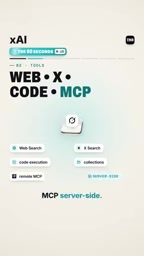
Based on the video walkthrough, Grok currently has access to a full suite of server-side tools: web search, X search, code execution, collections, and remote MCP (Model Context Protocol) server calls.

The key phrase here is "server-side." Tool execution happens on the server, so developers don't need to stand up their own execution environments or maintain a stack of local plugins — the call logic is hosted by xAI. For teams that want to quickly plug in real-time research capabilities, this significantly reduces engineering overhead. The addition of code execution and remote MCP also pushes Grok's capabilities well beyond Q&A, giving it genuine task-execution properties.
Remote MCP (Model Context Protocol) is an open protocol introduced by Anthropic to standardize communication between AI models and external tools or data sources. Think of MCP in relation to AI tool-calling the way USB-C relates to device connectivity — it provides a unified interface specification so models can connect to external services consistently, without needing custom integration logic for each one. xAI's support for remote MCP server calls means developers can mount their existing MCP-compatible services directly onto Grok's tool chain, dramatically lowering the engineering cost of connecting custom tools and enabling Grok to participate in a broader third-party tool ecosystem.
An OpenAI-Compatible Responses API
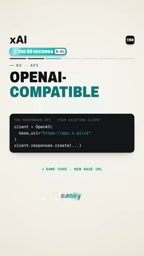
One detail that's easy to overlook but critically important for developers: xAI's Responses API is OpenAI-compatible.
Compatibility means that client code already written against the OpenAI interface can be migrated over with minimal effort. Developers don't need to rewrite their call logic — most existing client patterns can be reused as-is. In the LLM API ecosystem, interface compatibility largely determines the friction of switching providers. xAI's choice to align with the existing standard is clearly designed to lower the barrier to adoption — a pragmatic ecosystem strategy.
A Beta Multi-Agent Model
The video also covers a multi-agent model currently in Beta that can "fan out" a research task to 4 or 16 agents running in parallel.
After each agent independently makes progress, a "leader" agent is responsible for synthesizing a final answer.

This distribute-then-aggregate architecture is essentially a parallel research paradigm: break a large problem into sub-tasks, let multiple agents explore different directions simultaneously, then converge on a unified result. For complex research tasks, this approach can theoretically improve both coverage and efficiency. That said, it remains in Beta — stability and real-world performance still need to be validated.
The "fan out" architecture is a classic parallel task decomposition pattern in multi-agent systems, rooted in the divide-and-conquer strategy from distributed computing. An orchestrator or leader agent receives a complex task, breaks it into relatively independent sub-tasks, and dispatches them to multiple worker agents for concurrent execution. Once complete, the leader aggregates and synthesizes the results. The core advantage is time efficiency — research steps that would otherwise run sequentially can proceed in parallel, theoretically compressing response time by a factor proportional to the number of agents. However, complexity rises accordingly: sensibly decomposing sub-tasks, deduplicating and resolving conflicts across agent outputs, and ensuring final synthesis quality are all non-trivial engineering challenges. This is precisely why xAI has labeled the capability Beta.
An Honest Assessment of Strengths and Trade-offs
Taken together, xAI's advantages in this agent capability stack are clear: exclusive X data, a powerful server-side toolset, real-time research capabilities, and an open-source Grok build harness. The open-source framework gives the community and developers a genuine opportunity to contribute to the tool ecosystem.
But the trade-offs are equally clear. What xAI provides is better described as an excellent "real-time tool layer" rather than a complete managed agent runtime. In other words, it gives you powerful tools and data — but the full operating system around agents — task orchestration, state management, long-running managed execution environments — isn't fully there yet.
Additionally, the multi-agent capability is still in Beta, and X search carries separate fetch costs. Applications that rely heavily on X data will need to carefully model those costs into their economics.
A managed agent runtime refers to a platform-owned infrastructure layer that takes full responsibility for managing an agent's lifecycle. This typically includes: task queuing and scheduling, cross-step state persistence, error retry and checkpoint recovery, resource management for long-running tasks, and observability capabilities (logging, tracing, alerting). Products like Salesforce Agentforce and Microsoft Azure AI Agent Service are both evolving in this direction. Without this layer, developers must build their own "scaffolding" to manage agent execution state — and as tasks grow in complexity or duration, the engineering burden rises sharply. xAI's tool-layer capabilities are already quite strong, but this infrastructure gap is the primary distance between it and a "complete agent platform."
The Verdict: Strong Tool Layer, Incomplete Operating System
To put it plainly: xAI is an excellent real-time tool layer, but it's not yet a complete "agent operating system."
That positioning isn't inherently good or bad — what matters is your use case. If your core need is real-time information retrieval, social data analysis, or trend tracking, xAI's exclusive access to X data makes it genuinely compelling. But if you need an out-of-the-box, end-to-end managed agent orchestration platform, xAI in its current state will require you to fill in significant engineering gaps yourself. For developers, understanding where that line falls is more practically valuable than chasing the "most powerful agent" label.
Related articles

Chain of Thought Isn't Just for AI: How Humans Can Use CoT to Improve Thinking Quality
Chain of Thought isn't just a prompt trick for large models. Starting from a Hacker News discussion, this article analyzes why CoT works for human thinking too, breaks down actionable ways to transfer it, and highlights the key differences between human CoT and machine CoT.
Cloudflare Teams Up with OpenAI: Closi…
Cloudflare Teams Up with OpenAI: Closing the Loop from Vulnerability Discovery to Defense with AI
Cloudflare uses OpenAI Daybreak to investigate security vulnerabilities and generate reviewable remediation plans, while developers use Codex to boost coding efficiency and quality.

Orca Multi-Agent Orchestration in Practice: A Guide to Parallel Collaboration with Claude and Codex
Orca is Stable AI's free open-source agent workbench supporting 34 agents like Claude Code and Codex in parallel. Learn its Git worktree isolation, multi-model orchestration, and mobile management.