xAI Teams Up with SpaceX to Train Grok 4.5: Entering a New Era of Hardcore Engineering Intelligence

xAI partners with SpaceX to train Grok 4.5, a general-purpose model going beyond software engineering.
xAI has announced a partnership with SpaceX to train Grok 4.5, positioned as its most powerful model yet and the first Grok going beyond software engineering. The collaboration leverages SpaceX's proprietary aerospace and engineering data to build a differentiated moat, signaling a shift toward hardcore, real-world engineering intelligence in the AI race.
xAI and SpaceX Join Forces to Train Grok 4.5
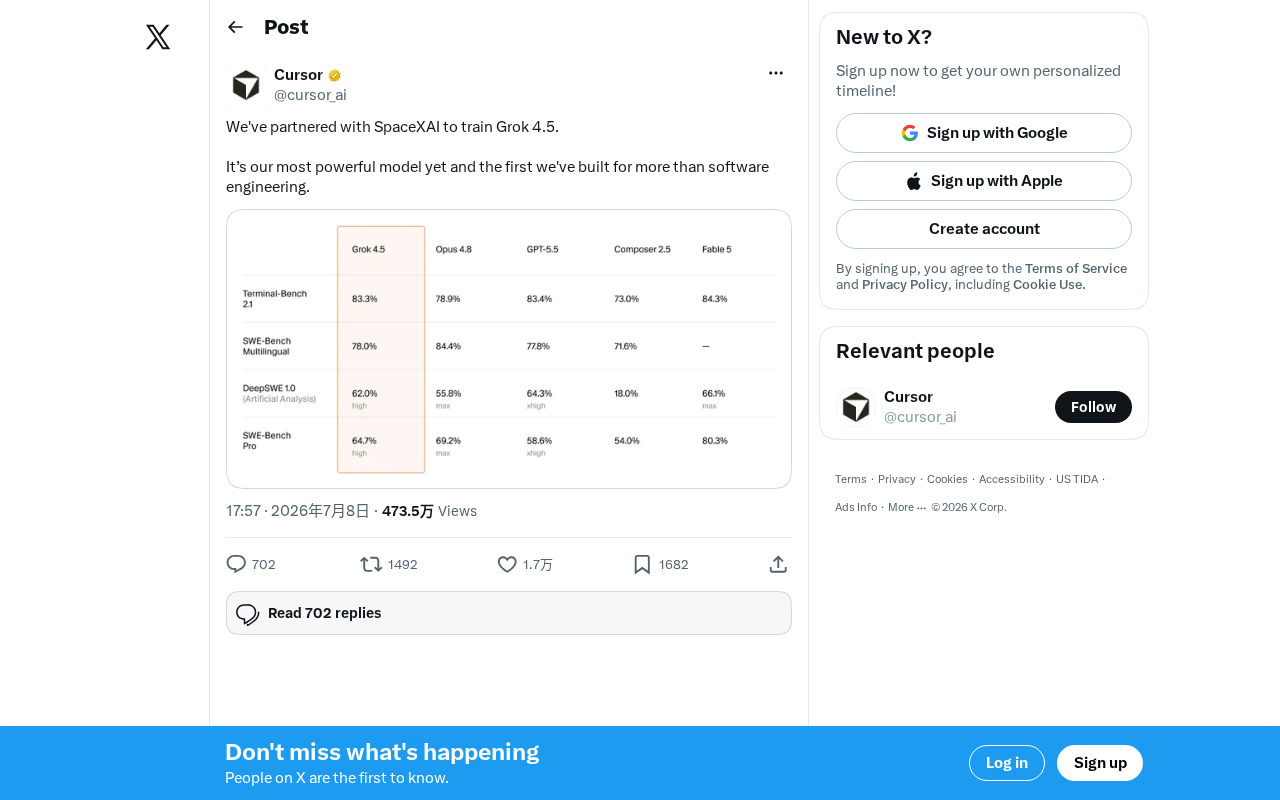
Recently, xAI announced on the social platform X that it has partnered with SpaceX to jointly train the next-generation large model, Grok 4.5. According to the official statement, this is the most powerful model xAI has released to date, and the first version in the Grok series explicitly positioned as a general-purpose capability model that goes "beyond software engineering."
Behind this brief announcement lies a significant shift in xAI's model capability roadmap. Previous Grok models, like most frontier models in the industry, treated code generation and software engineering as the primary battleground for core capability benchmarks. Grok 4.5, however, is positioned as a general intelligence model aimed at a broader range of real-world tasks—marking xAI's ambition for this generation to deliver genuine value in complex engineering scenarios.
Why Partner with SpaceX?
Internal Synergy Within Musk's Ecosystem
The collaboration between xAI and SpaceX is hardly surprising. Both companies fall under Elon Musk's umbrella, and together with Tesla and X (formerly Twitter), they form a vast technology and data ecosystem. The most direct value of this partnership lies in SpaceX's ability to provide xAI with unique data and application scenarios that are difficult to access in the pure software domain.
As a leading global aerospace company, SpaceX spans numerous hardcore engineering fields, including rocket design, orbital calculations, materials engineering, manufacturing processes, and mission scheduling. The specialized knowledge and data from these scenarios are exactly the kind of high-value corpus needed to train a general intelligence model that goes "beyond software engineering." Compared to the readily available general text on the internet, proprietary data from real aerospace and industrial scenarios tends to be far scarcer and harder to obtain.
The Strategic Value of Proprietary Data: Current mainstream large models rely heavily on publicly available internet data for pretraining, including CommonCrawl, Wikipedia, GitHub code repositories, and more. As various vendors approach saturation in mining this public data, the marginal room for improving data quality has narrowed considerably. Meanwhile, high-quality proprietary data from specific vertical domains—such as clinical medical records, industrial sensor logs, and aerospace mission telemetry—carries denser signals of domain knowledge due to its scarcity and specialization. Such data is not only limited in quantity but also protected by multiple layers of commercial confidentiality, industry regulation, and technical barriers, making it nearly impossible for ordinary organizations to obtain. This is precisely the core asset logic of Musk's ecosystem: Tesla's driving data, SpaceX's engineering data, and X's real-time social data collectively form a data moat that is difficult to replicate, providing differentiated "fuel" for xAI's model training.
From "Writing Code" to "Solving Real Engineering Problems"
Over the past two years, the industry's assessment of large model capabilities has focused heavily on programming benchmarks such as SWE-bench, which to some extent has driven model training to "optimize toward the benchmarks."
What is SWE-bench? SWE-bench, short for Software Engineering Benchmark, is a software engineering benchmark proposed by a Princeton University research team in 2023. It extracts tasks from real open-source project issues on GitHub, requiring the model to read code repositories and automatically generate fix patches, ultimately judging correctness by running unit tests. Unlike earlier benchmarks focused primarily on code generation, such as HumanEval, SWE-bench more closely resembles real software development scenarios, testing a model's understanding of large code repositories, cross-file reasoning, and precise modification capabilities. Because of its difficulty and realism, SWE-bench quickly became the mainstream standard for measuring a model's software engineering capabilities, with major vendors like OpenAI, Anthropic, and Google all adopting it as a core evaluation metric for their flagship models.
By emphasizing that Grok 4.5 is "not built solely for software engineering," xAI is sending a clear signal: they want the model to handle complex system problems in the physical world, not just fix bugs in code repositories.
This aligns with Musk's consistently emphasized concepts of "first principles" and "real-world intelligence." First Principles Thinking, rooted in Aristotelian philosophy, refers to reasoning from the most fundamental, irreducible axioms rather than relying on analogy or existing experience. Musk has widely applied this approach to engineering decisions at SpaceX and Tesla—for example, he once used it to break the industry consensus that "rockets must inevitably be extremely expensive": by breaking down a rocket into its raw material costs, he found that the price could be drastically reduced, which drove the commercialization of reusable rockets. This mode of thinking requires a systematic understanding of physical constraints, material properties, and engineering trade-offs—precisely the kind of deep reasoning ability that AI models need in complex multidisciplinary scenarios: not retrieving answers, but building solutions from fundamental principles. Problems in fields like aerospace and manufacturing often involve interdisciplinary intersections, physical constraints, and engineering trade-offs, making them an excellent litmus test for whether a model possesses genuine reasoning capabilities.
Grok 4.5's Positioning and Industry Significance
The Claim of "Most Powerful Model" Remains to Be Verified
The official statement calls Grok 4.5 the "most powerful model to date," but the announcement currently includes no specific benchmark scores, technical reports, or parameter details. This "announce first, prove later" release cadence is common practice in today's AI competition among major vendors. For outside observers, a true capability assessment must wait until the model is officially opened for testing, to be verified through third-party evaluations and real-world usage experience.
A notable detail: the phrase "beyond software engineering" itself is open to interpretation—it could mean the model has specialized optimizations in areas like scientific reasoning and engineering design, or it could simply be marketing-level differentiated positioning. In the absence of further technical disclosure, cautious optimism is a reasonable observational stance.
Exploring a Path of Differentiated Competition
Amid the fierce competition among giants like OpenAI, Anthropic, and Google, xAI—as a relative latecomer—is pursuing a strategically valuable path by leveraging unique resources like SpaceX to build a differentiated advantage.
Capability Homogenization and Vertical Breakthroughs: With the widespread adoption of the Transformer architecture and Scaling Law, the performance gaps between mainstream frontier models on standard tasks such as general Q&A, text summarization, and code generation are continuously narrowing—a phenomenon the industry calls "capability convergence." Scaling Law describes the pattern by which model performance grows with parameter count, data volume, and computational resources, first systematically proposed by OpenAI in 2020. When the marginal returns on compute investment diminish, simply stacking scale can no longer establish a sustainable competitive advantage. Against this backdrop, some vendors are turning to a "vertical breakthrough" strategy: focusing on specific high-value domains and, through domain-specific proprietary data, customized training objectives, and industry scenario alignment, building specialized capability moats that may not be reflected on general leaderboards but hold immense value in real deployment. As mainstream models gradually converge in general capabilities and fall into homogenized competition, whoever can first build a data and capability moat in high-value verticals (such as aerospace, hardware engineering, and scientific research) may gain the upper hand in the next stage of competition. The xAI-SpaceX partnership is a textbook example of this strategy in practice.
Industry Trends and Outlook
Several noteworthy trends can be observed from this collaboration announcement:
The capability boundaries of frontier models are extending from the purely digital world into the physical engineering world. Software engineering was once the core high ground of large model capabilities, but vendors are now beginning to seek harder, more valuable real-world application scenarios.
The strategic value of exclusive data is becoming increasingly prominent. As public internet data is thoroughly mined by all players, proprietary data from real industrial scenarios will become a key variable in differentiating model capabilities. The synergy across Musk's multiple companies is a textbook embodiment of this logic.
The marketing-driven trend in AI release strategies is evident. Short, punchy social media announcements and "most powerful model" labels are common tactics for capturing attention in an information-overloaded environment. For technical practitioners, the subsequent technical reports and real-world test data are the core content worth paying attention to.
Overall, the Grok 4.5 and SpaceX collaboration is a signal worth continued observation. It may mark a new stage in large model competition—no longer confined to code and conversation, but moving toward a broader, more hardcore real-world engineering domain. As for whether Grok 4.5 is truly as powerful as advertised, that will require time and more substantial evidence to judge.
Key Takeaways
Related articles

Is the Agent Harness Dead? Cursor's Early Engineer Breaks Down the Real Architecture of AI Coding Agents
Cursor early engineer Jediah breaks down the real architecture of the agent harness: why "the harness is dead" is only half right, how the data flywheel lets the harness obsolete itself, and how Grokbot, software factories, and primitive design open new frontiers for agents.
Python Visitor Pattern and Better Alternatives Explained
A deep dive into Python's visitor pattern and four alternatives: method pattern, pattern matching, dictionary mapping, and functools.singledispatch. Choose the best decoupling design by change frequency.

357 Days of Deep Experience: Why Omarchy Made Me Stop Distro-Hopping
A 357-day deep dive into Omarchy: 59-second install, out-of-the-box audio and GPU support, the Quattro QuickShell rewrite migration pains, and why Arch users should try it.