Xbox Nano Controller Said to Hide Direct Wi-Fi Connection for Cloud Gaming

Xbox Nano controller reportedly connects directly to Xbox Cloud Gaming over Wi-Fi, skipping local devices to cut input latency.
The article reveals that Microsoft's upcoming Xbox Nano controller has an unannounced feature: it can connect directly to Xbox Cloud Gaming servers over Wi-Fi, bypassing local relay devices like phones, PCs, or TV boxes, shortening the input signal path to the cloud and theoretically reducing cloud gaming latency. It analyzes the latency pain points of traditional cloud gaming input chains and notes this design reflects Microsoft's hardware approach of optimizing the cloud gaming experience at the input source, consistent with its dedicated-accessory strategy. However, the feature is unconfirmed, and details like launch availability, network requirements, and battery impact remain unclear. The Xbox Nano launches tomorrow, when more may be revealed.
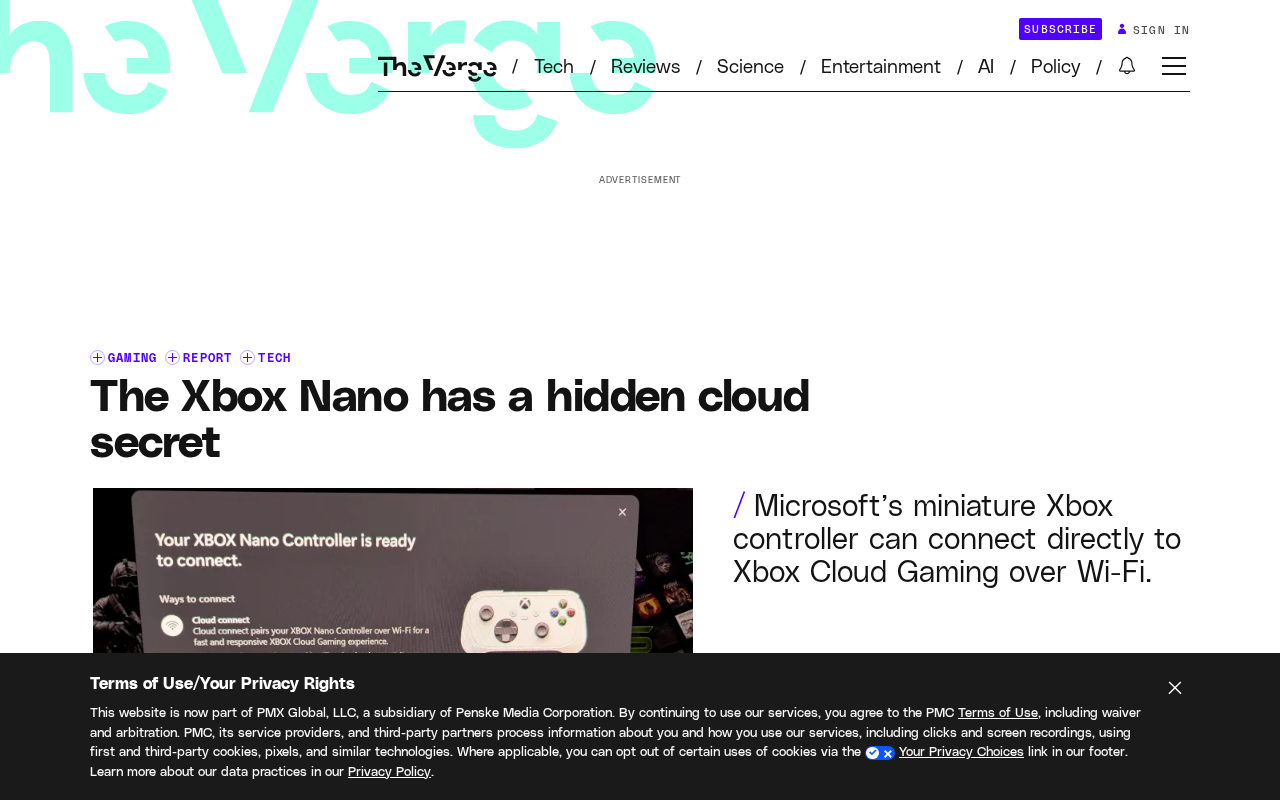
Microsoft's upcoming Xbox Nano controller hides an unannounced secret: it can connect directly to Xbox Cloud Gaming over Wi-Fi, reducing latency. Microsoft has not officially announced this feature, but observers predicted its existence as early as this year when the Xbox Nano leaked.
The cloud gaming latency problem and the controller's potential fix
One of the core bottlenecks in cloud gaming is input latency—the lag between pressing a button and seeing the response on screen. In the traditional setup, the controller first connects to a local device (phone, PC, or TV box) via Bluetooth or a proprietary protocol, and that device then communicates with the cloud server over the network. This chain adds an extra local hop that can introduce additional latency.
The Xbox Nano is said to support communicating directly with Xbox Cloud Gaming servers over Wi-Fi, skipping the local-device relay. If true, this means the controller's input signal can reach the cloud more directly, theoretically shortening response time. For latency-sensitive genres like racing and fighting games, this improvement could produce a noticeable difference in experience.
What makes up input latency: End-to-end latency in cloud gaming typically consists of several parts—transmission time from controller to local device, processing and encoding time on the local device, network round-trip time (RTT), cloud rendering and encoding time, and video stream decoding and display time. Network RTT often accounts for the largest share, but the local relay in the input path is not negligible either. Bluetooth typically adds latency in the tens of milliseconds, 5GHz Wi-Fi is usually lower than Bluetooth, and proprietary wireless protocols (such as Xbox Wireless) each perform differently. A controller connecting directly to cloud gaming servers essentially changes "input → local device → cloud" to "input → cloud," eliminating the relay and queuing time of the local device—but it also means the controller must bear the stability and power cost of the Wi-Fi connection itself.
Microsoft's cloud gaming hardware strategy
Microsoft has been doubling down on cloud gaming in recent years. Xbox Cloud Gaming already covers a wide range of devices, but input latency remains a key variable affecting the experience. The Xbox Nano's hidden feature reflects Microsoft's search for optimization at the source of the network path—not simply improving server performance or codec efficiency, but redesigning the transmission path of the input signal.
This approach is consistent with Microsoft's previous hardware strategy: compensating for the shortcomings of general-purpose devices with dedicated hardware. The Xbox Nano itself is a compact, portable controller, and if the direct cloud gaming connection is officially confirmed, it will further strengthen its positioning as a "cloud gaming accessory."
Xbox Cloud Gaming's tech stack: Xbox Cloud Gaming (formerly xCloud) runs games on custom Xbox Series X hardware in Microsoft Azure data centers, then pushes them to clients as video streams. Its experience depends on Microsoft's globally deployed server nodes and edge network; client-side codec capability, network jitter, and packet loss all directly affect smoothness. Because server location and network path are key latency variables, any design that shortens the signal path—including letting the controller bypass the local device—could yield marginal gains. It's worth noting that cloud gaming platforms typically have strict authentication and session management mechanisms for input protocols. If the controller connects directly, it needs built-in authentication and pairing processes, which is where the difficulty of implementing this feature lies.
Uncertainty behind the lack of an official announcement
The feature has not yet been confirmed by Microsoft. The original report noted that this is a feature the author had been anticipating since the early Xbox Nano leaks, but official information is still missing. This leaves several open questions: Will the direct Wi-Fi feature be enabled at launch? Does it require a specific network environment or subscription tier? How does it affect battery life and connection stability in non-cloud-gaming scenarios?
Until official details are released, these questions have no answers. But one thing is certain: a controller connecting directly to cloud gaming represents a hardware design direction worth watching—pushing network connectivity down into the input device itself rather than relying on a relay device.
What it means for players
For cloud gaming users, the potential value of this feature lies in simplifying the chain and reducing latency. But the actual effect depends on network conditions, server distance, and Microsoft's specific implementation. If the Xbox Nano's direct-connect feature works reliably, it could become a more attractive controller choice for cloud gaming; conversely, if the feature is limited or the experience is unstable, it will be more of a marketing highlight.
The Xbox Nano officially launches tomorrow, when more details are expected to surface. Whether Microsoft will reveal this hidden feature at the same time is worth watching.
One-line Summary
Xbox Nano controller reportedly connects directly to Xbox Cloud Gaming over Wi-Fi, skipping the local-device relay to reduce input latency.
Paragraph Summary
The article reveals that Microsoft's upcoming Xbox Nano controller has an unannounced feature: it can connect directly to Xbox Cloud Gaming servers over Wi-Fi, skipping local relay devices such as phones, PCs, or TV boxes, thereby shortening the path for input signals to reach the cloud and theoretically reducing cloud gaming latency. The article analyzes the latency pain points of the traditional cloud gaming input chain and notes that this design reflects Microsoft's hardware approach of optimizing the cloud gaming experience from the source of the input chain, consistent with its dedicated-accessory strategy. However, the feature has not been officially confirmed, and details such as whether it will be enabled at launch, network requirements, and battery impact remain unclear. The Xbox Nano launches tomorrow, when more information may be revealed.
Related articles

AI Tools Quietly Altering Settings: Postman Silently Installs Plugin, Codex Sharing Option Auto-Resets
AI Daily reports: Postman silently installs a Mac plugin and self-approves startup hooks, logged as auto-existing upgrade; Hacker News developers say Codex data-sharing opt-out flips back. Plus Simon Willison's raw float weight experiment with QEN 3.8-27B.

AI Learns to Rewrite AI: MIT's "Weightspace Programming" Redraws the Path to Recursive Self-Improvement
MIT team proposes weightspace programming: GPT-6 Astra reads and edits AI model weights directly. Math scores jump several-fold, hand-written networks beat trained models. Eight experiments analyzed, plus Anthropic's same-day warning and the real boundaries of recursive self-improvement.

Running Qwen 3.8 on a Laptop to Read Raw Weights: 46 Minutes Per Answer
Simon Willison reproduced weight space programming with Qwen 3.8 27B on a laptop: a 17GB model file, 46 minutes per answer, 43,506 reasoning tokens, Pong over an hour, Freeway failed. Suited for interpretability researchers.