Xbox Officially Announces Wolfenstein 3, MachineGames Returns to the Series

Xbox announces MachineGames-developed Wolfenstein 3, nearly a decade after the last entry, with details still unknown.
Xbox has officially announced Wolfenstein 3, developed by Bethesda's MachineGames, nearly ten years after Wolfenstein II: The New Colossus. No release date, platforms, or gameplay details were disclosed, but as an Xbox first-party title it is widely expected to launch on Game Pass. Coming just days after Bethesda confirmed The Elder Scrolls VI: Sentinel, the announcement highlights Xbox's dense IP marketing cadence. For now, the reveal only confirms the project is real; future trailers and gameplay will be key to judging its progress.
After Nearly a Decade, Xbox Officially Announces Wolfenstein 3
According to an RSS source, Xbox today officially announced Wolfenstein 3, which will be developed by Bethesda-owned studio MachineGames. Nearly ten years have passed since the release of the series' previous mainline entry, Wolfenstein II: The New Colossus, and this announcement marks a new chapter for the classic first-person shooter franchise.
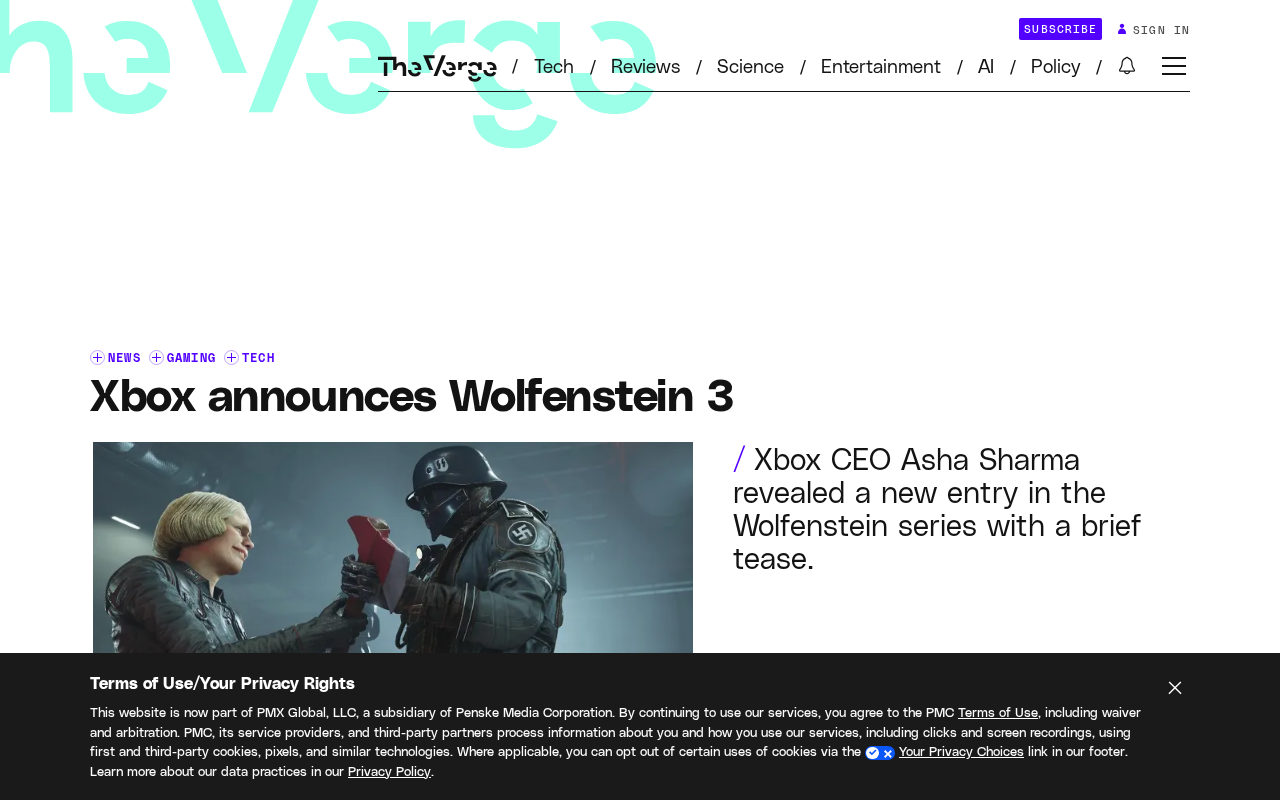
The source did not disclose a specific release date or platform details, but as a title from an Xbox first-party studio, it is widely expected to launch on Game Pass at release.
MachineGames' Return and the Series' Direction
After releasing Wolfenstein II: The New Colossus in 2017, MachineGames shifted its focus primarily to new projects such as Indiana Jones and the Great Circle. Its return to the Wolfenstein series indicates that Xbox is reactivating Bethesda's classic IP assets.
The Wolfenstein series is known for its alternate-history setting and fast-paced shooting experience, and the story of protagonist BJ Blazkowicz left clear room for a sequel at the end of the second game. There is currently no official information on how the new title will continue the narrative or whether it will introduce new gameplay mechanics.
The history of the Wolfenstein series dates back to the 1981 Apple II game Castle Wolfenstein, and 1992's Wolfenstein 3D is widely regarded as one of the founding works of the modern first-person shooter genre. The series saw a reboot in 2009, but it was MachineGames' 2014 release Wolfenstein: The New Order and 2017's The New Colossus that truly established the current narrative framework. The latter is set in an alternate 1960s where Nazi Germany won World War II, with protagonist BJ Blazkowicz leading a resistance movement against the totalitarian regime. This alternate-history worldview and its strong political metaphors are the series' signature traits that distinguish it from other shooters.
A Coordinated Rhythm with the Elder Scrolls 6 Announcement
One detail worth noting: the reveal of Wolfenstein 3 comes just days after Bethesda confirmed that the next Elder Scrolls title will be named The Elder Scrolls VI: Sentinel. Announcing new developments for two heavyweight IPs in quick succession shows Xbox's dense content marketing cadence.
This string of moves also reflects that Xbox's integration of Bethesda's studios is entering a productive phase. From shooters to role-playing games, Xbox is trying to strengthen its first-party content lineup through sequels to classic IPs.
Game Pass is Microsoft's game subscription service, where players pay a monthly fee to access hundreds of games in the library, and titles from Microsoft's first-party studios are typically added on day one. This strategy is seen as one of Xbox's core competitive advantages over Sony's PlayStation. That is precisely why, in the absence of official platform information, observers widely speculate that Wolfenstein 3 will follow the precedent of first-party titles such as Halo, Forza, and Starfield by launching into the library on day one. However, Microsoft has also been adjusting its strategy in recent years, and whether some titles will launch simultaneously remains uncertain, so this expectation is still speculation rather than a settled fact.
Limited Information, Players Should Keep Expectations Realistic
At present, the only public information about Wolfenstein 3 is that it has been "officially announced"; there is no gameplay footage, release window, or platform list. Given the development cycle of AAA shooters, players may need to wait a long time before seeing substantive content.
For players following the series, this announcement at least confirms that the project genuinely exists rather than remaining stuck in the rumor stage. The eventual official trailer and gameplay showcase will be the key moments for judging its level of completion.
One-line Summary
Xbox officially announces MachineGames-developed Wolfenstein 3, nearly a decade after the previous entry, with details still unavailable.
Paragraph Summary
Xbox has officially announced Wolfenstein 3, developed by Bethesda-owned MachineGames, nearly ten years after the previous mainline entry Wolfenstein II: The New Colossus. The source did not disclose a release date, platforms, or gameplay details, but as an Xbox first-party title, it is widely expected to launch on Game Pass at release. The announcement comes just days after Bethesda confirmed the title The Elder Scrolls VI: Sentinel, highlighting Xbox's dense IP marketing cadence and showing that its integration of Bethesda's studios is entering a productive phase. For players, this reveal only confirms that the project genuinely exists; future trailers and gameplay showcases will be key to judging its completion.
Related articles

From 0 to 1: Vibe Coding an AI Knowledge Base — A Practical Retrospective and Tech Stack Breakdown
A retrospective on building the AI knowledge base OilBook from scratch with Vibe Coding: Next.js+Neon stack, Oil Dev Skill workflow, Stripe paywall security, interview-style writing, AI-flavor control, and Vercel deployment.

GLM-5.4 Hands-On: Native Vision Meets a New Vibe Coding Workflow
Hands-on with Zhipu GLM-5.4: native vision tested across a 3D product demo, pure-code video generation, and remote-control Vibe Coding, compared with GPT-6.2 and Gemini Neon.

AI and Humans Claim to Prove the Riemann Hypothesis: Machine-Verified, Yet Nobody Can Understand It
Anthropic mathematician and AI Claude claim to prove the Riemann Hypothesis with 17 million lines of Lean code, machine-verified but unreadable by humans. This article analyzes the event, the zero proportion record from 41.6% to 67.2%, and the gap between machine verification and human understanding.