Xiaodu Health Screen Review: How an AI Large Model Enhances Companionship and Remote Care for the Elderly
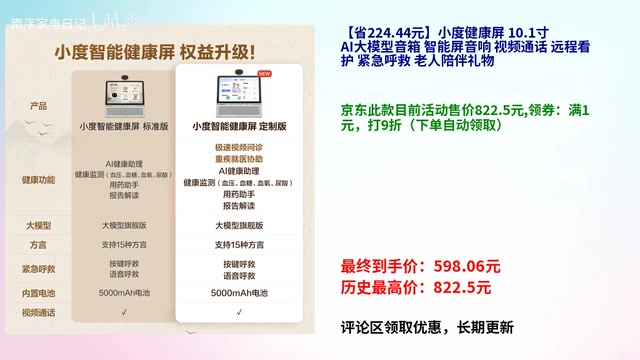
Xiaodu Health Screen: an AI large-model smart display designed for elderly companionship and remote care.
The Xiaodu Health Screen is a 10.1-inch AI smart display built for the elderly, integrating a large language model for natural chat, one-touch emergency calling, and remote video monitoring. Powered by a hybrid cloud architecture and RLHF-tuned companionship, and priced as low as ~598 yuan with national subsidies, it's a practical gift for children caring for aging parents.
An AI-Powered Smart Display Designed Specifically for the Elderly
As large model technology reaches the consumer market, smart speakers are evolving from simple voice assistants into more vertically specialized applications. A Large Language Model (LLM) is a deep neural network trained on massive amounts of data, represented by GPT, ERNIE Bot, Kimi, and others. At its foundation lies the Transformer architecture proposed by Google in 2017—an architecture that, through its "Self-Attention mechanism," enables models to capture long-range dependencies between words when processing language. It serves as the technical foundation for virtually all mainstream large language models today.
Specifically, the Transformer's self-attention mechanism overcame the bottleneck of earlier RNNs (Recurrent Neural Networks), which could only process sequences sequentially: it allows the model, when processing each word, to simultaneously "see" the semantic weight of all other words in the sentence, thereby establishing semantic associations across long distances. For example, when an elderly person says, "That... you know, that medicine I told you about earlier," the model can trace back through the context to understand what "that" refers to, without forgetting due to the long gap between pieces of information. This capability is especially critical for understanding the colloquial and fragmented ways elderly people express themselves. Parameter counts typically range from billions to hundreds of billions—the larger the parameter count, the stronger the model's ability to understand complex contexts, but the computational demand also grows exponentially. Since 2023, such technologies have accelerated their penetration from the laboratory into consumer hardware, enabling devices to truly "understand" users' non-standardized colloquial expressions rather than relying on fixed keyword triggers. The Xiaodu Health Screen is a product of this trend—using a 10.1-inch extra-large display as its carrier, it deeply integrates AI large model capabilities with elder-care scenarios such as remote monitoring and health companionship, aiming to address the communication and companionship challenges the elderly face in the digital age.
Unlike traditional smart speakers, this product's core positioning is neither "entertainment" nor "smart home hub," but rather revolves around the clear need to "accompany the elderly." Behind this lies a clear demographic driving force: China's population aged 60 and above has exceeded 290 million, with the proportion of elderly people living alone or in empty nests continuously rising, giving rise to rigid demands such as remote care and health monitoring. According to iResearch's forecast, China's silver economy market will surpass 20 trillion yuan around 2030, becoming an incremental battleground that consumer electronics brands are vying to enter.
Notably, the rise of China's silver economy is driven not only by demographic structure but also strongly supported by a series of policy frameworks. Since 2020, the Ministry of Industry and Information Technology (MIIT) has been promoting the age-friendly (aging-adaptation) transformation of internet applications, explicitly requiring larger fonts, simplified operation processes, and reduced interaction layers, while incorporating age-friendliness standards into the app listing review system. In 2021, the MIIT released the "Special Action Plan for Age-Friendly and Barrier-Free Transformation of Internet Applications," bringing an initial batch of 115 websites and 43 apps into the scope of transformation, with specific metrics such as fonts no smaller than 16px, key operation steps not exceeding 3, and prohibition of mandatory complex CAPTCHAs. In 2023, the State Council further issued "Opinions on Developing the Silver Economy to Enhance the Welfare of the Elderly," defining and planning the "silver economy" as an independent economic form at the national level for the first time, covering subdivided sectors such as smart health care for the elderly and age-friendly smart terminals.
From a global perspective, aging-in-place technology has already formed mature systems in Japan, Europe, and the United States. Since 2015, the Japanese government has promoted a national "care robot" strategy, incorporating AI companion devices into the coverage of long-term care insurance (介護保険). The U.S. Consumer Technology Association (CTA) has established a dedicated "aging technology" product certification standard, with evaluation dimensions covering cognitive load, visual accessibility, and emergency response efficiency. China's age-friendly policy evolution has drawn on these experiences but places greater emphasis on promoting the widespread adoption of consumer hardware through standardized, large-scale means. This policy evolution has gradually transformed "age-friendliness" from an early accessibility-oriented public welfare attribute into a commercially viable direction for product differentiation. The 10.1-inch large screen is a typical case of translating this policy orientation into product language. A larger display area means clearer video images and more readable interface text, effectively lowering the usage barrier for the elderly, while also representing an industry microcosm of smart hardware shifting from "pursuing feature richness" to "focusing on the experience of specific demographics."
Core Features: Remote Monitoring and Emergency Calling
For children who live far away and cannot always accompany their parents, this product's most valuable features center on remote monitoring. Through video calls, children can talk face-to-face with elderly family members at any time. More importantly, there is the one-touch emergency call feature—when the elderly encounter a sudden situation, they can immediately initiate a call for help. Amid the growing number of elderly people living alone, this feature carries strong practical significance. Data from the Ministry of Civil Affairs shows that China's elderly population living alone has exceeded 26 million, with falls and sudden cardiovascular and cerebrovascular diseases being the main causes of accidental death among these individuals. The one-touch emergency call feature uses a preset list of emergency contacts to simultaneously send location and video requests to multiple family members via the most simplified interaction path (a single button press or voice wake-up), even when the elderly person cannot operate a phone normally, significantly shortening the emergency response time window.
From the perspective of Human-Computer Interaction (HCI) design theory, the core value of the one-touch emergency call feature lies in compressing "cognitive load" to the extreme. Cognitive load theory, proposed by psychologist John Sweller in 1988, refers to the total amount of information the brain must process when completing a task. For elderly people in a stressful state (falling, chest pain), their momentary cognitive resources drop dramatically, making multi-step operations nearly impossible to complete. The single-button design compresses the decision chain from "find phone → unlock → find contact → dial" into the single action of "pressing a button," achieving a "zero cognitive load" emergency response path from an engineering standpoint.
Companionship Experience Upgraded by the AI Large Model
Being equipped with an AI large model is the core highlight that distinguishes the Xiaodu Health Screen from the previous generation of smart displays. Compared with traditional voice assistants that can only execute fixed commands, the conversational ability powered by a large model is more natural and continuous, capable of understanding the more colloquial and non-standardized ways elderly people express themselves.
On the technical level, the device typically adopts a hybrid architecture of "cloud-based large model + local wake-up." The local end usually employs a lightweight neural network based on Keyword Spotting (KWS). Representative solutions include TinyML models running on ARM Cortex-M series MCUs, with power consumption controllable at the milliwatt level, enabling 24-hour standby monitoring. Wake-word detection can respond without network connectivity, keeping the false wake-up rate and response latency at the millisecond level.
TinyML (Tiny Machine Learning) is a specialized research direction that has emerged in recent years, with the core goal of deploying neural network inference capabilities on microcontrollers (MCUs) that have only hundreds of KB of memory and extremely limited computing power. Its main technical approaches include model quantization (compressing 32-bit floating-point parameters into 8-bit or 4-bit integers), model pruning (removing neuron connections with low contribution to the output), and knowledge distillation (using the "soft labels" of a large model to train a small model). Google's TensorFlow Lite Micro and Arm's CMSIS-NN library are currently the mainstream TinyML deployment frameworks, widely applied in scenarios such as smart speakers, wearable devices, and industrial sensors. In voice wake-up scenarios, TinyML models typically only need to recognize a fixed wake word of 3-5 syllables (such as "Xiaodu Xiaodu"), and the model's parameter count can be compressed to a few hundred KB—enough to achieve several inferences per second on low-power chips while maintaining an extremely low false wake-up rate.
Once the wake word is confirmed, the device transmits the audio stream in real time to the cloud via WebSocket or gRPC protocols, where a large model deployed on GPU server clusters completes the full pipeline of ASR (Automatic Speech Recognition), NLU (Natural Language Understanding), and NLG (Natural Language Generation), then sends the text or speech back to the local device for playback. The core challenge of this architecture lies in network latency management—the ideal conversational response time should be kept within 800 milliseconds, and once it exceeds 1.5 seconds, users will experience a noticeable lag. To address this, mainstream vendors deploy inference acceleration services at edge nodes close to the user and use Streaming Output technology to achieve "generate-while-broadcasting," further compressing perceived latency.
Edge inference acceleration relies on the evolved form of the CDN (Content Delivery Network)—the Edge Computing Node. Unlike traditional CDNs, which mainly cache static content, edge computing nodes have real-time inference capabilities and can complete part of the AI computation tasks at the network access point closest to the user (typically within 100 kilometers physically). For voice conversation scenarios, this means that latency-sensitive steps such as ASR (speech-to-text) can be completed at the edge node, while compute-intensive tasks such as semantic understanding and answer generation continue to be processed on centralized GPU clusters. The coordination of the two can compress end-to-end latency from over 800ms in a centralized solution to around 400ms. This architecture strikes an engineering balance between computing cost and interaction experience, and it is also the mainstream technical route for current consumer-grade AI hardware.
This "can chat" characteristic provides a degree of emotional comfort for elderly people who lack daily companionship. Research from the MIT AgeLab shows that regular conversational interaction—whether with a person or an AI—can, to a certain extent, activate the language centers and cognitive functions of the elderly, slowing the progression of Mild Cognitive Impairment (MCI). A tracking study by East China Normal University targeting elderly communities in Shanghai also found that elderly people who engaged in more than 10 minutes of meaningful conversation daily experienced about 18% slower decline in memory tests compared with the control group.
Of course, the boundaries of AI emotional companionship also require a clear-eyed understanding. The core of realizing this capability lies in RLHF (Reinforcement Learning from Human Feedback) technology: its training process is divided into three stages—first, supervised pre-training is completed on massive amounts of text to acquire basic language capabilities; second, human annotators rank the model's multiple output results by preference, training a "Reward Model" to quantify answer quality; finally, reinforcement learning algorithms such as PPO (Proximal Policy Optimization) are used to continuously iterate the language model's generation strategy toward higher rewards.
In actual annotation work, RLHF annotation guidelines for elderly companionship scenarios usually establish a set of dedicated evaluation dimensions that differ significantly from those of general-purpose conversational assistants. For example, when an elderly person repeatedly asks the same question, the optimal strategy for a general assistant might be to briefly point out "you just asked this question," but the annotation standards for elderly companionship scenarios would mark "gently answering again without mentioning the repetition" as the higher-scoring response—because memory decline is a common physiological characteristic of the elderly, and any expression implying "you forgot" could cause psychological frustration. Similarly, stylistic features such as a slower speech pace, shorter sentences, and more use of confirmatory feedback ("Okay, I heard you") all receive higher preference scores in elderly-scenario annotation, thereby guiding the reward model and the final language model to converge in this direction. OpenAI first systematically disclosed the general technical route of RLHF in the InstructGPT paper (2022), which subsequently became a standard component of the training processes for mainstream models such as GPT-4, Claude, and ERNIE Bot. It must be made clear that RLHF essentially optimizes the model's "expression style" to better align with human preferences, rather than granting the model genuine emotional experience—it does not make the machine "feel emotions," but rather simulates empathetic expression through natural language generation capabilities. The lack of genuine emotional feedback, dependence on network stability, and the psychological acceptance among elderly users of "chatting with a machine" are all challenges that must be faced squarely in practical use.
AI companionship cannot replace true companionship from family, but as an effective supplement, it can indeed reduce the loneliness of the elderly. This is also the most noteworthy differentiated value of the product.
Price and National Subsidy Analysis: Final Price as Low as 598 Yuan
From a pricing standpoint, this product currently offers strong value for money.

The product's original price is 822.5 yuan, and multiple discounts can substantially lower the actual payment amount. Specific discount paths include: a coupon offering a 10% discount on orders over 1 yuan, stacked with the national home appliance subsidy (which can reach 15% to 20% in some regions).

The national subsidy (national home appliance subsidy) is an important policy dividend for such products at present. To understand this policy, one must trace its historical evolution: the national home appliance subsidy policy dates back to the "Home Appliances to the Countryside" program launched by the Ministry of Commerce in 2007, whose core logic was to activate the rural consumer market through fiscal subsidies and stimulate the absorption of domestic home appliance industry capacity. Against the backdrop of the 2009 financial crisis, the policy expanded into a "trade-in" scheme applicable to both urban and rural areas, binding the recycling of old appliances with subsidies for purchasing new ones, simultaneously achieving the dual policy goals of stimulating consumption and recycling used appliances. This dual-goal policy design logic has been carried forward in every subsequent round of home appliance subsidy policies, and has gradually expanded into new dimensions such as carbon reduction (promoting the replacement with high-energy-efficiency products).
The new round of national subsidy policy launched in 2024 (officially the "Large-Scale Equipment Renewal and Consumer Goods Trade-In Program") is the largest in scale to date, with the central government allocating over 150 billion yuan in special funds and expanding the subsidized categories significantly from traditional home appliances to digital products such as smartphones, tablets, and smart wearables. The reason smart display products were included on a large scale for the first time lies in their dual attributes as both a "display terminal" and a "smart home gateway," which highly align with the policy's goals of boosting domestic demand and promoting consumption upgrades.
This policy is jointly led by the Ministry of Commerce and the Ministry of Finance, implemented through a two-tier funding mechanism of "central subsidy + local matching." In terms of the subsidy verification mechanism, major e-commerce platforms such as JD.com, Tmall, and Suning have completed integration with the Ministry of Commerce's system, achieving a fully online closed-loop process of "automatically verifying eligibility when users place orders, and instantly deducting the subsidy from the payment amount," without requiring users to file claims afterward, significantly lowering the threshold for receiving subsidies.
The technical implementation of this online verification system involves data interconnection among multiple parties: the e-commerce platform must call the Ministry of Commerce's "national subsidy verification system" API in real time, query the user's subsidy eligibility and used quota using the user's real-name identity information (phone number/ID card), automatically deduct the subsidy amount at the payment stage after eligibility verification, and synchronously send the transaction record back to the government system to complete verification registration. The establishment of this mechanism has made the online payout rate of the 2024 national subsidy far higher than the offline store stamp-and-declare method that was relied upon in the 2009 "trade-in" era, greatly improving the efficiency of policy implementation. Calculating with a 20% subsidy strength, this alone can save over 160 yuan. It should be noted that the national subsidy policy has significant regional differences—fiscally affluent provinces such as Beijing, Shanghai, and Guangdong usually stack an additional 5%-10% local subsidy, while some central and western provinces, limited by fiscal pressure, only implement the central standard, with subsidy ratios ranging from 10% to 20%. There may also be situations such as regional quotas being exhausted or category restrictions, so it is recommended to consult customer service before purchasing to confirm the local subsidy amount and application method.

In addition, an extra 30 yuan rebate can be stacked via the 1-yuan pre-order link. After combining all discounts, the final price can be as low as 598.06 yuan, saving about 224 yuan compared with the original price of 822.5 yuan, nearly a 30% reduction. For a product integrating a 10.1-inch large screen, an AI large model, and remote monitoring features, this price point offers a fairly low entry barrier.
Who Should Buy It?
Overall, the target users of the Xiaodu Health Screen are very clear:
- Children with parents living far away: those who wish to achieve remote care and daily companionship through technology
- Families concerned about the safety of elderly living alone: those who need to add a layer of emergency-call protection for their elders
Its attribute as a "practical gift" is equally prominent—compared with ordinary holiday gifts, this type of product, which combines functional value with emotional warmth, better reflects the thoughtfulness of children.
Of course, a rational assessment is also needed before purchasing. Although the AI companionship feature has made significant progress, it still plays a supporting role; remote monitoring also depends on a stable network environment and the elderly person's acceptance of the device. For very elderly people who are entirely unaccustomed to smart devices, children may need to patiently guide them in the early stages, assisting with initial setups such as account binding and network configuration.
It is worth noting that brands like Xiaodu have already launched a "simple mode" for age-friendly scenarios—in this mode, the screen displays only 4 to 6 core function entries such as video calls, emergency calling, and weather reports, with icon sizes enlarged to more than twice those of the regular interface, effectively reducing the cognitive burden and probability of misoperation for very elderly people. From a product design perspective, the essence of this mode is switching "Information Architecture" from prioritizing feature completeness to prioritizing cognitive accessibility—sacrificing the visibility of some features in exchange for the absolute usability of core functions. This is a mature design strategy validated through extensive user research when targeting special user groups with varying cognitive abilities.
Conclusion
The Xiaodu Health Screen represents a positive exploration of smart hardware in the direction of age-friendliness. It does not pile on flashy specifications but focuses on the real pain points of the elderly—communication, monitoring, and companionship. From a technical standpoint, a large model based on the Transformer architecture powers natural conversation, a conversational style fine-tuned via RLHF simulates emotional companionship, and a hybrid cloud architecture (TinyML local wake-up + edge computing acceleration + centralized large-model inference) enables smooth responses. Together with the age-friendly design of the 10.1-inch large screen, these constitute the product's core competitiveness. With the national subsidy dividend stacked on top, the final price of around 600 yuan gives this AI smart display for the elderly considerable purchasing value. For users concerned about the daily safety and emotional companionship of elderly family members, this is a choice worth seriously considering.
Key Takeaways
Related articles

Felix Rieseberg Personal Homepage
Felix Rieseberg's personal homepage sparks attention on Hacker News. This article covers the Slack engineer's technical background, the rise and fall of nativefier, and the value of a developer homepage as a tech calling card.

@ai-sdk/vue 3.0.306 Patch Release Syncs with [email protected] Update
@ai-sdk/vue 3.0.306 released, synced with [email protected]. A routine patch release for the Vercel AI SDK ecosystem with no public API changes; the Vue adapter layer stays version-aligned with the core package.

Gemini 4 Argon API Launches: The Era of Million-Token Output Begins
Google launches Gemini 4 Argon with sparse MoE architecture, up to 1M output tokens, and a 68.90% Vals Index score, available across API, AI Studio, and the Gemini app.