Xiaomi 18 Pro Rear Screen Review: The Dual-Screen Design Is Still a Gimmick

Xiaomi 18 Pro's rear screen debuts overseas, but dual-screen interaction lacks continuity and sees limited use.
Xiaomi 18 Pro and Pro Max bring the rear-screen design to overseas markets for the first time, and the author tests whether it's more useful than before. Meant to solve rear-camera selfie framing and face-down notification checks, both scenarios have limited triggers. The rear screen costs internal space and strains structure, cooling, and battery life while splitting interaction. Unlike foldables' continuous single-screen expansion, it's two independent screens requiring attention switching, which cancels out the convenience. It's a commendable experiment, but screen count doesn't equal a better experience—continuity is key.
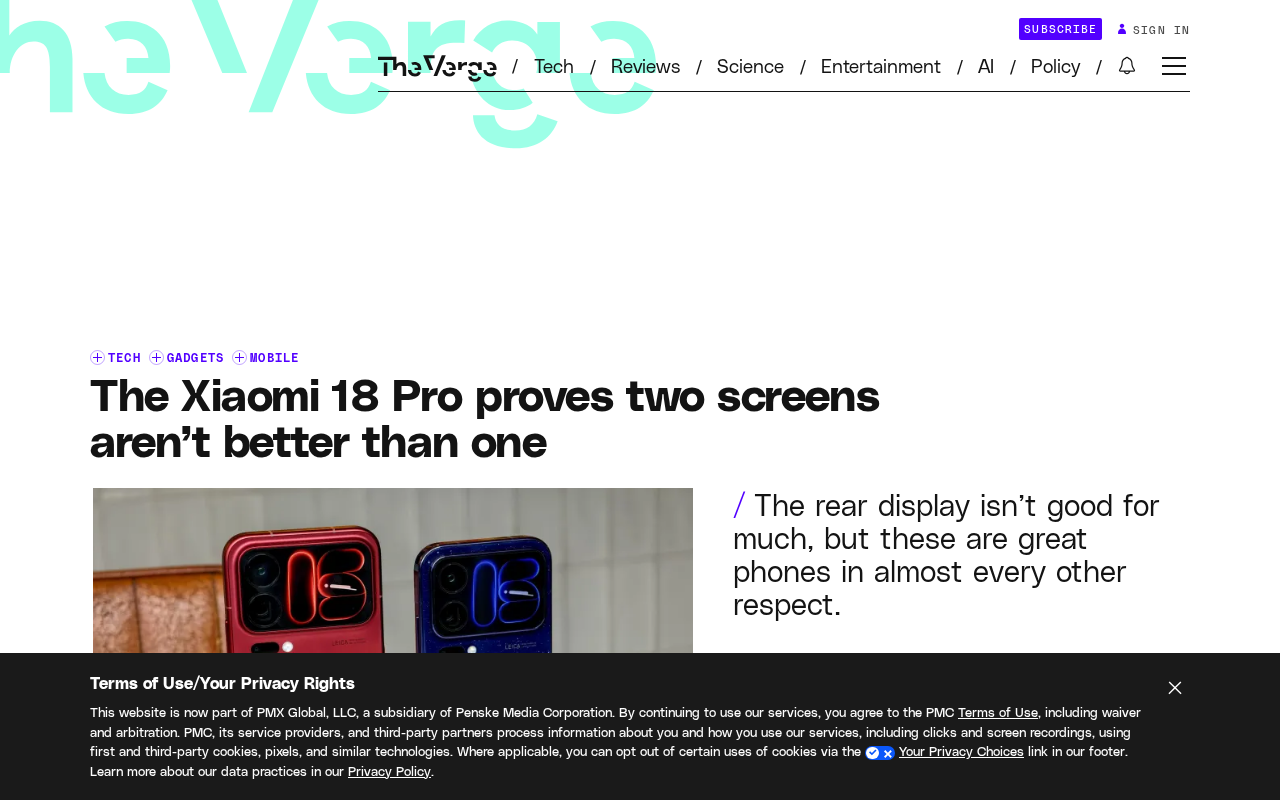
Xiaomi first added a rear screen to its flagship phones with the previous-generation 17 Pro series, but it never sold those devices outside China. That makes the all-new Xiaomi 18 Pro and Pro Max my first real opportunity to test whether a screen on the back of a phone is any more useful today than it was in the past.
The Original Intent: From Selfies to Notifications
From a product-logic standpoint, the reasoning behind the rear screen isn't hard to grasp. It tries to solve two pain points: first, when taking selfies with the rear main camera, the rear screen can serve as a viewfinder; second, when the phone is placed face-down, the rear screen can display notifications, the time, and other lightweight information, reducing how often you need to flip the phone over.
These scenarios sound reasonable, but in practice their trigger conditions are quite limited. Selfie framing is a genuine need, yet most users don't frequently shoot selfies with the rear camera. Notification display faces an awkward problem: when the phone is face-up, the main screen itself is the better information entry point.
Technically, the rear screen typically uses a small OLED or AMOLED panel that runs in parallel with the main screen through an independent display driver. Because the rear screen is small and relatively low-resolution, its power draw per illumination isn't high, but frequent wake-ups still add up. More notably, the rear screen requires extra flex cables, driver ICs, and a glass cover, all of which eat into the already limited internal stacking space. Manufacturers often have to redesign the motherboard layout, antenna positions, and battery shape just to make room for the rear screen. The engineering cost of the rear screen therefore goes far beyond a single panel—it triggers a system-wide adjustment to the entire device structure.
The Real Cost of Dual Screens
The rear screen isn't free. It occupies space on the back of the device and imposes additional requirements on structural design, heat dissipation, and battery life. With flagship phones already tight on internal space, a secondary screen that isn't used often means other components may have to compromise.
More critically, there's a split at the interaction level. Users need to build new habits around two screens, and the system doesn't give them a strong enough reason to actively use the rear screen. When the main screen can already handle the vast majority of tasks, the rear screen feels more like an add-on feature than an extension of the core experience.
Heat dissipation is the most underestimated cost of a dual-screen design. A flagship phone's high-performance chip generates a lot of heat under full load, which is normally conducted outward through the vapor chamber and large-area graphite sheets on the back of the device. The rear screen and its cover obscure part of the heat-dissipation path, forcing manufacturers to adjust the vapor chamber's routing or even sacrifice some cooling area. At the same time, the thickness of the rear-screen module itself compresses battery space—in a flagship market where battery life is fiercely competitive, that means either reducing battery capacity or increasing body thickness. Structurally, the rear screen also requires extra cushioning layers and sealing to meet drop and water/dust resistance requirements, further raising the design complexity of the whole device.
Why "Two Screens" Didn't Become "Better to Use"
Looking at the industry, dual-screen phones aren't a new concept. Manufacturers have tried front-plus-back screen combinations before, but market feedback has generally been lukewarm. The core reason is that a phone's core interaction has always revolved around one hand and the primary field of view; the rear screen is naturally outside your line of sight and requires an extra action to reach.
This is different from the logic of foldables. A foldable expands display area on the same screen, so the interaction is continuous; the rear screen is two independent screens, and users have to switch attention between them. That switching cost cancels out the convenience the rear screen offers.
From a human-computer interaction perspective, the rear screen faces an "attention-switching cost" problem. The main screen sits within the user's natural line of sight, so hand and eye stay coordinated during operation; the rear screen is on the back of the device, so users must flip the phone or adjust their grip to see it—a process that interrupts the mental flow of the current task. "Task-switching cost" in cognitive psychology shows that frequently switching between two information sources significantly reduces efficiency, even if each switch only takes an extra second or two. The rear screen's convenience only holds when the switching cost is lower than the benefit it provides, and in lightweight scenarios like checking notifications or framing selfies, that condition is hard to meet consistently.
A Commendable Attempt, But Not the Direction
The rear screen on the Xiaomi 18 Pro isn't without value. It does offer convenience in specific scenarios, and it demonstrates Xiaomi's willingness to explore industrial design. But in terms of the overall experience, it feels more like an experiment worth respecting than a direction that should become mainstream.
For consumers, the novelty of the rear screen will fade quickly, and what really determines usage frequency is still the main screen experience. For the industry, Xiaomi's attempt once again shows that the number of screens doesn't equal a better experience—interaction continuity is what matters.
One-line Summary
Xiaomi 18 Pro's rear screen reaches overseas markets for the first time, but dual-screen interaction lacks continuity and sees limited use.
Paragraph Summary
Xiaomi 18 Pro and Pro Max bring the rear-screen design to overseas markets for the first time, and the author uses the opportunity to test whether the rear screen is more useful than before. Its original intent was to solve two pain points—rear-camera selfie framing and checking notifications when the phone is face-down—but both scenarios have quite limited trigger conditions. The rear screen isn't free: it takes up internal space, imposes extra requirements on structure, heat dissipation, and battery life, and creates a split at the interaction level. Unlike foldables, which continuously expand display area on a single screen, the rear screen is two independent screens, and users must switch attention between them, with the switching cost canceling out the convenience. The author sees the rear screen as an experiment worth respecting, but the number of screens doesn't equal a better experience—interaction continuity is what matters.
Related articles

Braised Meat Shop Forced Out by Rent Hike: A Life-and-Death Contest Between Craft and Location
Braised meat shop owner forced out by a 100,000 yuan rent hike moves overnight; landlord's daughter takes over with seasoning packets and overnight meat sickens customers. A tale of location versus craft.

AI One-Click Emotional Short Drama: Bilibili Creator Tests the "Beautiful Landlady" Script
Bilibili creator uses AI to produce the emotional short drama "The Beautiful Landlady Comes to Fix the Guy's Drain," testing everything from script generation to character consistency.

Braised Meat Stall Goes Viral, Landlord Raises Rent—She Leaves Gracefully by Contract While Rival Cuts Corners and Loses Everything
A braised meat stall's rent was hiked from ¥68K to ¥168K after going viral; the owner moved out by contract while her rival cut corners and lost it all.