Xiaomi MiMo V2.5 Pro In-Depth Review: Comprehensive Testing of Code, 3D, and SVG Generation Capabilities
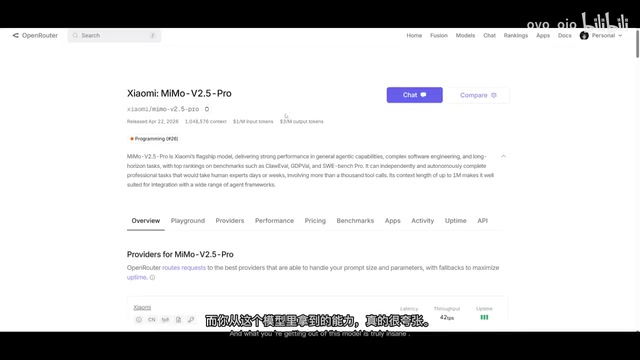
Xiaomi's open-source MiMo V2.5 Pro rivals top closed-source models in performance.
Xiaomi has released MiMo V2.5 Pro, an open-source MoE large language model with 1.2 trillion total parameters and 42 billion active parameters, supporting a 1 million token context window. The model competes directly with GPT-5.4 and Claude Opus 4.6 on benchmarks like SWE-Bench, is fully open-sourced under the MIT license, offers highly competitive API pricing, and consumes 40%-60% fewer tokens than competitors for equivalent tasks.
Introduction
Xiaomi's latest release, the MiMo V2.5 Pro open-source large language model, has generated significant buzz. This Mixture of Experts (MoE) model with 1.2 trillion parameters not only competes head-to-head with top closed-source models like GPT-5.4 and Claude Opus 4.6 across multiple benchmarks, but also demonstrates surprisingly strong long-chain reasoning and code generation capabilities in real-world tasks. This article provides an in-depth evaluation of MiMo V2.5 Pro's actual performance through multiple practical test scenarios.
MiMo V2.5 Pro Model Architecture and Core Specifications
MiMo V2.5 Pro adopts a Mixture of Experts (MoE) architecture with a total parameter count of 1.2 trillion, of which 42 billion are active parameters.
About the Mixture of Experts Architecture: MoE is a design paradigm that splits a large neural network into multiple "expert sub-networks." During inference, a routing mechanism called the "Gating Network" dynamically selects only a few experts to participate in computation based on the input content, rather than activating all parameters. This means the model possesses a massive total parameter count (representing knowledge capacity), but only invokes a small fraction per inference pass (representing computational cost). The ratio between MiMo V2.5 Pro's 1.2 trillion total parameters and 42 billion active parameters is a textbook example of this architecture—its theoretical knowledge reservoir is several times that of a dense model, while the compute cost per inference is comparable to a standard 42 billion parameter model.
This design was first systematized by Google in their 2017 Sparsely-Gated MoE paper. The core insight is that not all tasks require the model's entire knowledge base; letting different experts specialize in different input types (e.g., code, math, natural language) enhances domain depth while avoiding wasteful computation. Later, Mistral AI's Mixtral 8x7B brought this approach to the open-source community, and DeepSeekAd-V2/V3 further scaled the number of experts to hundreds while introducing fine-grained expert grouping, making MoE one of the mainstream architectural approaches for ultra-large-scale language models. It's worth noting that the key challenge with MoE architecture lies in training stability—the gating network is prone to "Expert Collapse," where most tokens are routed to only a few experts, leaving the rest insufficiently trained. The industry typically addresses this through auxiliary loss functions to enforce load balancing, which is also a critical component of MiMo V2.5 Pro's training engineering.
The model supports an ultra-long context window of 1 million tokens and employs a hybrid attention mechanism, specifically designed for handling complex multi-step agentic workflows.
About the Million-Token Context Window: The context window determines how much information a model can "remember" and process within a single conversation or task. Early GPT-3 had a context window of only 4,096 tokens (approximately 3,000 English words), whereas a 1 million token context is equivalent to processing roughly 750,000 English words simultaneously, or dozens of complete software codebases.
The core challenge in achieving ultra-long context lies in the computational complexity of the attention mechanism—standard Transformer self-attention computation grows quadratically with sequence length (O(n²)), making processing 1 million tokens extremely expensive from an engineering standpoint. A naive implementation would require roughly 60,000 times the computation needed for 4,096 tokens. The industry typically employs multiple technical approaches to mitigate this: Sparse Attention allows each token to attend to only a subset of other tokens rather than the entire sequence; Sliding Window Attention limits each token's receptive field; Linear Attention Approximations reduce complexity to O(n); and Positional Encoding Extrapolation techniques (such as RoPE, YaRN, LongRoPE) enable the model to generalize to longer sequences unseen during training. The "hybrid attention mechanism" mentioned here combines multiple such strategies—for example, using global attention in shallow layers to capture long-range dependencies while using local attention in deeper layers to reduce computational overhead.
For agentic workflows, ultra-long context means far more than just "being able to read longer documents." When a model needs to execute thousands of tool calls (such as search, code execution, file I/O), all historical operation records, intermediate results, and error feedback must be retained in context for the model to make coherent decisions. A 1 million token window means the model can work continuously for hours without losing any historical record—this is the key technical foundation enabling MiMo V2.5 Pro's coherence in long-running tasks.
Xiaomi released two versions simultaneously: MiMo V2.5 Pro and MiMo V2.5 Base. The Pro version is specifically optimized for advanced agentic workflows and software engineering, delivering strong performance on benchmarks like SWE Bench Pro, GDP EVOL, and CLAW EVOL, directly competing with Claude Opus 4.6, Gemini 3.1 Pro, and GPT-5.4.
About the SWE-Bench Benchmark: SWE-Bench (Software Engineering Benchmark) was proposed by Princeton University in 2023 and is considered one of the most challenging standards for measuring AI programming capabilities. Unlike traditional code completion or algorithm problem tests, SWE-Bench requires models to solve real Issues from actual GitHub repositories—given a software bug report, the model must locate the problematic code, understand the project structure, generate a correct patch, and pass test cases, closely simulating the daily workflow of real software engineers.
This design makes SWE-Bench much harder to "game" than traditional benchmarks like HumanEval and MBPP. Traditional benchmarks often test isolated algorithm implementations, while SWE-Bench requires cross-file understanding, dependency analysis, and regression testing awareness. SWE-Bench Pro is its upgraded version, featuring more complex and recent real-world problems, with temporal cutoffs filtering out older issues that might have been "memorized" due to training data leakage—this design directly addresses the "Data Contamination" problem in AI evaluation, where models may have seen test answers during training, inflating evaluation results. By continuously updating the problem set and introducing new Issues posted after training cutoff dates, SWE-Bench Pro ensures evaluation results better reflect genuine reasoning ability rather than memorization. MiMo V2.5 Pro's strong performance on this benchmark provides important evidence for its "production-ready" positioning.
The Base version is a native multimodal model with strong multimodal understanding and integrated agentic capabilities.
Both models are fully open-sourced under the MIT license and can be directly deployed for commercial use.
About the MIT License and Open-Source Commercialization: The MIT license is one of the most permissive licenses in the software open-source world, allowing anyone to freely use, copy, modify, merge, publish, distribute, sublicense, and even use the code in commercial products—the only requirement is retaining the original copyright notice. For AI large models, adopting the MIT license means enterprises can directly deploy the model in production environments, perform private fine-tuning, and integrate it into commercial products without paying licensing fees to Xiaomi or open-sourcing their own modifications.
This stands in stark contrast to other licenses in the AI open-source space: early versions of Meta's LLaMA series used a custom license prohibiting use by products with over 700 million monthly active users; some models use the Apache 2.0 license, which is similarly permissive but includes patent clauses; and others use "research-only" licenses that explicitly prohibit commercial use. Xiaomi's choice of the MIT license, approaching Mistral AI's fully open route in terms of openness, represents one of the most commercially friendly licensing approaches among current open-source AI models.
From a business strategy perspective, Xiaomi aims to build a developer ecosystem and technical influence through open-sourcing—widespread adoption by the developer community creates de facto standards, driving continuous accumulation of toolchains, fine-tuning datasets, and application cases around the MiMo ecosystem. Meanwhile, low-priced API services generate revenue at scale, and community contributions help continuously identify model deficiencies and improvement directions. This is a classic "open-source for acquisition, services for monetization" business model, highly similar to Red Hat's relationship with Linux and Elastic's relationship with Elasticsearch—except in the AI era, marginal costs for inference services decline faster and scale effects are more pronounced.
API pricing is set at $1 per million input tokens and $3 per million output tokens, offering outstanding cost-effectiveness. More critically, MiMo V2.5 Pro consumes 40%-60% fewer tokens than models like GPT-5.4 and Claude Opus 4.6 when completing similar tasks, translating to significant cost advantages in production environments.
About Token Efficiency and Production Costs: Differences in token consumption are not solely determined by pricing—the deeper reason lies in a model's "expression efficiency," i.e., the output length required to complete a task of equivalent quality. Some models tend to generate verbose explanations and repetitive content, while efficient models can convey the same information more compactly. For code generation tasks, token efficiency also manifests in "Pass@1 rate": if a model requires multiple correction rounds to generate runnable code, each conversation round consumes additional tokens, and cumulative costs can be several times that of a single successful attempt. In enterprise production environments, assuming 1 million API calls per day with an average savings of 500 tokens per call, at an output price of $3 per million tokens, daily savings amount to approximately $1,500, with annualized savings exceeding $500,000—making token efficiency an economic metric that cannot be ignored in model selection decisions, rather than a purely technical parameter.
macOS Clone Generation Test: Building a Complete Desktop Interface in Three Minutes
To test MiMo V2.5 Pro's comprehensive code generation capabilities, the tester used Kilo Code paired with the model, asking it to create a macOS operating system clone in the browser with an embedded Minecraft clone game.
About Kilo Code and AI Programming Workflows: Kilo Code represents a category of AI-assisted programming tools whose core value lies in deeply integrating large language model code generation capabilities with the local development environment—the model can not only generate code snippets but also directly read/write the file system, execute terminal commands, run tests, and automatically correct based on error output. This "read-generate-execute-feedback" closed-loop workflow enables models to iteratively debug like real programmers, rather than merely outputting static code text. The rise of such tools marks AI programming's evolution from "code completion"
Related articles
 Product Reviews
The Programmer's Desk Setup Guide: Building a Workspace That Feels Like Home
Discover how programmers build productive, comfortable workspaces. From multi-monitor setups to ergonomic design, explore the desk philosophy that drives focus and flow.
 Product Reviews
Qoder vs Cursor Real-World Comparison: Which $20/Month AI IDE Is Better?
Hands-on comparison of Qoder vs Cursor AI IDEs: Agent autonomy, human interaction count, and architecture decisions. Qoder needed only 2 interactions vs Cursor's 8.
 Product Reviews
Cursor Cloud Agent Demo: Eliminating Bottlenecks Across the Entire Software Development Lifecycle
Deep analysis of Cursor's Cloud Agent demo showing how cloud VMs, automated test artifacts, and a full-chain control plane systematically eliminate human bottlenecks across the software development lifecycle.