Xiaomi MiMo-V2.6 Dual-Model Review: Flash Impresses, Pro Puzzles

Xiaomi MiMo-V2.6: Flash is a strong value pick; Pro's ultra-low cache pricing is its real killer feature.
Xiaomi's MiMo-V2.6 Flash and Pro open-source models show a clear split in real-world testing. Flash outperforms DeepSeek 4.1 Flash on benchmarks, excels at long-horizon tasks, and undercuts rival pricing — making it a compelling Flash-tier contender. Pro, officially positioned against Kimi K3, repeatedly trails its own Flash sibling and even returns a 404 error on a complex full-stack task. Both models share a world knowledge gap, evident in incorrect sun/moon trajectories. Yet MiMo's true edge lies in pricing: cache-hit rates make Flash cost less than half of Qwen 3.8, and Pro's total cost falls below DeepSeek Flash's peak price — a major draw for heavy Agent users.
Xiaomi has officially launched MiMo-V2.6, releasing the weights of both Flash and Pro models as open source. The company posted results on the AA leaderboard, claiming that 2.6 Pro surpasses Kimi K3 and Qwen 3.8 Max to claim the top spot among current open-source models. This is quintessentially Xiaomi — going head-to-head with competitors and striking back late. But the real headline is the pricing comparison chart in the official report: at equivalent intelligence levels, the two new models cost just 1/20 to 1/60 of their overseas counterparts.
This article is based on hands-on testing of MiMo-V2.6 Flash and Pro by a Bilibili content creator. The core verdict: Flash is a pleasant surprise; Pro is a love-hate relationship.
Standard Benchmarks: Pro Can't Even Beat Its Own Flash
On standard benchmark leaderboards, 2.6 Flash ranks third — one point above DeepSeekAd 4.1 Flash — firmly placing it in the top tier of Flash-class models. But the shocking finding is that the Pro model, which Xiaomi officially positions against Kimi K3, actually falls behind its own Flash on standard benchmarks.
This raises an obvious question: if Pro truly competes with Kimi K3 as claimed, it should dominate the standard leaderboard — not trail behind its own Flash sibling. This anomaly runs through nearly every subsequent test, becoming the central mystery of the entire review.
Looking at pricing, MiMo is clearly targeting DeepSeek rather than Kimi — both on performance and cost. The review therefore pits MiMo directly against DeepSeek in a head-to-head comparison, using identical prompts and tasks to reveal the true picture.
Flash and Pro are standard product tier naming conventions among major LLM providers. Flash (or Mini, Lite) typically denotes a lightweight, fast, low-cost smaller-parameter version, while Pro (or Plus, Max) is the flagship performance tier with more parameters, stronger reasoning, and a higher price tag. In theory, Pro should outperform Flash on nearly all tasks. The fact that MiMo-V2.6 Pro lags behind Flash in multiple tests suggests an asymmetric trade-off in architecture or training strategy — Pro may be optimized for specific scenarios (such as visual interaction or Agent caching use cases) rather than aiming for across-the-board superiority. This also explains why Xiaomi positions Pro against Kimi K3 rather than DeepSeek Flash.
Animated SVG Test: World Knowledge Gaps Exposed
The first test is an animated SVG of "Shanghai's Bund," with all four models given identical prompts to generate a Bund animation featuring day-to-night transitions.
In the Flash comparison, MiMo placed the buildings from both banks of the Bund on the same side. The sun's rise and set lacked a natural arc — it went essentially straight up and down, defying natural physics — and the sky's lighting gradients were also weaker. Final score: DeepSeek (小鲸鱼) 7 points, MiMo 6 points, with DeepSeek edging ahead.
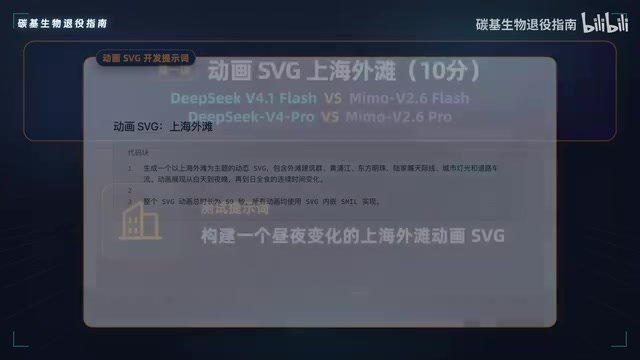
The Pro comparison was more interesting. Since DeepSeek's previous V4 generation had relatively weaker aesthetics overall, MiMo clearly came out ahead: buildings on both banks were rendered correctly, including the clock tower, the iconic Bund trio, and the TV tower, with decent cloud effects. However, the fatal flaw was that the sun and moon followed completely incorrect orbital paths. Both MiMo models showed gaps in world knowledge, earning a score of 8.
Long-Horizon Task: Pro's 404 Error and Thin Implementation
The second test stepped up the difficulty — building a full illustrated novel reading website for a "Cultivation Tea Shop" story, a complex long-horizon task. Models had to process roughly one season's worth of raw story material, write it into a database, build both frontend and backend, and deliver a fully functional web application.
At the Flash level, MiMo Flash beat DeepSeek on absolute speed and cost, also scoring one point higher. This further validates the Flash version's quality.
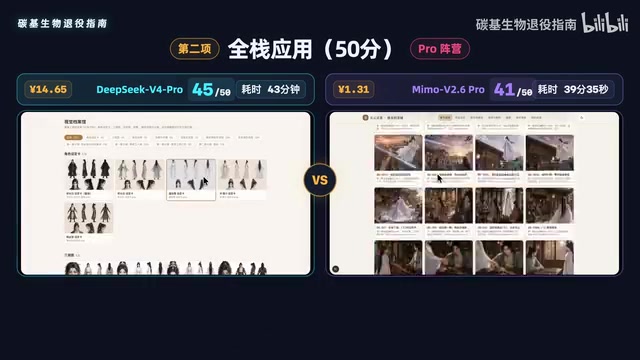
At the Pro level, DeepSeek scored 15 points (per source data), while the supposedly Kimi K3-competitive 2.6 Pro returned a 404 error. Its overall implementation was even thinner than its own Flash sibling, earning only 41 points (per source data), and it took twice as long as Flash to complete. The only bright spot was its price. Pro's performance here was once again baffling.
Long-horizon tasks are a critical dimension for evaluating a model's real-world engineering capabilities, distinct from single-turn Q&A or simple code completion. These tasks require models to continuously plan, decompose subtasks, invoke tools, process intermediate results, and ultimately deliver a complex, fully functional product — all within a single conversation or autonomous execution pipeline. The "Cultivation Tea Shop" full-site generation is a textbook long-horizon task: the model must understand raw story material, design a database schema, write backend APIs, build frontend pages, and ensure all modules work together. Such tasks demand extremely high consistency in instruction-following, efficient use of the context window, and strong self-correction capabilities. They are the ultimate litmus test separating "usable" from "truly good" models — and an area where even leading models today have significant weaknesses.
Element Sandbox: Pro's Visual Expressiveness Makes a Comeback
In the third test — an element sandbox — both Flash models showed mixed results on 3D modeling, motion effects, and particle effects, with both feeling somewhat stiff. DeepSeek's light beam lacked sharpness, appearing as a plain straight column; MiMo used a burning effect, but the earthquake mechanic had no actual shaking. Both sides were roughly equal, each earning 6 points. To MiMo's credit, its translations were complete with no omissions.
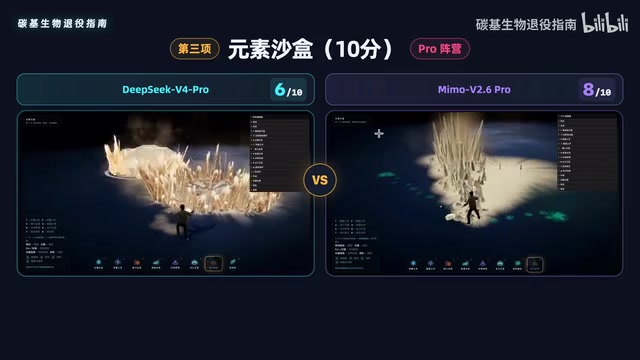
At the Pro level, MiMo showed stronger visual expressiveness, with two game abilities that were clearly differentiated. DeepSeek Pro wasn't bad either, but half of its menu items were left untranslated, dragging its score down to 6. MiMo Pro earned 8 points. This shows that Pro isn't without merit — it actually shines on tasks that are more visually and interaction-heavy.
Pricing Is the Real Weapon: Cache Hit Rates Make It Exceptionally Affordable
Across all tests, Xiaomi and DeepSeek proved to be well-matched rivals, each with their own strengths. But the real gap shows up in cost — MiMo charges significantly less than DeepSeek.
MiMo's biggest highlight is its extremely low cache-hit pricing, especially for the Pro model. This strategy closely mirrors early DeepSeek: draw users in with ultra-low cache prices, making it especially attractive for heavy Agent workloads.
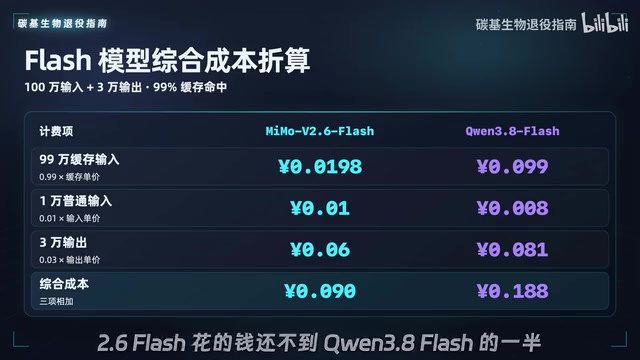
Let's run the numbers on a real task: one million input tokens, thirty thousand output tokens, 99% cache hit rate. Under these conditions, 2.6 Flash costs less than half of what Qwen 3.8 Flash charges. And before MiMo 2.6 launched, Qwen 3.8 was the universally acknowledged cheapest Flash model on the market.
Running the same calculation for 2.6 Pro — thanks to its rock-bottom cache pricing — the total cost comes out lower than DeepSeek Flash's peak pricing. In other words, running Xiaomi's Pro model during peak daytime hours costs less than 80% of what DeepSeek Flash charges. This is MiMo Pro's biggest hidden advantage.
Cache hit is a key concept in LLM API billing. When users repeatedly send requests containing identical prefix content (such as fixed system prompts, long documents, or codebases), the model provider retains the KV cache from the first computation for a period of time. Subsequent requests that hit the cache don't require recomputation, and are billed at a lower "cache hit price" — only newly added input tokens are charged at full price. In Agent scenarios, each round of conversation carries the full history context and tool descriptions, resulting in very large input token counts where most content remains unchanged across turns. Cache hit rates often exceed 90%. This means the cache hit price has a far greater impact on actual costs for heavy Agent users than the model's listed input price — making it the most important hidden variable when choosing a model.
Conclusion: Flash Impresses, Pro Is Complicated
Overall, 2.6 Flash is genuinely impressive — extremely competitive on price, and solidly entrenched in the top tier of Flash-class models on performance. Pro is a more complicated story: it sometimes can't even beat its own Flash sibling, yet it excels on certain tasks and carries genuine, hard-to-ignore value thanks to its ultra-low cache pricing.
The tests and experiences described above represent the reviewer's personal views and are for reference only. For heavy Agent users, MiMo's extremely low cache pricing may be more worth paying attention to than its leaderboard rankings.
Related articles

How Big Can Stars Really Get? The Physical Limits of the Largest Stars
Red supergiants are the largest stars by volume, with radii up to 2,000 times the Sun, engulfing the inner solar system. But there is no precise upper limit on stellar size—models predict up to 15,000 solar radii. The most massive blue stars are far smaller than red supergiants—biggest and heaviest are two different things.

Apple HomeView Smart Display Full Feature Breakdown: Wall-Mount or Desktop, $299
Apple launches HomeView, a $299 smart display with wall-mount and desktop options, 12MP camera for facial recognition, smart home control, music playback, and recipe step-by-step cooking. Full breakdown of watch faces, apps, privacy, and cooking integration.

Where Did the Promised New Studio Go? Craft Computing Answers After Five Years
Craft Computing's host responds to viewer questions: the new studio promised five years ago was shelved as construction costs soared from $30,000 to $75,000, and was replaced by a 168-square-foot garage conversion.