Xiaomi MiMo v2.6 Hands-On: The $3.5M RL Training Behind the Strongest Open-Source Model

Xiaomi live-streamed the full RL training of MiMo v2.6, producing open-source models that rival GPT-5.6 in performance.
Xiaomi released MiMo v2.6, completing a $3.5M reinforcement learning training run streamed publicly, yielding Pro and Flash variants. The Pro model ranks as the strongest open-source LLM per Artificial Analysis, just behind GPT-5.6 Sol, and sits on the performance-cost Pareto frontier. Hands-on testing in the DeepSeek agentic harness showed 98% cache hit rates and solid output quality, with additional capabilities spanning Blender 3D generation and live API calls. Pro requires ~8 H100s to run, making it enterprise-facing, while the distilled 9B variant suits individual developers. The model also shows early Lean theorem-proving and materials science capability, signaling scientific research as the next open-source frontier.
Xiaomi has quietly launched its MiMo v2.6 series — and it's reshaping the competitive landscape of open-source large language models. A company that was previously a minor player in the LLM space has now delivered a suite of models that rival GPT-5.6 and Opus-class performance, while doing something remarkably rare: live-streaming the entire reinforcement learning (RL) training process at a cost of approximately $3.5 million. This isn't just a model release — it's a bold statement about the strength of China's open-source AI ecosystem.
Live-Streaming RL Training: Two Models for $3.5M
The most striking detail is that Xiaomi made MiMo v2.6's training process publicly visible in real time. Viewers could watch the model's performance improve step by step as RL training progressed — a level of transparency that's extremely rare in the industry, and one that vividly illustrates the scale of investment Chinese companies are putting into model training. The entire training run cost approximately $3.5 million.
This training produced two variants: Pro and Flash. According to the Artificial Analysis Intelligence Index, the Pro version is currently the strongest open-source model available, trailing only GPT-5.6 Sol at its highest settings. Even more notable is its cost-efficiency — thanks to an exceptional performance-to-cost ratio, MiMo Pro sits on the Pareto frontier as one of the most economical open-source models available today.
On Terminal Bench 4.0 — a benchmark for agentic coding that hasn't yet reached saturation — both Pro and Flash perform impressively, with Pro reaching GPT-5.6 Sol-level results. Unsaturated benchmarks like this tend to reflect real-world agentic capability more faithfully than traditional tests.
What does RL actually do in LLM training? The pretraining phase teaches models language patterns; supervised fine-tuning (SFT) teaches them to respond in ways humans prefer; and the RL phase further optimizes decision quality through reward signals — especially for tasks requiring multi-step planning like reasoning, coding, and tool use. Xiaomi likely used algorithms similar to GRPO or PPO, with code execution results (pass/fail on tests) as reward signals rather than human scoring. This "verifiable reward" training paradigm is the core mechanism behind recent breakthroughs in coding and math across models like DeepSeekAd-R1 and Qwen3. The Pareto frontier here refers to the set of points that are simultaneously undominated on both "performance" and "cost" dimensions — being on it means you can't get a stronger model for the same price, or achieve the same performance for less.
Agentic Coding in Practice: 45M Tokens and 98% Cache Hit Rate
The author tested the model within the DeepSeek harness — one of the better-implemented agentic coding frameworks in the open-source world, and one that most models likely haven't seen during training, making it a useful probe of genuine capability in unfamiliar environments.
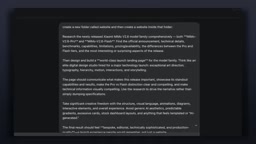
The baseline test asked the model to research itself and build a landing page resembling a product launch page, with instructions to verify each step of its work. Thanks to this verification loop, the task consumed nearly 45 million tokens in total — but approximately 98% were cache hits, which is exactly what the DeepSeek harness handles extremely well. The entire run used the medium setting, balancing performance and cost.
As a multimodal model, MiMo v2.6 proactively takes screenshots of resources it uses and verifies its own output — precisely what the task instructions required. The final landing page was accurately scoped to cover both Flash and Pro versions, even attempting to reproduce some of the demos and animations from the original blog post. A solid first-pass result.
The Weak Point: Why General Web Search Falls Short for Code
One clear tendency emerged during testing — the model leaned heavily on web search. This exposes a common failure mode: models are "frozen in time" after their training cutoff. When a library introduces a breaking change, the model has no way of knowing and may continue recommending deprecated APIs.
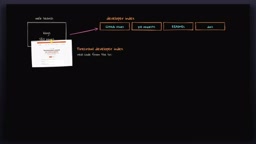
The standard solution is to give the agent a web search tool, but general web search is optimized for broad relevance — not for code. The article uses the example of upgrading a library from 0.7 to 0.8: general search might pull answers from secondary sources but often fails on recent changes and can be misled by SEO-optimized pages. By contrast, developer-focused code indexes crawl live GitHub issues, merged PRs, changelogs, and raw documentation — feeding the model actual source files rather than summaries, and even capturing traps like wildcard version pinning that general search would miss entirely.
Why breaking changes are such a hard problem for agentic coding: LLMs have a training data cutoff, meaning their knowledge is frozen at a point in time. For fast-moving open-source libraries, API signatures, configuration formats, and dependency structures can change fundamentally within months — yet models will confidently recommend deprecated patterns. This "confident wrongness" is harder to debug than simply not knowing. Developer-focused indexes (such as Exa or Phind) prioritize crawling GitHub issue threads, merged PR diffs, official changelogs, and README updates rather than blog reposts or Q&A aggregators. This gives the model context that's closer to a "first-hand change record," dramatically reducing hallucination risk from stale information. Wildcard version pinning (e.g.,
>=0.7,<1.0) is a classic dependency trap that general search engines rarely index as valuable content — but for an agent debugging dependency conflicts, it's often the root cause.
Hardware Requirements: Open Source Doesn't Mean You Can Run It Locally
The other side of open source is the reality of hardware constraints. MiMo Pro is a 1-trillion-parameter model with 20 billion active parameters — far beyond what consumer hardware can handle. Running it at 4-bit quantization requires approximately 8 H100 GPUs.
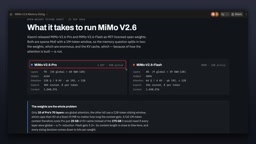
The Flash variant is considerably more approachable at roughly 310 billion total parameters and 15 billion active parameters, potentially runnable on two machines with 4-bit quantization. That said, KV cache grows with context length — VRAM must accommodate not just model weights but also the KV cache for 128K context windows. In other words, these models are genuinely open source, but the larger one is effectively enterprise-facing rather than individual-developer-facing. Xiaomi has also distilled a MiMo v2.6 Distilled Qwen 9B specifically optimized for agentic coding, which is far more accessible to everyday users.
Understanding "1T parameters, 20B active": The MoE (Mixture of Experts) architecture is key here. Traditional dense models activate all parameters on every forward pass; MoE models distribute parameters across many "expert" modules and only route to and activate a small subset per inference. This means total parameter count determines storage requirements (the VRAM floor), while active parameter count determines per-inference compute (i.e., speed). Pro's 1T total parameters require roughly 500GB VRAM at 4-bit quantization — just fitting across 8 × 80GB H100s. Flash's 310B parameters require roughly 160GB, feasible on two H100s. KV cache (Key-Value Cache) is the VRAM region storing intermediate attention results during Transformer inference; its size scales linearly with context length — 128K context can consume tens of additional GB on long tasks, which is the real substance behind the warning that "VRAM must accommodate both weights and KV cache." The distilled Qwen 9B compresses capabilities by training a small model to match the output distribution of the large one; at 9B parameters, it runs on a consumer-grade single GPU and is the most practical local deployment option for most developers.
From 3D Generation to Scientific Research: The Next Frontier
The model demonstrated a remarkably broad capability profile. It accurately tracked the International Space Station's real-time position, called live APIs to render trajectory plots, and drove Blender to generate 3D assets before animating them with code.

The author is candid that spatial reasoning isn't a strong suit — when procedurally generating 3D scenes with three.js, performance was only mediocre, and in some scenarios it underperformed DeepSeek 4.1 Flash. Importantly, none of these tasks were single-shot generations; they were completed inside an agentic loop with verification — which is far closer to how real software development actually works.
What's genuinely exciting is the scientific research direction. Xiaomi's experiments show the model can use Lean to solve mathematical formulas and assist in fields like materials science and biochemistry — all without domain-specific RL. The author argues that most models are already useful enough for coding, even if they can't serve as a primary orchestrator, they can handle well-defined subtasks as sub-agents. The next frontier, in their view, is either the physical world or scientific research. Open-weight models are beginning to show early usability in these areas — provided they remain open.
What is Lean, and why does it matter? Lean is an interactive theorem-proving language developed by Microsoft Research and widely used by the mathematics community to formally verify the correctness of proofs. Unlike natural-language proofs, Lean requires every inference step to conform to strict formal logic, allowing mechanical verification. A model's ability to use Lean to solve mathematical formulas without domain-specific RL suggests genuine formal reasoning capability rather than superficial pattern matching that merely "looks like math." The significance: once models can reliably generate machine-verifiable reasoning chains, their outputs can be fed directly into high-stakes domains like scientific hypothesis generation or drug molecule design verification — without requiring human experts to review line by line. Systems including DeepMind's AlphaProof have already demonstrated formal reasoning ability on International Mathematical Olympiad problems; early signals from open-weight models in this direction suggest the barrier to scientific AI is falling systematically.
Related articles

Chain of Thought Isn't Just for AI: How Humans Can Use CoT to Improve Thinking Quality
Chain of Thought isn't just a prompt trick for large models. Starting from a Hacker News discussion, this article analyzes why CoT works for human thinking too, breaks down actionable ways to transfer it, and highlights the key differences between human CoT and machine CoT.
Cloudflare Teams Up with OpenAI: Closi…
Cloudflare Teams Up with OpenAI: Closing the Loop from Vulnerability Discovery to Defense with AI
Cloudflare uses OpenAI Daybreak to investigate security vulnerabilities and generate reviewable remediation plans, while developers use Codex to boost coding efficiency and quality.

Orca Multi-Agent Orchestration in Practice: A Guide to Parallel Collaboration with Claude and Codex
Orca is Stable AI's free open-source agent workbench supporting 34 agents like Claude Code and Codex in parallel. Learn its Git worktree isolation, multi-model orchestration, and mobile management.