Xiaomi MiMo v2.6 Released: Another Step Forward for Open-Source LLMs
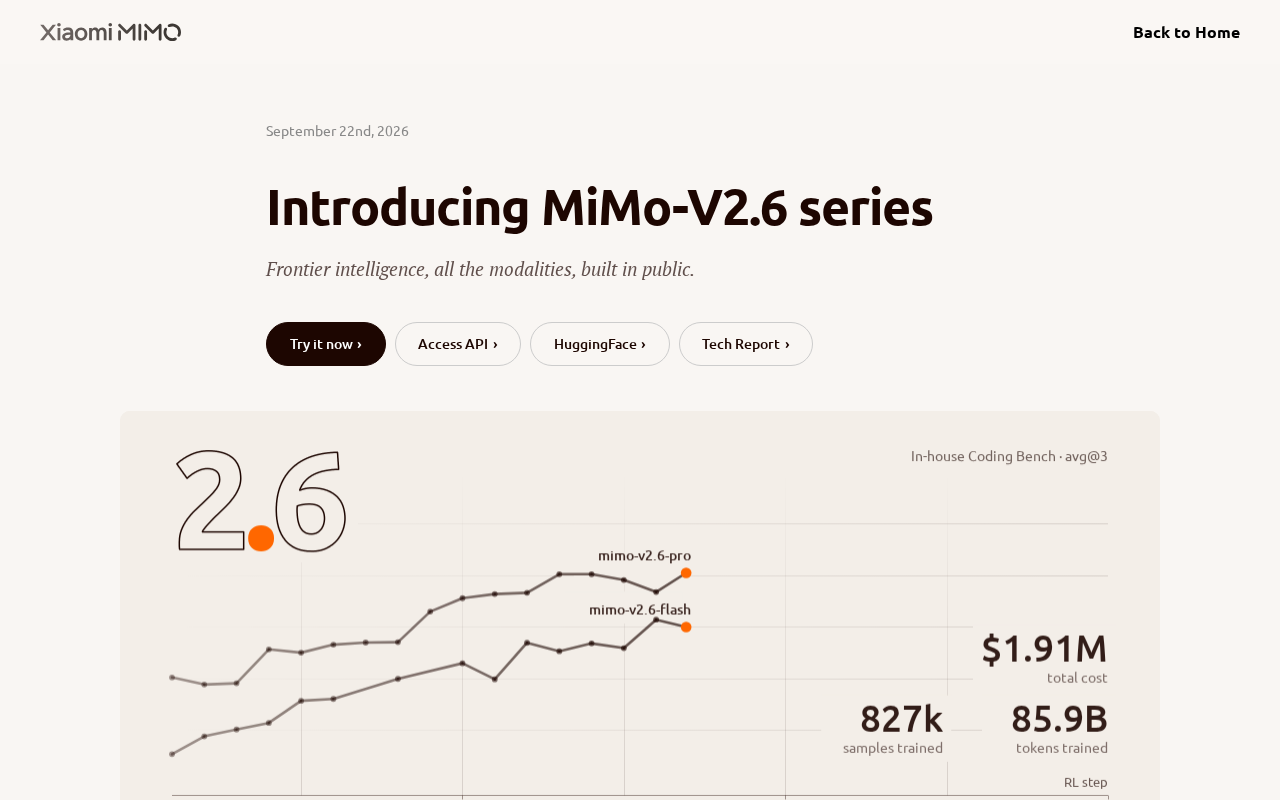
Xiaomi's MiMo v2.6 LLM goes viral on Hacker News, but key technical details are still pending.
Xiaomi has launched MiMo v2.6, its latest large language model, drawing nearly 300 upvotes and hundreds of comments on Hacker News — a sign of sustained international interest in Chinese AI releases. MiMo carries clear strategic value for Xiaomi: its sprawling hardware ecosystem across smartphones, IoT, and EVs provides real-world deployment targets and user feedback loops, along with a pressing need for on-device inference. MiMo v2.6 enters a fiercely competitive open-source arena already shaped by Alibaba, DeepSeek, and Moonshot AI, but without a full technical report or benchmark data yet available, any definitive judgment on its capabilities remains premature.
Xiaomi has launched its latest large language model, MiMo v2.6, drawing significant attention on Hacker News — racking up 293 upvotes and over 133 comments shortly after the announcement. The buzz reflects the sustained interest of the international tech community in moves Chinese companies are making in the LLM space.
It's worth noting that most publicly available information comes from Xiaomi's official pages and community discussions; a detailed technical whitepaper and comprehensive benchmark results have yet to be released. This article offers a preliminary overview of MiMo v2.6 based on what's currently known, along with some broader industry context.
What MiMo Is and Where It Fits
MiMo is Xiaomi's large language model series. Based on the versioning, v2.6 is an iterative update within the v2 line rather than a major architectural overhaul. A minor version bump like this typically signals capability improvements, performance optimizations, or bug fixes — not a ground-up redesign.
For Xiaomi, developing its own LLMs carries clear strategic weight. As a hardware giant spanning smartphones, IoT, and EVs, Xiaomi needs a controllable AI foundation to power its vast device ecosystem — from voice assistants and computational photography on phones, to natural language interfaces in smart home products, to in-car AI experiences. Owning the model stack means greater autonomy over cost, data privacy, and product integration.
Why It Trended on Hacker News
Landing nearly 300 upvotes on Hacker News is noteworthy in itself. The platform's audience skews heavily toward engineers and technical founders, who tend to care deeply about a model's practical utility, openness, and technical depth.
Chinese AI labs have been generating regular discussion in international developer communities lately, for two main reasons: many have opted for open-weight or open-source releases that lower the barrier for overseas developers to experiment with; and their benchmark performance often invites direct comparisons with leading open-source models like Llama, Qwen, and DeepSeekAd, sparking evaluation threads and debate.
The fact that MiMo v2.6 made the front page suggests it offers something the community considers worth trying — whether that's raw performance, openness, or a good fit for specific use cases.
One More Player in a Crowded Open-Source Arena
Zooming out, MiMo v2.6 is the latest in a dense wave of model releases from Chinese labs. Over the past year, teams at Alibaba, DeepSeek, Moonshot AI, and others have been continuously pushing up the open-source leaderboards, creating an intensely competitive landscape.
In this context, Xiaomi's entry has a few interesting angles:
The Natural Advantage of a Hardware Ecosystem
Unlike teams focused purely on software or research, Xiaomi has a massive base of real devices and real users. This creates a natural feedback loop for model improvement, and — crucially — a clear deployment destination. There's no risk of building a model with nowhere to go.
The On-Device Inference Opportunity
For hardware companies like Xiaomi, getting models to run efficiently on resource-constrained devices — phones, in-car systems — is a core challenge. If the MiMo series emphasizes lightweight design and inference efficiency, it would directly serve Xiaomi's on-device AI strategy. That said, this remains to be confirmed by official technical details.
On-device inference refers to running models locally on devices like smartphones, tablets, or in-car systems, rather than relying on cloud servers. The key challenges are significant: flagship phones typically have 12–16 GB of RAM — far less than what large models require — and the compute gap between mobile NPUs/GPUs and data center GPUs is enormous. Common approaches to bridge this gap include quantization (compressing model weights from FP16 to INT8 or INT4), knowledge distillation (training smaller models from larger ones), and structural pruning. Chip makers like Apple, Qualcomm, and MediaTek have also added LLM-specific optimizations to their latest SoCs. For Xiaomi, co-optimizing its Surge chipset with its own LLMs represents a potentially meaningful on-device AI differentiator.
Openness Determines Reach
How far a model spreads in the developer community depends heavily on its release strategy — whether it offers open weights, allows commercial use, or restricts access to API calls only. This is typically one of the first things the community scrutinizes in any new model release.
The current open-source LLM race among Chinese labs revolves around several dimensions: parameter scale (ranging from 7B to hundreds of billions), reasoning ability (math, code, logic), multilingual support, and how permissive the license is. Alibaba's Qwen series is known for multimodal capabilities and long-context handling; DeepSeek attracted widespread international attention for math reasoning and code performance that rivals or surpasses GPT-4; Moonshot AI's Kimi series focuses on ultra-long context windows. In this crowded field, any new model needs a standout capability in at least one niche to cut through the noise in high-signal developer communities. Third-party evaluation platforms like Hugging Face's Open LLM Leaderboard have become key battlegrounds for mindshare.
A Measured Take: Waiting for the Data
Without a complete set of benchmarks and a technical report, it's too early to draw firm conclusions about MiMo v2.6's capabilities. Community engagement signals interest — not quality.
For developers and observers tracking this space, the key questions to watch include: the model's parameter count and architecture; its scores on standard evaluation benchmarks; whether weights are openly released and under what license; and how well it's optimized for on-device deployment. The answers to these will determine whether MiMo v2.6 is a routine version bump or a meaningful move in Xiaomi's AI play.
As Xiaomi releases more technical details and community evaluations roll in, a clearer picture will emerge. Until then, the most reasonable stance is to file it as another name worth watching in China's fast-moving LLM ecosystem.
Related articles

Chain of Thought Isn't Just for AI: How Humans Can Use CoT to Improve Thinking Quality
Chain of Thought isn't just a prompt trick for large models. Starting from a Hacker News discussion, this article analyzes why CoT works for human thinking too, breaks down actionable ways to transfer it, and highlights the key differences between human CoT and machine CoT.
Cloudflare Teams Up with OpenAI: Closi…
Cloudflare Teams Up with OpenAI: Closing the Loop from Vulnerability Discovery to Defense with AI
Cloudflare uses OpenAI Daybreak to investigate security vulnerabilities and generate reviewable remediation plans, while developers use Codex to boost coding efficiency and quality.

Orca Multi-Agent Orchestration in Practice: A Guide to Parallel Collaboration with Claude and Codex
Orca is Stable AI's free open-source agent workbench supporting 34 agents like Claude Code and Codex in parallel. Learn its Git worktree isolation, multi-model orchestration, and mobile management.