Xiaomi MiMo-V2.6 Released: Trillion-Parameter Multimodal MoE with Day-0 vLLM Support

Xiaomi releases MiMo-V2.6 Pro & Flash MoE multimodal models with day-0 vLLM support and open RL training stack.
Xiaomi's MiMo team released MiMo-V2.6 with two MoE variants: Pro (1.02T total / 42B activated params) and Flash (309B total / 15B activated), both natively fusing text, image, video, and audio in a single checkpoint. The models support 1M token context, native FP8 weights, and built-in DFlash speculative decoding drafting 7 tokens per step. Day-0 vLLM support enables immediate deployment, while open-sourced weights and the RL training stack give the community a complete foundation for replication and improvement.
Xiaomi Takes Another Step Forward in Open-Source LLMs
Xiaomi's MiMo team has released MiMo-V2.6, a new generation multimodal large language model, with day-0 support from vLLM — both variants are deployable via vLLM on the very day of release. This kind of cadence is uncommon in the open-source LLM space, where community adaptation for inference frameworks typically takes days or even weeks. Xiaomi's deep collaboration with vLLM has dramatically shortened the time from release to production readiness.
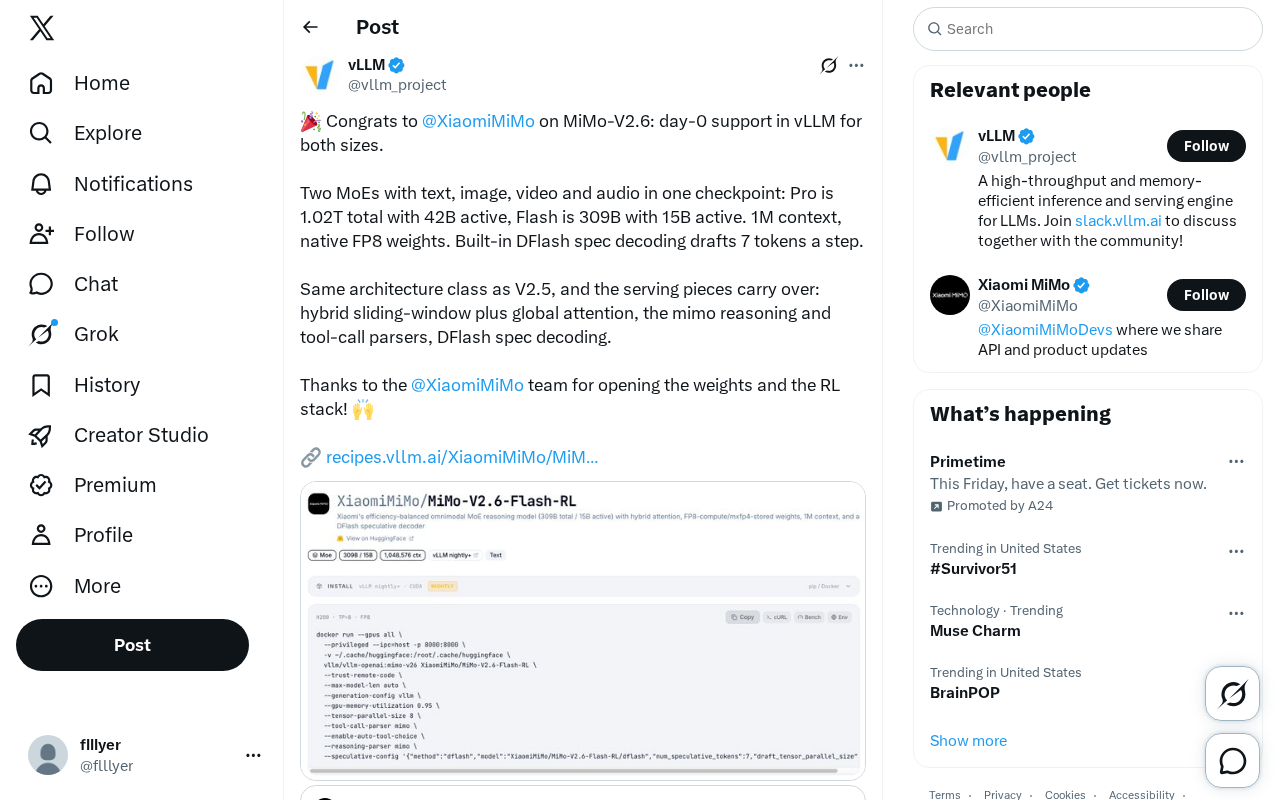
For developers eager to get started immediately, this means no waiting for additional integration work — the model can be plugged directly into existing inference serving stacks. Xiaomi has also released the model weights and RL (reinforcement learning) training stack, continuing its commitment to the open-source ecosystem.
Two MoE Variants: Pro and Flash
MiMo-V2.6 launches with two Mixture-of-Experts (MoE) architecture variants, catering to different compute budgets and deployment scenarios.
Pro: The Trillion-Parameter Flagship
The Pro variant features a total of 1.02 trillion (1.02T) parameters, with 42B activated parameters per forward pass. This is precisely where MoE architecture shines — despite the massive total parameter count, only a subset of experts (42B) are activated during each inference step, keeping actual compute costs manageable while preserving full model capacity.
Flash: Lightweight and Efficient
The Flash variant has 309B total parameters with 15B activated, targeting latency- and cost-sensitive deployments. Compared to Pro, Flash significantly lowers the resource barrier while retaining multimodal capabilities, making it better suited for large-scale online serving.
Both variants fuse text, image, video, and audio into a single unified checkpoint, making them truly native multimodal models rather than an ensemble of separate single-modal systems.
What is Mixture of Experts (MoE)? MoE is an architecture paradigm that distributes model parameters across multiple "expert" sub-networks. Unlike traditional dense models that activate all parameters during every forward pass, MoE models use a routing mechanism to select only a small number of experts for each input token — a concept known as "sparse activation." In the Pro variant, for example, only 42B out of 1.02T total parameters are activated per inference step, drastically reducing compute while keeping the model's knowledge capacity close to the trillion-parameter scale. This design has been adopted by several prominent models including GPT-4, Mixtral, and DeepSeekAd, and is widely regarded as a mainstream approach to scaling model size under compute constraints. The primary challenges of MoE include expert load balancing (preventing some experts from being overused while others sit idle) and communication overhead during distributed deployment.
Key Technical Features
MiMo-V2.6 builds on the architectural design of V2.5 while integrating several techniques aimed at efficient inference.
1M Context Window and Native FP8
The model supports a 1M (one million) token context window, enabling it to handle extremely long documents, lengthy videos, and other complex inputs. It also uses native FP8 weights, reducing memory footprint and improving throughput without the precision loss that can come from post-training quantization.
FP8 and 1M Context: A Deeper Look FP8 (8-bit floating point) is an important direction for accelerating inference and training. Compared to mainstream FP16/BF16, it can cut memory usage by roughly half and deliver higher matrix operation throughput on FP8-capable hardware (e.g., NVIDIA H100/H800). The key distinction between "native FP8" and "post-quantization FP8" is that post-quantization compresses weights after FP16 training, which can introduce precision degradation. Native FP8, by contrast, means the model stores and computes key weights in FP8 format during training itself, resulting in less precision loss and better compatibility with inference frameworks. Achieving a 1M token context window typically relies on sparse attention mechanisms (such as sliding window attention) or linear attention variants — standard full attention scales quadratically with sequence length in memory, making million-token contexts infeasible without architectural modifications.
DFlash Speculative Decoding
The built-in DFlash speculative decoding mechanism drafts 7 tokens per step. Speculative decoding uses a smaller draft model to predict multiple candidate tokens, which are then verified in parallel by the main model — significantly accelerating generation speed. A draft budget of 7 tokens per step is on the higher end among comparable approaches.
What is Speculative Decoding? Speculative decoding is an inference acceleration technique that speeds up autoregressive generation through a "draft-then-verify" pipeline. Standard autoregressive decoding generates only one token per step, which becomes the primary latency bottleneck for large model inference. Speculative decoding introduces a smaller, faster draft model that predicts several candidate token sequences at once; the full sequence is then passed to the main model for parallel verification — accepted draft tokens are kept, and generation resumes from any rejected position. Since verification can be parallelized, this approach can multiply effective throughput with virtually no loss in generation quality. Drafting 7 tokens per step means that in the ideal case, a single main model forward pass can yield up to 7 valid tokens — a significantly higher speedup compared to the common 3–4 token draft configurations. DFlash is likely Xiaomi's custom-optimized speculative decoding implementation tailored to their specific architecture.
Reuse of Serving Components
Because MiMo-V2.6 shares the same architectural family as V2.5, previously built serving components can be used directly, including:
- Hybrid sliding window attention + global attention: balancing long-context efficiency with global information capture
- MiMo reasoning and tool-call parsers
- DFlash speculative decoding
This architectural continuity is particularly friendly to teams that have already deployed V2.5, substantially lowering the cost of migration.
Implications for the Open-Source Ecosystem
From a strategic standpoint, MiMo-V2.6 covers the full spectrum from research exploration to production deployment by offering both a trillion-parameter flagship and a lightweight variant. The combination of native multimodality, million-token context, FP8 weights, and speculative decoding signals that Xiaomi places equal emphasis on real-world inference efficiency alongside raw model capability.
Equally noteworthy is the release of both weights and the RL training stack. Open-sourcing the RL stack is particularly rare and valuable — reinforcement learning post-training is often a critical determinant of model capability, and one that many closed-source providers are reluctant to disclose. Xiaomi's decision to release this gives researchers a more complete foundation for replication and further improvement.
Combined with day-0 vLLM support, MiMo-V2.6 sets a strong example on the often-overlooked dimension of usability. An open-source model, no matter how capable, loses much of its real-world impact without mature inference support. Xiaomi's simultaneous push on model release and ecosystem readiness may well become a reference model for how open-source multimodal models should be delivered.
Related articles

Chain of Thought Isn't Just for AI: How Humans Can Use CoT to Improve Thinking Quality
Chain of Thought isn't just a prompt trick for large models. Starting from a Hacker News discussion, this article analyzes why CoT works for human thinking too, breaks down actionable ways to transfer it, and highlights the key differences between human CoT and machine CoT.
Cloudflare Teams Up with OpenAI: Closi…
Cloudflare Teams Up with OpenAI: Closing the Loop from Vulnerability Discovery to Defense with AI
Cloudflare uses OpenAI Daybreak to investigate security vulnerabilities and generate reviewable remediation plans, while developers use Codex to boost coding efficiency and quality.

Orca Multi-Agent Orchestration in Practice: A Guide to Parallel Collaboration with Claude and Codex
Orca is Stable AI's free open-source agent workbench supporting 34 agents like Claude Code and Codex in parallel. Learn its Git worktree isolation, multi-model orchestration, and mobile management.