Xiaomi mimo-v2-tts Pitfall Report: Three Major Bugs — Contradictory Docs, Misread Tags, and Audio Cross-Contamination

Xiaomi's mimo-v2-tts hit by contradictory docs, model bugs, and backend audio cross-contamination.
Xiaomi's open-source TTS model mimo-v2-tts has exposed three serious issues since release: documentation where bracket syntax descriptions contradict the example code; a model bug that reads audio control tags aloud instead of treating them as instructions, likely due to overfitting and poor generalization; and suspected backend request cross-contamination that returns other users' unrelated audio, posing data privacy risks. The product is severely undercooked, and developers are advised to avoid production use for now.
What Is mimo-v2-tts? And Why Are Developers Complaining?
Xiaomi recently released mimo-v2-tts, an open-source text-to-speech model that quickly drew a flood of negative feedback from the developer community. From self-contradictory documentation to critical model bugs and suspected backend stream cross-contamination, this TTS product falls far short of expectations in terms of completeness.
This article breaks down the three core issues exposed in mimo-v2-tts from a hands-on developer perspective, helping anyone considering it to avoid the same pitfalls.
TTS Technical Background: Why Audio Tag Control Matters So Much
TTS (Text-to-Speech) technology has evolved from concatenative synthesis and parametric synthesis to today's end-to-end neural network synthesis powered by deep learning. Modern TTS systems typically support special markup languages (such as SSML — Speech Synthesis Markup Language) to control pauses, speed, pitch, emotion, and other dimensions of speech.
Audio tag control is essentially a "meta-instruction" mechanism — the model must distinguish between "content to be spoken aloud" and "control instructions to be executed" during inference, which places high demands on the model's instruction-following capability. Industrial-grade TTS products (such as Microsoft Azure TTS and Google Cloud TTS) typically incorporate large volumes of annotated control samples during training and ensure stable tag parsing through rigorous regression testing. It's precisely because this mechanism is so critical that mimo-v2-tts's instability in this area is especially damaging.
Documentation Chaos: Square Brackets or Parentheses? The Docs Contradict Themselves
For a developer-facing TTS model, clear and accurate documentation is the bare minimum. Yet mimo-v2-tts's official documentation stumbles at the most basic level — syntax notation.
The documentation body explicitly states that audio tag control uses square brackets for markup. However, scrolling down to the example code, every single example uses parentheses instead. The description and the examples directly contradict each other, leaving developers completely confused — which bracket type should they actually use?
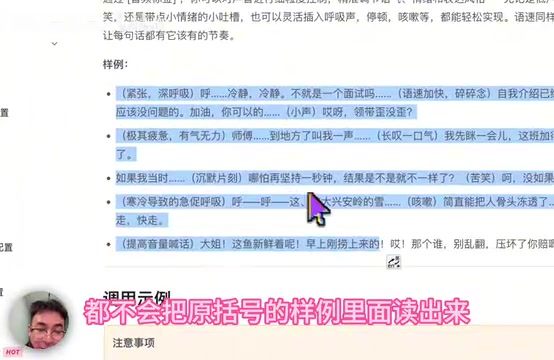
This might seem like a minor issue, but in scenarios requiring precise control over speech output, inconsistent syntax conventions directly waste significant debugging time. Especially when you follow the documentation's description and use square brackets only to find they don't work, then switch to parentheses and run into the bug described below — the troubleshooting cost multiplies.
It's worth noting that this kind of documentation inconsistency often reveals deeper engineering culture problems: a lack of effective synchronization between the documentation writers and the engineers who actually develop the model, or documentation that isn't updated in sync with code iterations. For an open-source project aimed at the developer community, documentation IS the product — mistakes here directly damage first impressions.
Core Bug: Audio Tag Content Erroneously Read Aloud by the Model
If documentation chaos merely hurts the developer experience, unpredictable model behavior is a truly critical flaw.
When using parentheses for audio tag control as shown in the documentation examples, mimo-v2-tts sometimes reads the control tag content inside the parentheses aloud instead of treating it as a control instruction.
Here's what happens specifically:
- All 5 example texts provided by the official documentation work correctly — tags inside parentheses are not read aloud
- But when developers write their own text, the tag content inside parentheses gets spoken as if it were regular text

One developer conducted a meticulous investigation, comparing the ASCII encoding of the parentheses in the official examples versus custom text byte by byte. The result: they were completely identical (both EFBC88), ruling out any possibility of full-width/half-width or character encoding differences.
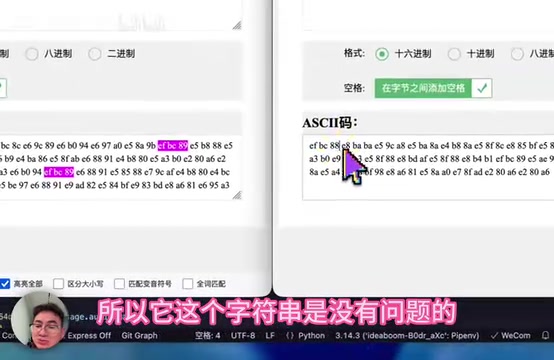
This means the problem is definitively in the model itself, not in the input data format. From a technical standpoint, this "only works with official examples" behavior strongly suggests the model developed overfitting to specific example texts during training — the model memorized particular sample patterns from the training set without truly generalizing the ability to "recognize control tags." A TTS model that can't even reliably determine "what should be read aloud and what shouldn't" renders the audio tag control feature essentially useless.
Suspected Backend Stream Cross-Contamination: API Calls Return Completely Unrelated Audio
The previous issues are at least about model capability shortcomings. The next problem is on another level entirely — when calling the same code multiple times, mimo-v2-tts sometimes returns audio that is completely unrelated to the input content.

Developers discovered in real-world testing that the generated audio content has zero connection to the input text — it sounds like generation results from other users' requests. This strongly suggests the backend service has a request cross-contamination problem.
From an engineering perspective, request cross-contamination is a severe class of defect in distributed inference services. Under high concurrency, if the server's request queue, cache, or session state management contains race conditions, User A's generation results can be erroneously written into User B's response buffer. This is particularly common in streaming output architectures, because streaming transmission requires maintaining long-lived connections and intermediate state — once session ID mapping goes wrong, data "flows to the wrong place." These issues typically require rigorous concurrent stress testing to be caught and fixed before going live.
The consequences of this problem in a production environment are extremely serious:
- Data privacy risk: Users' text content could be leaked to others via audio
- Service reliability drops to zero: There's no guarantee that each API call will return the correct result
- Safety hazards: If deployed in real-time scenarios like in-car voice systems or smart home devices, returning incorrect content could have dire consequences
Summary of All Three Issues and Severity Assessment
Here's a consolidated view of the issues currently exposed in mimo-v2-tts:
| Problem Layer | Specific Behavior | Severity |
|---|---|---|
| Documentation | Syntax description and example code use inconsistent bracket types | Medium |
| Model | Audio tag control is unstable — control content inside parentheses is sometimes erroneously read aloud | High |
| Service | Backend requests are suspected of cross-contamination, returning other users' audio results | Critical |
With issues stacked across all three layers, it's fair to conclude that mimo-v2-tts did not undergo adequate testing and quality assurance before release.
It's worth mentioning that open-source AI model releases typically fall into two stages: "research preview" and "production ready." A research preview is allowed to have known defects, but limitations should be clearly noted in the README. A formal release targeting the developer community should go through a complete testing pipeline, including unit tests, integration tests, concurrent stress tests, and documentation consistency reviews. Xiaomi's release of mimo-v2-tts is closer to the former, but lacks the corresponding disclaimers — causing developers to evaluate a research-stage product against production-grade standards, which amplifies the sense of disappointment.
What Should Developers Do? Avoidance Tips and Outlook
Practical Advice for the Current Stage
Given the severity of the issues above, developers are advised to avoid integrating mimo-v2-tts into production environments for now. If you need to evaluate it for technical research purposes, consider the following:
- Only test with official example texts: Custom text will very likely trigger the tag-reading bug
- Manually verify every generated result: Don't trust the output of a single API call
- Keep an eye on official updates: Wait for bug fixes before re-evaluating
Expectations for Xiaomi's AI Team
Xiaomi has made significant investments in AI, but based on mimo-v2-tts's performance, there's considerable room for improvement in their model productization process. Before launching a qualified TTS product, at minimum they should ensure:
- Documentation passes strict consistency reviews — descriptions and examples must not contradict each other
- Model behavior boundary testing must be comprehensive, not limited to verifying that official examples work; systematic evaluation of "instruction-following generalization capability" is especially needed, rather than validating only a handful of fixed samples
- Backend service stability must be verified through stress testing and concurrency testing; request isolation mechanisms need thorough validation before going live
Pushing a product that clearly hasn't undergone adequate testing onto the developer community burns user trust in the short term and damages Xiaomi's technical reputation in the AI space in the long term. Hopefully, the team can quickly identify and fix these issues, making mimo-v2-tts a truly usable open-source TTS tool.
Key Takeaways
- mimo-v2-tts documentation has inconsistencies between syntax descriptions and examples, with mixed use of square brackets and parentheses confusing developers
- Core model bug: Audio tag control is unstable — control content inside parentheses is sometimes erroneously read aloud, likely due to training data overfitting leading to poor generalization
- The backend service is suspected of request cross-contamination, returning completely unrelated audio from other users, posing data privacy risks
- ASCII encoding comparison confirms the issue lies in the model itself, not in input data formatting
- The product is severely undercooked — developers are advised to avoid production use for now and wait for official fixes before re-evaluating
Related articles
 Product Reviews
The Programmer's Desk Setup Guide: Building a Workspace That Feels Like Home
Discover how programmers build productive, comfortable workspaces. From multi-monitor setups to ergonomic design, explore the desk philosophy that drives focus and flow.
 Product Reviews
Qoder vs Cursor Real-World Comparison: Which $20/Month AI IDE Is Better?
Hands-on comparison of Qoder vs Cursor AI IDEs: Agent autonomy, human interaction count, and architecture decisions. Qoder needed only 2 interactions vs Cursor's 8.
 Product Reviews
Cursor Cloud Agent Demo: Eliminating Bottlenecks Across the Entire Software Development Lifecycle
Deep analysis of Cursor's Cloud Agent demo showing how cloud VMs, automated test artifacts, and a full-chain control plane systematically eliminate human bottlenecks across the software development lifecycle.