Xiaozhi ESP32 Backend Rewritten in Go: Building a High-Concurrency AI Voice Interaction Service

Xiaozhi ESP32 backend rewritten in Go for high-performance AI voice interaction
Developer hackers365 released xiaozhi-esp32-server-golang, a Go rewrite of the Xiaozhi ESP32 backend service that offers superior concurrency and deployment over the Python version. The project supports dual WebSocket and MQTT+UDP protocols, integrates voiceprint recognition, voice cloning, knowledge bases, MCP remote calls, and proactive audio push, delivering an efficient and feature-rich backend solution for smart voice interaction hardware.
Project Overview: A Go-Powered Backend Service for Xiaozhi ESP32
In the open-source AI hardware space, Xiaozhi ESP32 is a highly popular intelligent voice interaction project. Recently, developer hackers365 published xiaozhi-esp32-server-golang on GitHub — a backend service for Xiaozhi rewritten in Go. With 316 Stars and 107 Forks already, the project demonstrates strong community demand for high-performance AI backend solutions.
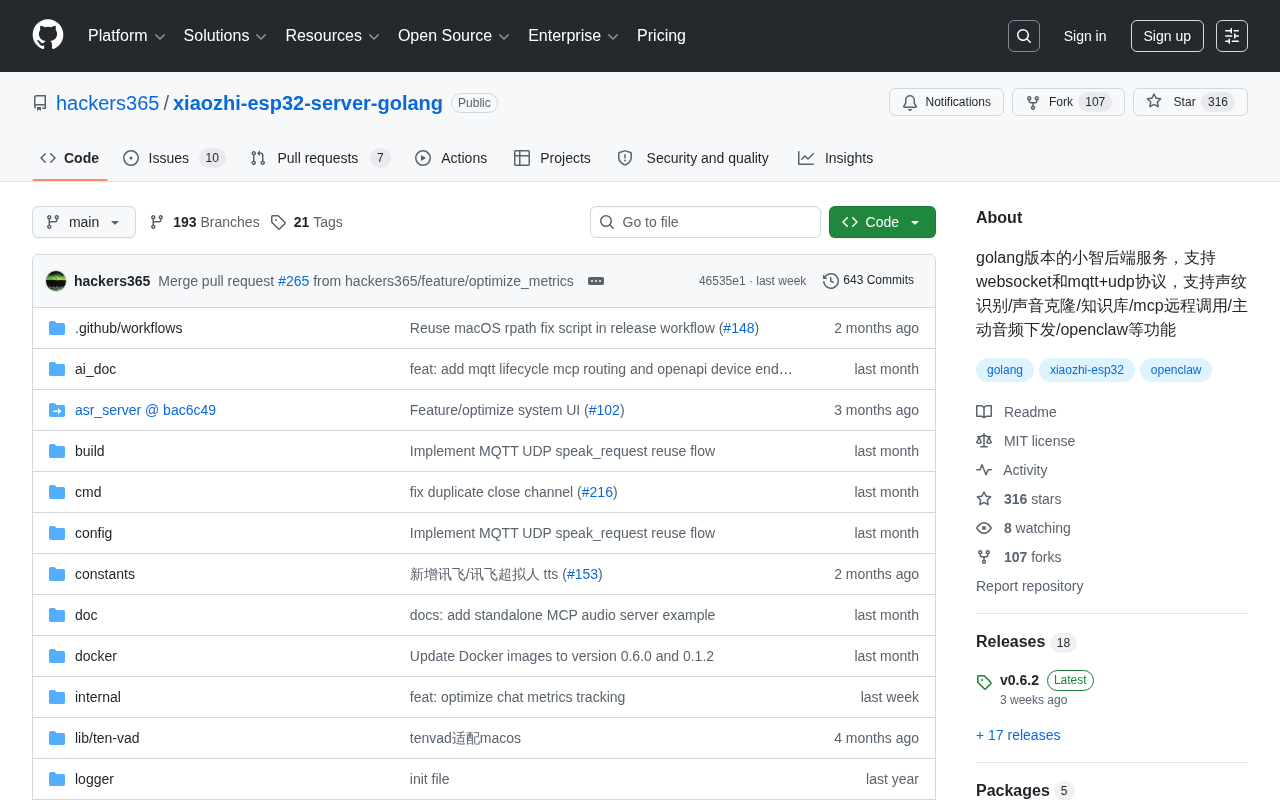
The project's core goal is to provide a more efficient and easier-to-deploy backend service for Xiaozhi ESP32 hardware devices. Compared to the original Python implementation, the Go version offers inherent advantages in concurrent processing, memory usage, and deployment convenience — making it particularly well-suited for IoT scenarios that require handling large numbers of device connections.
Core Feature Breakdown
Dual Protocol Support: WebSocket and MQTT+UDP
The project supports both WebSocket and MQTT+UDP communication protocols, addressing the needs of different deployment scenarios. Understanding the technical background of these two protocols helps developers make more informed architecture decisions.
WebSocket is a full-duplex communication protocol built on TCP, introduced by the HTML5 specification. It establishes a persistent connection through a single HTTP handshake upgrade. Compared to traditional HTTP polling, WebSocket offers significantly improved real-time performance and bandwidth efficiency, making it especially suitable for scenarios like voice streaming that require sustained low-latency transmission. In LAN or home network environments with good connectivity, WebSocket is the most straightforward choice for real-time voice stream transmission and control command delivery.
MQTT (Message Queuing Telemetry Transport) is a publish/subscribe protocol originally designed by IBM in 1999 for satellite link telemetry monitoring, which later became the de facto standard in the IoT domain. With a minimum packet header of just 2 bytes, it remains stable and reliable even on weak networks like 2G/3G, excelling in more complex IoT deployment scenarios. UDP, as a connectionless transport protocol, doesn't guarantee reliability, but its extremely low protocol overhead makes it the preferred choice for real-time audio transmission — even with occasional packet loss, human perception of brief audio gaps is far less noticeable than perception of latency, which is why UDP is widely used in voice communication. The MQTT + UDP combination offers greater advantages in large-scale device management and cross-network deployments.
Dual protocol support gives developers the flexibility to choose based on actual network conditions, without being constrained to a single communication method.
Voiceprint Recognition and Voice Cloning
Voiceprint Recognition (Speaker Recognition) is a branch of biometric identification that leverages the uniqueness of each person's vocal tract structure and speaking habits to identify speakers. Technically, it's divided into two task types: "speaker verification" (1:1 verification of whether someone is a specific person) and "speaker identification" (1:N identification of which person is speaking). Modern voiceprint recognition systems typically use deep neural networks to extract speaker embedding vectors (such as d-vectors and x-vectors), then perform comparison through cosine similarity or PLDA models. In smart home scenarios, voiceprint recognition enables automatic switching between "child mode" and "adult mode," or provides differentiated personalized services for different family members — for example, different members can receive their own customized response content and service configurations.
Voice Cloning is an advanced form of text-to-speech (TTS) technology, aiming to synthesize highly similar personalized speech using minimal target speaker voice samples (typically seconds to minutes). Early approaches required hours of recording data, but modern approaches based on meta-learning and transfer learning (such as SV2TTS, VALL-E, CosyVoice, etc.) have compressed the required samples to just a few seconds. The technical pipeline typically includes three modules: a speaker encoder to extract speaker features, a sequence-to-sequence synthesis model to generate mel spectrograms, and a vocoder to convert spectrograms into waveforms. Users can generate synthesized speech in a specific voice timbre using just a small number of voice samples, making the AI assistant's responses sound more familiar and natural. It's worth noting that voice cloning technology also introduces ethical risks of deepfake audio — academia and industry are actively researching audio watermarking and synthetic speech detection techniques to address potential misuse.
The combination of these two features significantly enhances the practicality and user experience of Xiaozhi devices in daily use.
Knowledge Base and MCP Remote Calls
Knowledge Base functionality allows users to build custom knowledge systems, enabling the AI assistant to answer domain-specific questions. This is particularly important for enterprise scenarios — whether it's product FAQs, internal knowledge management, or vertical domain Q&A, all can be implemented through knowledge bases.
MCP (Model Context Protocol) is a standardized protocol officially open-sourced by Anthropic in November 2024, designed to solve the integration fragmentation problem between large language models and external tools/data sources. Before MCP, every AI application needed custom integration code for different tools, resulting in extremely high maintenance costs. Drawing inspiration from the Language Server Protocol (LSP), MCP defines a unified client-server architecture: AI models serve as MCP clients, while various external services (file systems, databases, APIs, smart home devices, etc.) serve as MCP servers, communicating through standardized JSON-RPC messages. This design allows a single MCP server to be reused by any AI client that supports MCP. Currently, mainstream AI products including Claude, Cursor, and Windsurf all support MCP, with ecosystem expansion accelerating rapidly — it's widely regarded in the industry as an important milestone in AI toolchain standardization.
The project's MCP support means Xiaozhi devices can remotely invoke various external tools and services, greatly extending the AI assistant's capability boundaries. Users can trigger rich functionalities like smart home control, information queries, and schedule management through voice commands.
Proactive Audio Push and OpenClaw Integration
Proactive Audio Push breaks the traditional "call-and-response" pattern
Related articles
 Product Reviews
The Programmer's Desk Setup Guide: Building a Workspace That Feels Like Home
Discover how programmers build productive, comfortable workspaces. From multi-monitor setups to ergonomic design, explore the desk philosophy that drives focus and flow.
 Product Reviews
Qoder vs Cursor Real-World Comparison: Which $20/Month AI IDE Is Better?
Hands-on comparison of Qoder vs Cursor AI IDEs: Agent autonomy, human interaction count, and architecture decisions. Qoder needed only 2 interactions vs Cursor's 8.
 Product Reviews
Cursor Cloud Agent Demo: Eliminating Bottlenecks Across the Entire Software Development Lifecycle
Deep analysis of Cursor's Cloud Agent demo showing how cloud VMs, automated test artifacts, and a full-chain control plane systematically eliminate human bottlenecks across the software development lifecycle.