XLA Compiler Correctness Validation: A Practical Approach for Large-Scale TPU Workloads
An industry paper shares a systematic approach for validating and triaging XLA:TPU compiler defects at hyperscale.
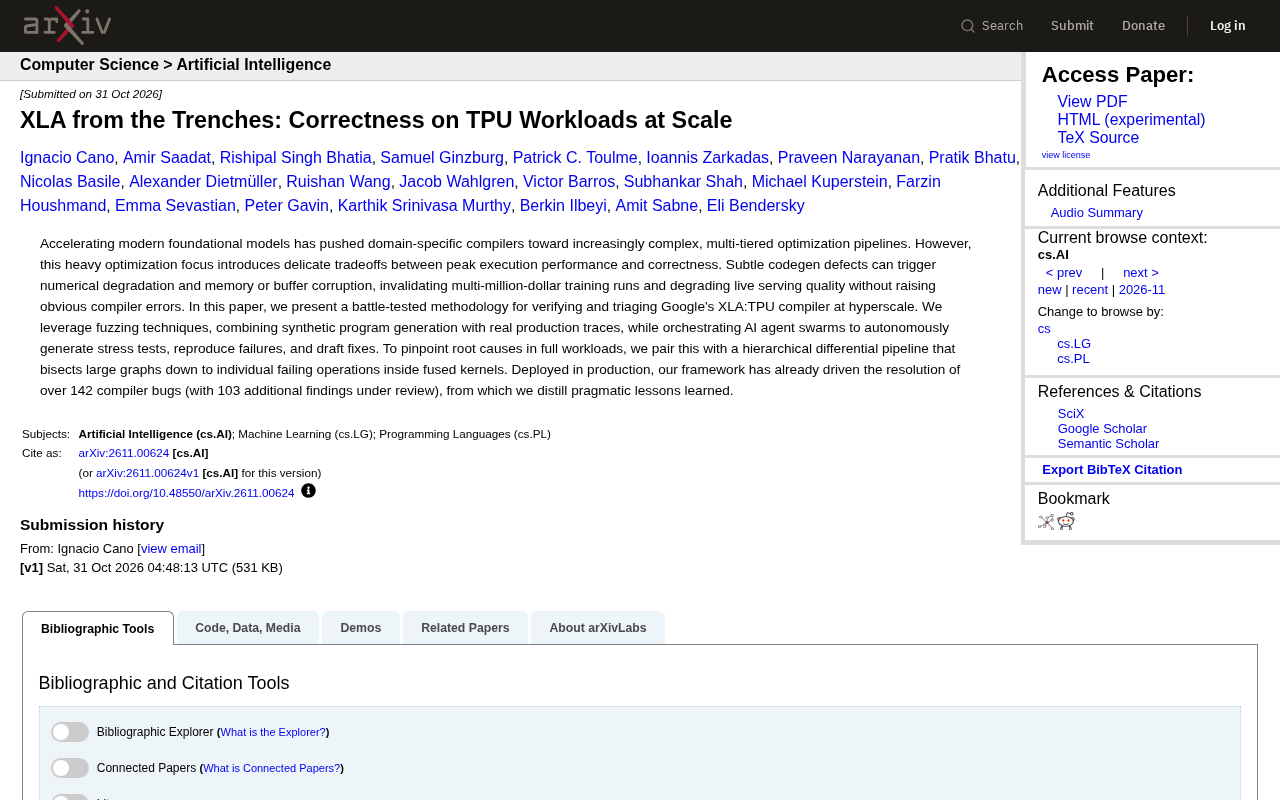
Based on an industry practice paper, this article explores systematic methods for validating and triaging XLA:TPU compiler issues at hyperscale. Subtle code generation defects can cause numerical degradation or memory corruption without compilation errors, threatening costly training runs. The team combines fuzzing with real production traces and uses AI agent swarms to autonomously generate stress tests, reproduce failures, and draft fixes. A hierarchical differential pipeline bisects large graphs to localize failing operators within fused kernels. Deployed in production, the framework drove 142 compiler defect fixes, with 103 more under review.
Modern foundation models' acceleration demands have pushed domain-specific compilers into increasingly complex multi-tier optimization pipelines. However, the pursuit of peak performance also introduces subtle trade-offs in correctness. XLA, Google's compiler designed for hardware such as TPUs, can have subtle defects in its code generation that trigger numerical degradation or memory/buffer corruption, causing multi-million-dollar training runs to fail or degrading online service quality without triggering obvious compilation errors. Based on an industry practice paper, this article explores systematic methods for validating and triaging XLA:TPU compiler issues at hyperscale.
Why XLA correctness is especially tricky at scale
XLA's core value lies in translating high-level computation graphs into efficient machine code for specific hardware (such as TPUs). This process involves multiple stages—graph optimization, operator fusion, memory planning, and more—each of which can introduce hard-to-detect defects. In hyperscale deployments, the destructive power of such defects is magnified dramatically: a single incorrect fusion can send training loss spiking abnormally, or a buffer overrun can corrupt results without immediately crashing. Traditional unit tests and manual review struggle to cover such a vast combinatorial space of optimizations.
The paper notes that these "code generation defects" typically do not throw compilation errors; instead, they manifest as numerical precision degradation or memory corruption that is extremely difficult to diagnose. Therefore, a dedicated validation and triage methodology for compiler correctness is needed, rather than relying on after-the-fact debugging.
XLA (Accelerated Linear Algebra) is an open-source domain-specific compiler developed by Google, originally designed for TensorFlow and now the backend for frameworks such as JAX and PyTorch/XLA. It converts high-level computation graphs (e.g., matrix multiplication, reductions, broadcasting) into optimized machine code for specific hardware (TPU, GPU, CPU). Its core optimizations include operator fusion (merging multiple small operators into a single kernel to reduce memory access), memory planning (statically allocating buffers to reuse memory), layout optimization (choosing the best data arrangement), and more. XLA's compilation process is divided into multiple stages such as HLO (high-level optimization) and LLO (low-level optimization), each of which can introduce defects. Because XLA is typically triggered frequently during training loops via just-in-time (JIT) compilation, its correctness directly affects the numerical stability and memory safety of model training.
Fuzzing and AI agent swarms: automating stress testing
The research team adopted fuzzing as a core technique, combining synthetic program generation with real production traces. Synthetic programs can explore extreme cases in compiler optimization paths, while production traces ensure tests stay close to real workload shapes. This hybrid strategy can cover combinations that hand-written tests struggle to reach.
More notably, they leveraged AI agent swarms to autonomously generate stress tests, reproduce failures, and draft fixes. AI agents play the role of "test engineers" here, continuously producing high-value test cases and accelerating the loop from failure to root-cause localization. This automated closed loop significantly improves defect discovery efficiency.
Fuzzing is an automated testing technique that triggers abnormal program behavior by generating large volumes of random or semi-random inputs. In compiler testing, fuzzing typically generates syntactically valid synthetic programs (e.g., randomly combined operator graphs) and checks whether compilation results match expectations (e.g., comparing outputs across optimization levels via differential testing). Production traces refer to compiler input records captured from real production environments, typically containing the computation graph structure and parameters of actual models. Combining the two allows exploration of extreme cases in compiler optimization paths (synthetic programs) while ensuring test workloads stay close to real scenarios (production traces), thereby uncovering defects that only surface under specific optimization combinations. This hybrid strategy has become a common practice in industrial-grade compiler validation.
Hierarchical differential pipeline: fine-grained localization from large graphs to fused kernels
Localizing the root cause of compiler defects is often harder than finding them. An error in a large computation graph may originate from a single operator within a fused kernel. The paper proposes a hierarchical differential pipeline: by bisecting large graphs layer by layer, the problem scope is narrowed down to the specific failing operator, even when that operator resides inside a complex fused kernel. This approach is similar to binary search in software debugging, but targets the structure of computation graphs and compilation stages.
In practice, the team compares behavioral differences across optimization levels or compilation paths, using differential testing to isolate the minimal conditions that trigger the defect. This systematic localization approach dramatically shortens fix cycles compared to empirical guesswork.
Differential testing is a technique that discovers defects by comparing the behavior of the same program under different configurations. In compiler validation, a common approach is to compile and execute the same computation graph under different optimization levels (e.g., O0 vs. O3), different compilation paths (e.g., operator fusion enabled/disabled), or different backends (e.g., XLA:TPU vs. a reference implementation), then compare output results. If results differ significantly, a defect exists under one of the configurations. The hierarchical differential pipeline further applies this idea to the structural levels of computation graphs: first compare the output of the entire graph; if inconsistent, bisect the graph into subgraphs, progressively narrowing the scope until the specific failing operator or fused kernel is localized. This method is particularly suited for localizing numerical errors or buffer overruns that only appear under specific fusion patterns.
Production deployment results and lessons learned
The framework has been deployed in production and has driven fixes for over 142 compiler defects (with another 103 findings under review). This figure comes from the paper's abstract and reflects the method's effectiveness in real hyperscale scenarios. The team distilled several practical lessons, such as: prioritize defect patterns related to numerical stability and memory safety; combining fuzzing with production traces can expose high-impact issues faster; AI agents excel at generating diverse tests but still require human oversight to ensure test quality.
These lessons are equally valuable for validating other domain-specific compilers (e.g., compilers for GPUs or other accelerators). As foundation models continue to grow in scale, compiler correctness validation will no longer be a peripheral task but a key link in ensuring the reliability of training and inference.
Industry impact and implications
The practice of XLA correctness validation reveals a trend: compiler testing is shifting from hand-written cases to automated, intelligent stress testing. The introduction of AI agents not only improves test coverage but also transforms the defect-fixing workflow. For enterprises relying on TPUs for large-scale training, investing in compiler correctness validation toolchains may offer more long-term value than merely chasing peak performance. After all, a single silent numerical error is enough to waste costly training results.
The paper's methodology also suggests that correctness validation must proceed in tandem with performance optimization, not as an afterthought. Incorporating fuzzing and differential testing in the early stages of compiler development can help uncover deep-seated defects early that would be difficult to localize later.
One-line Summary
An industry paper shares a systematic approach for validating and triaging XLA:TPU compiler defects at hyperscale.
Paragraph Summary
Based on an industry practice paper, this article explores systematic methods for validating and triaging XLA:TPU compiler issues at hyperscale. Subtle defects in XLA code generation can cause numerical degradation or memory corruption without triggering compilation errors, threatening multi-million-dollar training runs. The team uses fuzzing combining synthetic programs with real production traces, and leverages AI agent swarms to autonomously generate stress tests, reproduce failures, and draft fixes. A hierarchical differential pipeline bisects large graphs to localize a single failing operator within fused kernels, accelerating root-cause analysis. The framework has been deployed in production, driving fixes for 142 compiler defects, with 103 more under review. Lessons show that compiler correctness validation must proceed alongside performance optimization, and AI agents are effective but still need human oversight.
Related articles

Glasshand: Giving AI Agents a Real iPhone and Mac
Glasshand lets AI agents rent real iPhones and Macs, supporting Claude Code, Codex, and more to post, book services, and test iOS apps on real devices. This article explains how it works, its use cases, and potential boundaries.

ChatGPT Images 2.6 Released: GIF Generation, Reference Image Reuse, and 50% Speed Boost
ChatGPT Images 2.6 released: prompt-to-GIF animation with frame-by-frame editing, reusable reference images for yourself, pets, or characters, 50% faster generation, plus Flare and Sunburst API model variants and SVG export for developers.

Rerun: Turn Your AI Subscription into an AI Coworker Team
Rerun, #3 on Product Hunt, turns your ChatGPT or Claude subscription into a team of AI coworkers that run on schedules or triggers, each with tools, a computer, and a shared workspace. It asks before risky actions, is open source (AGPL v3), and supports self-hosting.