XREAL Project Aura Deep Dive: The Ideal Form Factor for Android XR Glasses?

XREAL unveils Project Aura Android XR glasses, balancing lightweight design with immersive experience.
At Google I/O 2025, XREAL announced Project Aura smart glasses running Android XR, positioned between fully enclosed headsets and lightweight smart glasses. Featuring electrochromic lenses with adjustable transparency, an external Puck compute module to reduce head burden, a 70-degree FOV for large-screen experiences, and compatibility with millions of existing Android apps via the Android XR platform, it elegantly solves the cold-start ecosystem challenge facing new platforms.
At Google I/O 2025, Google unveiled a massive wave of new products and technology updates. Among the most eye-catching hardware was XREAL's Project Aura—a pair of smart glasses powered by the Android XR operating system. It elegantly fills the gap between fully immersive headsets and lightweight smart glasses, offering a glimpse into another possibility for XR devices.
Product Positioning: The Sweet Spot Between Headsets and Glasses
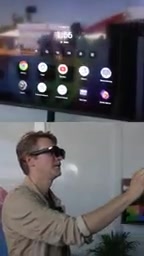
Project Aura's positioning is crystal clear—it's neither a fully enclosed VR/MR headset like the Quest, nor a feature-limited pair of smart glasses like Ray-Ban Meta. In the form factor of ordinary eyeglasses, it delivers the complete Android XR experience.
This means users can walk freely around their home while enjoying large-screen content display, AI interactions, and the full capabilities of the Android XR platform. This "everyday-wearable XR device" is precisely the product form factor many consumers actually need.
Core Hardware Breakdown: Electrochromic Lenses and External Compute Module
Electrochromic Display Technology
Project Aura features electrochromic lenses that allow users to adjust light transmittance via software controls or a physical button. When you need to focus on virtual content, the external environment can be darkened for clearer display; during everyday walking, the lenses can remain transparent.
The core principle of electrochromic technology involves applying a low-voltage current to trigger a redox reaction in the material, enabling reversible switching between transparent and tinted states. Common electrochromic materials include tungsten oxide (WO₃) and Prussian blue, among other transition metal oxides. This technology was first widely adopted in automotive auto-dimming rearview mirrors and the Boeing 787 Dreamliner's cabin window dimming system. In AR glasses, electrochromic lenses can typically vary their transmittance dynamically between 10% and 70%, with response times within a few seconds. This precisely solves the long-standing conflict between AR displays needing dark backgrounds and everyday transparent vision, and fundamentally addresses the pain point of insufficient content visibility in outdoor bright-light conditions.
External Compute Module (Puck)
All of Project Aura's computing power is concentrated in an external "Puck" module. This design choice is quite clever—moving the heat-generating, heavy computing unit away from the head allows the glasses themselves to remain lightweight and comfortable.
This "tethered architecture" is a critical engineering strategy in XR hardware design, driven by the dual constraints of thermodynamics and ergonomics: modern high-performance SoCs can reach 5-10W of thermal power at full load. If all that heat dissipation is concentrated at the head, it not only causes wearing discomfort but also throttles chip performance. XREAL's earlier Air series products already validated this approach—using a USB-C cable to connect to a phone or computer for compute tasks. Project Aura's Puck module evolves this concept into a dedicated standalone compute unit.

The Puck module also integrates a touchpad, allowing users to navigate the interface through touch without relying entirely on gestures or voice control. Even more noteworthy, the Puck features a DisplayPort input—DisplayPort supports video transmission up to 8K resolution, with theoretical bandwidth far exceeding HDMI 2.0, providing ample data throughput for high-quality content projection. This means any device with DisplayPort output (laptops, gaming consoles, phones, etc.) can project its display onto Project Aura's large virtual screen.

70-Degree Field of View: A Practical Display Experience in AR Glasses Form Factor
The 70-degree field of view (FOV) is a key specification for Project Aura. FOV directly determines the perceived "screen size" and sense of immersion—the human eye's natural horizontal FOV is approximately 200 degrees (including peripheral vision), with the comfortable binocular overlap region being about 120 degrees. AR glasses have long been constrained by the volume and weight of optical engines, making FOV the hardest bottleneck to break: the original Google Glass had only about 15 degrees, HoloLens 2 achieved 52 degrees, and Project Aura's claimed 70 degrees means that at normal viewing distance, virtual content can cover the visual equivalent of approximately a 150-inch projected screen. The optical solution to achieve this FOV typically involves waveguide technology—light propagates through total internal reflection within thin glass substrates before being projected to the eye, which is currently the mainstream approach balancing thinness with large FOV.
For comparison, most consumer AR glasses on the market today offer FOVs between 30-50 degrees, while fully enclosed headsets typically range from 90-120 degrees. A 70-degree FOV is quite impressive for a glasses-form-factor device, sufficient to deliver a strongly immersive large-screen experience whether watching videos, browsing the web, or multitasking for work.
Android XR Developer Ecosystem: The Natural Advantage of Millions of Apps
The Android XR platform powering Project Aura brings a massive benefit for developers: existing large-screen Android apps can run well on Android XR without any modifications.
Android XR is the spatial computing operating system officially released by Google in late 2024, built on top of Android 15, providing spatial computing capabilities through extended OpenXR standards and the Jetpack XR SDK. Google's "backward compatibility" strategy carries profound historical lessons: Android tablets' failure was largely due to the absence of an app ecosystem—developers were unwilling to build apps specifically for a new platform with uncertain market share. Android XR circumvents this cold-start dilemma by letting existing phone and tablet apps run directly in "floating window" mode—millions of Android apps are usable on Project Aura from day one, massively solving the app scarcity problem that plagues new platforms in their early stages.

For developers looking to deeply customize their apps for devices like Project Aura, Google has launched an early access program called Catalyst. This program is similar to Apple's early "Made for iPhone" initiative.
Related articles
 Product Reviews
The Programmer's Desk Setup Guide: Building a Workspace That Feels Like Home
Discover how programmers build productive, comfortable workspaces. From multi-monitor setups to ergonomic design, explore the desk philosophy that drives focus and flow.
 Product Reviews
Qoder vs Cursor Real-World Comparison: Which $20/Month AI IDE Is Better?
Hands-on comparison of Qoder vs Cursor AI IDEs: Agent autonomy, human interaction count, and architecture decisions. Qoder needed only 2 interactions vs Cursor's 8.
 Product Reviews
Cursor Cloud Agent Demo: Eliminating Bottlenecks Across the Entire Software Development Lifecycle
Deep analysis of Cursor's Cloud Agent demo showing how cloud VMs, automated test artifacts, and a full-chain control plane systematically eliminate human bottlenecks across the software development lifecycle.