XTRA MUSE 2 PRO Unboxing: 1-Inch Sensor Pocket Gimbal Camera Challenges DJI

XTRA MUSE 2 PRO challenges the DJI Pocket 4P with highly comparable image quality and greater availability.
The article covers a YouTube creator's unboxing of the XTRA MUSE 2 PRO pocket gimbal camera and comparisons with the DJI Pocket 4P and Insta360 products. The MUSE 2 PRO features a 1-inch CMOS, a 60mm primary lens, claimed 17-stop dynamic range, X-Log 3 10-bit log, and 4K 240fps recording; the body is slightly taller than the Pocket 4P but has a direct tripod thread in the base and a dual-sided flip touchscreen. Side-by-side tests show the two are very close in standard color under daylight, with slight nighttime color differences (MUSE cooler and bluer, Pocket warmer and more yellow), but subtle enough to be indistinguishable in blind tests, allowing footage to be intercut. The creator speculates they might be the same camera due to highly corresponding feature terminology, but admits a lack of official evidence. The product launches globally on November 10, and its availability in the U.S. market is a notable advantage over DJI.
The pocket gimbal camera market has a new player. In an unboxing of the XTRA MUSE 2 PRO, a YouTube creator noted that this new brand proactively invited media to compare it with the DJI Pocket series and Insta360 products—a clear sign of confidence.
Core Specs and Design Differences
The XTRA MUSE 2 PRO features an enhanced 1-inch CMOS sensor with a 60mm primary lens, emphasizing natural portrait perspective. The Pro version offers a multi-lens setup and officially claims dynamic range of up to 17 stops, support for a 10-bit log format called X-Log 3, and recording at up to 4K 240fps.
In terms of body design, the MUSE 2 PRO is slightly taller than the DJI Pocket 4P, but it integrates a tripod thread directly into the base—no additional adapter needed. The screen is a dual-sided flip touchscreen that can flip out to either side and click into place; the creator described the "click" as crisp with a solid locking feel. However, this asymmetrical design means that when holding the camera in your right hand, the screen sits toward the right side, which takes some getting used to.
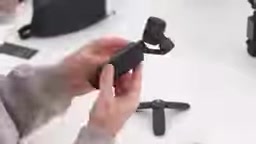
As for accessories, the Vlog Combo kit includes a fill light, wrist strap, and Type-C cable. The fill light's clip design is directly compatible with DJI products; the creator demonstrated swapping them on the spot and remarked that this cross-brand compatibility is "quite convenient."
1-Inch CMOS and Dynamic Range
A 1-inch CMOS refers to a sensor with a diagonal of about 25.4mm, with an area more than 4x that of the common 1/2.3-inch sensor—a large-sensor configuration among pocket gimbal cameras that delivers better low-light performance and shallower depth of field. Dynamic range refers to the camera's ability to simultaneously capture detail in the brightest and darkest areas of the same frame, usually measured in "stops"; 17 stops means the brightest and darkest recordable areas differ by roughly 2^17 in brightness—a fairly high claim, with real-world performance often affected by noise and compression.
X-Log 3 and 10-bit Log Format
Log format is a logarithmic gamma curve that compresses the sensor's linear response into a range better suited for post-production color grading, preserving more highlight and shadow detail. 10-bit means 1024 quantization levels per color channel, which significantly reduces banding in skies, gradients, and similar areas compared with 8-bit's 256 levels. X-Log 3 is XTRA's own log curve and requires the corresponding LUT in post to restore colors.
4K 240fps
4K 240fps means recording 240 frames per second at 3840×2160 resolution, enabling 8x slow motion (when output at 30fps). High frame rate recording typically requires greater bandwidth and faster heat dissipation; actual usable duration and whether the frame is cropped should be based on official specs.
Image Quality Test: Very Close to the Pocket 4P
The creator compared the MUSE 2 PRO with the DJI Pocket 4P across multiple scenarios, including indoor studio shooting, nighttime cityscapes, and slow-motion footage. In daylight scenes, the two performed very similarly in standard color profiles, with only subtle differences in sharpening.
The nighttime comparison is more telling. When shooting the CN Tower at night, the MUSE 2 PRO rendered the sky with a cooler, bluer tone, while the Pocket 4P leaned warmer and more yellow. In another comparison, the MUSE 2 PRO's reds appeared pinkish, while the Pocket 4P's leaned blue-green. Highlight detail retention differed slightly, with the MUSE 2 PRO showing a bit more detail at the edges of foreground elements.
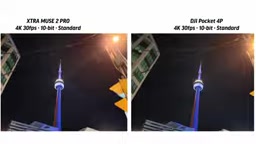
The creator repeatedly emphasized that these differences are very subtle: "If you showed both clips to passersby in a blind test, they couldn't tell them apart." He further noted that if you owned both cameras, you could easily intercut footage in editing without any sense of mismatch.
An Unavoidable Question
The most striking observation in the video was the creator's speculation: "They might be the same camera." He pointed out that the two products correspond closely in functional terminology—XTRA's "Master Follow" and "Subject Tracking" achieve the same effects as DJI's corresponding features, just under different names.
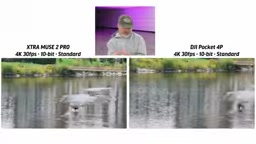
The creator also acknowledged that this judgment lacks official evidence and that the two do differ in body height, screen structure, and bottom connectors. But he believes that in everyday use with standard color profiles, the two perform "very, very similarly."
Master Follow and Subject Tracking
These terms refer to the gimbal camera's intelligent tracking features: the camera uses image recognition to lock onto a person or object and drives the three-axis gimbal to keep it in frame. Different manufacturers use different names, but the underlying technology often relies on similar object detection and tracking algorithms. Matching feature names and identical effects do not necessarily mean the hardware or firmware is shared—it could also result from converging supply-chain solutions or industry-standard algorithms, so the creator's speculation remains an observational inference.
Market Significance and Purchase Information
A practical factor that came up repeatedly in the video: the DJI Pocket 4P is unavailable in the U.S. market, while the XTRA MUSE 2 PRO is. The creator believes that for most users creating social media content, this type of pocket gimbal camera is the most efficient choice—combining a large sensor, wireless microphone connectivity, smooth tracking, and portability.
According to the video, the XTRA MUSE 2 PRO and MUSE 2 will launch globally on November 10 through XTRA's official website and TikTok Shop (in participating markets), with global warranty support. The MUSE 2 continues to be sold alongside the Pro version as an entry-level model at a more attractive price.
For users looking for a Pocket 4P alternative, the MUSE 2 PRO shows enough competitiveness in image quality, but the screen operation logic and the long-term performance of the brand ecosystem still need more real-world testing.
One-line Summary
XTRA MUSE 2 PRO challenges the DJI Pocket 4P with highly comparable image quality and greater availability.
Paragraph Summary
The article covers a YouTube creator's unboxing of the XTRA MUSE 2 PRO pocket gimbal camera and comparisons with the DJI Pocket 4P and Insta360 products. The MUSE 2 PRO features a 1-inch CMOS, a 60mm primary lens, claimed 17-stop dynamic range, X-Log 3 10-bit log, and 4K 240fps recording; the body is slightly taller than the Pocket 4P but has a direct tripod thread in the base and a dual-sided flip touchscreen. Side-by-side tests show the two are very close in standard color under daylight, with slight differences in nighttime color bias (MUSE cooler and bluer, Pocket warmer and more yellow), but subtle enough to be indistinguishable in blind tests, allowing footage to be intercut. The creator speculates they might be the same camera due to highly corresponding feature terminology, but admits a lack of official evidence. The product launches globally on November 10, and its availability in the U.S. market is a notable advantage over DJI.
Related articles

GPT-6.2 Astra and Sol Released: Dual-Model Architecture and Community Buzz
OpenAI releases GPT-6.2 with Astra and Sol models. This article summarizes the official announcement and Hacker News discussion, analyzing the potential impact of the dual-model architecture on developers and offering selection advice.

Gmod TTT Egyptian-Themed Map: Space Capitalism vs. the Pharaoh
Explore the fun of a Gmod TTT Egyptian-themed map: players pick roles like pharaoh, teleport to space via a cube, and engage in a humorous capitalism vs. communism showdown with chaotic prop fighting.

GraphRAG: Beyond Search, Toward Global Knowledge Discovery
GraphRAG is a knowledge-graph-enhanced retrieval technology from Microsoft Research that goes beyond local search in traditional RAG to enable global knowledge discovery. This article introduces its core ideas, generational evolution, and healthcare use cases.