Yale Professor Slams Nvidia: A "Stumbling Block" for American Industry, Not Its Defender

Yale professor Sonnenfeld slams Nvidia for harming American industry, warning of director liability and geopolitical risk.
Yale School of Management professor Jeffrey Sonnenfeld fiercely criticized Nvidia and CEO Jensen Huang, calling Nvidia a "detriment" rather than a defender of American industrial strength. He argues the market's optimism over Huang's board return may be a huge mistake, exposing directors to "historic" personal liability risk amid growing litigation, and questions whether Nvidia helps put advanced chips into rivals' hands. The debate centers on Nvidia's national role: symbol of U.S. tech leadership or strategic loophole from monopolistic control and global sales networks.
Title
Yale Professor Slams Nvidia: A "Stumbling Block" for American Industry, Not Its Defender
Meta Description
Yale professor Sonnenfeld criticizes Nvidia as a "detriment" rather than a defender of American industry, warning that Jensen Huang's return to the board brings historic personal liability risks and questioning the company's role in putting advanced chips into rivals' hands. Market euphoria contrasts sharply with expert warnings.
Article Content
Jeffrey Sonnenfeld, a professor at Yale School of Management, recently launched a fierce attack on Nvidia and its CEO Jensen Huang, stating bluntly that the chip giant is a "detriment" rather than a "defender" of American industrial strength. These remarks stand in sharp contrast to the market's enthusiastic response to Huang's return to Nvidia's board of directors, and they open up a deeper debate about the role of tech giants, legal liability, and geopolitical risk.
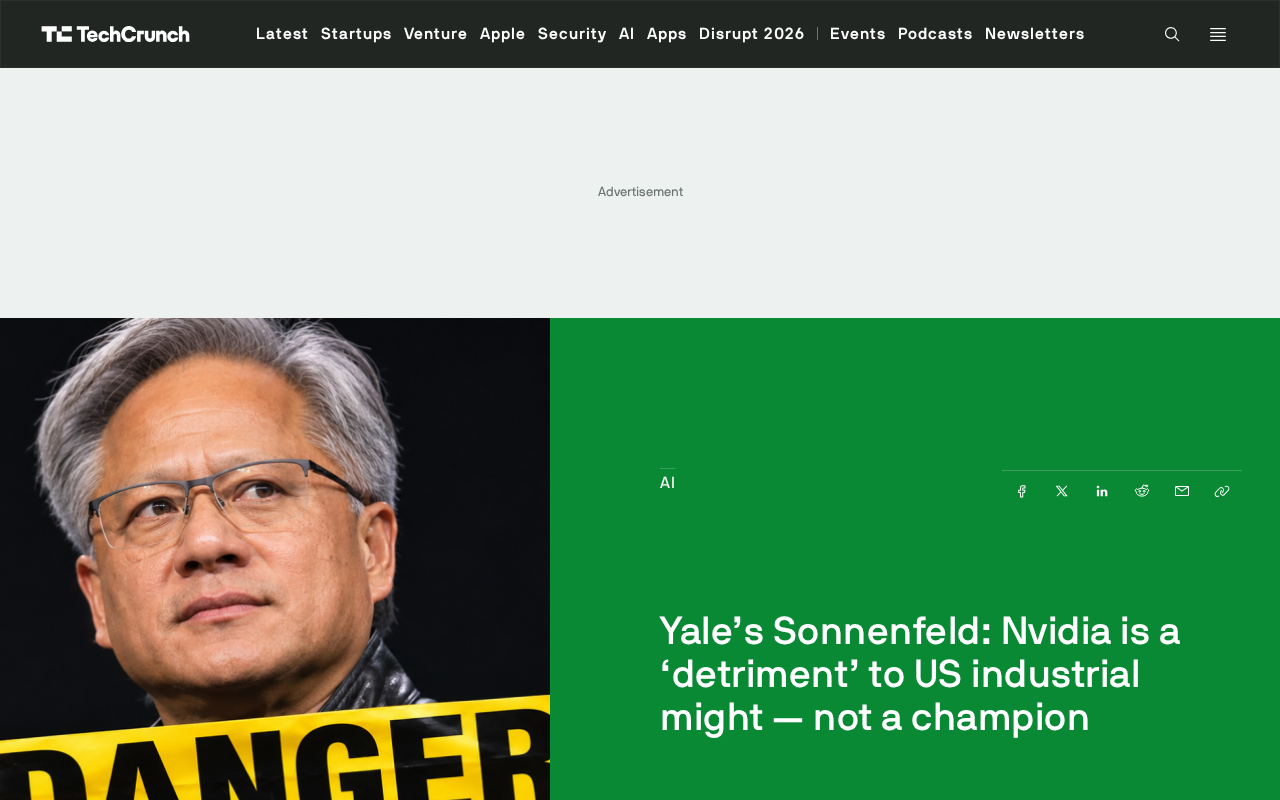
Hidden Concerns Behind Market Cheers: Personal Liability Risk for Directors
According to Sonnenfeld's analysis, the market has welcomed Huang's return to Nvidia's CEO and board positions with White House support, but this could be a huge mistake. He argues that this arrangement exposes directors to "historic" personal liability risk, while Nvidia faces a growing number of lawsuits.
This warning is not unfounded. As Nvidia's dominance in the AI chip market continues to strengthen, its business practices are coming under increasingly strict scrutiny. Sonnenfeld points out that the issue of personal liability for the board could become a time bomb—if the company is sued for alleged monopolistic practices or other misconduct, directors may not be able to escape responsibility.
Entangled in Litigation and Governance Questions
Sonnenfeld did not specify the details of the lawsuits, but stressed that "accumulating litigation" is posing a substantial threat. For a company with a massive market capitalization, personal liability risk for directors not only affects governance structure but could also shake investor confidence.
Personal liability risk for directors generally refers to the possibility that company directors may face personal compensation or even criminal liability for failing to fulfill their duties of loyalty or care. Under U.S. corporate law, directors are generally protected by the "business judgment rule," but this protection may fail if there are conflicts of interest, deliberate disregard of risks, or tolerance of illegal conduct. For a company like Nvidia, which sits at the intersection of antitrust and export controls, directors could face shareholder derivative suits or regulatory action if they are found to have failed to establish effective compliance oversight mechanisms. So-called "historic" risk often refers to compensation amounts, litigation scale, or precedent impact that exceed the norm and are sufficient to change standard practices in tech company board governance.
Geopolitical Accusations of "Putting Advanced Chips into Rivals' Hands"
One of the more controversial points in Sonnenfeld's criticism is his questioning of whether the United States is celebrating a company that "helps put advanced chips into rivals' hands." This accusation directly targets Nvidia's role in global chip trade, especially against the backdrop of increasingly tightened export controls.
Nvidia's GPU products are core hardware for training large-scale AI models, and its global sales network inevitably involves complex geopolitical considerations. The U.S. government imposes strict controls on advanced chip exports, and how Nvidia balances compliance with commercial interests has always been a focus of outside attention.
Sonnenfeld's remarks suggest that Nvidia's business practices may objectively weaken America's technological advantage. This view forms a strong contrast with the market's enthusiasm for Nvidia and reflects deep divisions over the national responsibilities of tech companies.
The Mismatch Between Market Reaction and Critical Voices
One detail worth noting is that Sonnenfeld's criticism is completely out of step with optimism in capital markets. The market views Huang's return as good news, while Sonnenfeld believes it may be a "huge mistake." This mismatch itself shows that investors focus more on short-term business prospects, while critics focus on long-term strategic risk.
U.S. export controls on advanced chips are mainly based on the Export Administration Regulations (EAR), enforced by the Bureau of Industry and Security (BIS) of the Department of Commerce, and restrict the flow of specific chips and manufacturing equipment to countries such as China through the "Entity List" and the "foreign direct product rule." Nvidia's GPUs, due to their high computing density, have been included in multiple rounds of controls, and the company needs to launch "downgraded" products that meet performance thresholds to maintain compliant sales. However, there is a time lag between control thresholds and technological iteration, and critics worry that commercial sales networks may indirectly give rivals access to advanced computing power through third-party transshipment or cloud services. This background explains why Sonnenfeld's accusations can resonate: compliance and strategic effect are not always aligned.
The Debate Over Nvidia's Role: Innovation Engine or Strategic Loophole?
The core of this debate lies in how to define Nvidia's national role. Supporters argue that Nvidia is a symbol of American technological leadership in the AI era, with its chips driving frontier fields from autonomous driving to drug discovery. Opponents worry that one company's monopolistic control over critical technology, combined with a globalized sales network, may bring uncontrollable strategic risks.
Sonnenfeld's "detriment theory" is sharp, but it is not an isolated view. In recent years, discussion has increased about the excessive power of tech giants, opaque governance, and their complex roles in geopolitics. Nvidia is merely the latest focus.
What Investors Need to Watch
For investors, Sonnenfeld's warning raises several dimensions worth attention: Is the legal liability risk of the board being underestimated? How will changes in export control policy affect Nvidia's global business? And is market sentiment around Nvidia overly optimistic while ignoring governance risk?
These questions have no simple answers, but Sonnenfeld's criticism at least reminds people that beneath Nvidia's halo lie complex challenges at the governance and strategic levels.
The debate over the "national role" of tech giants is not a new phenomenon. Historically, AT&T, IBM, and Microsoft have all faced antitrust or regulatory scrutiny due to market dominance and strategic importance. Compared with them, Nvidia's particularity lies in the fact that its products are at the core of the AI arms race, and its global supply chain is highly dependent on overseas manufacturing by companies such as TSMC. This means Nvidia is both a vehicle for American technological advantage and a focal point of geopolitical vulnerability. Supporters emphasize its R&D investment and ecosystem barriers, while opponents focus on monopoly rents, lobbying power, and actual influence over export control policy. Understanding this duality is the key framework for judging whether Sonnenfeld's criticism holds.
One-line Summary
Yale professor Sonnenfeld slams Nvidia for harming American industrial strength, warning of director liability and geopolitical risk.
Paragraph Summary
Jeffrey Sonnenfeld, a professor at Yale School of Management, recently launched a fierce criticism of Nvidia and its CEO Jensen Huang, saying Nvidia is a "detriment" rather than a defender of American industrial strength. He believes the market's optimistic reaction to Huang's return to the board may be a huge mistake, because it exposes directors to "historic" personal liability risk while Nvidia faces growing litigation. Sonnenfeld also questions whether Nvidia is helping put advanced chips into rivals' hands, raising geopolitical concerns. The article notes that the core of this debate is how to define Nvidia's national role: a symbol of American technological leadership in the AI era, or a strategic loophole created by monopolistic control and a globalized sales network. Investors need to watch governance risk, the impact of export controls, and whether market sentiment is overly optimistic.
Related articles

MIT PhD Takes You from Scratch to Build DeepSeek: A 25-Hour Hardcore Course
MIT PhD Raj Dandekar launches a 25+ hour Bilibili course building DeepSeek from scratch—MoE, MLA, GRPO, hand-written code plus math derivations, aiming to reproduce mini R1.

DeepSeek Harness in Practice: From Installation to Plugin Ecosystem, Building a Fully Automated AI Workflow
Based on a hardcore Bilibili tutorial, this guide systematically covers DeepSeek Harness installation, three plugin installation methods, and real-world use cases to help developers quickly build customizable AI Agent workflows.

DeepSeek Harness in Practice: From Installation to Automated Workflows
Hands-on DeepSeek Harness tutorial covering Mac/Windows installation, login, workspace binding, model & permission setup, and minimal closed-loop verification for AI automation workflows.