Yalqen Browser: An Open-Source Arc Alternative Built for Developers
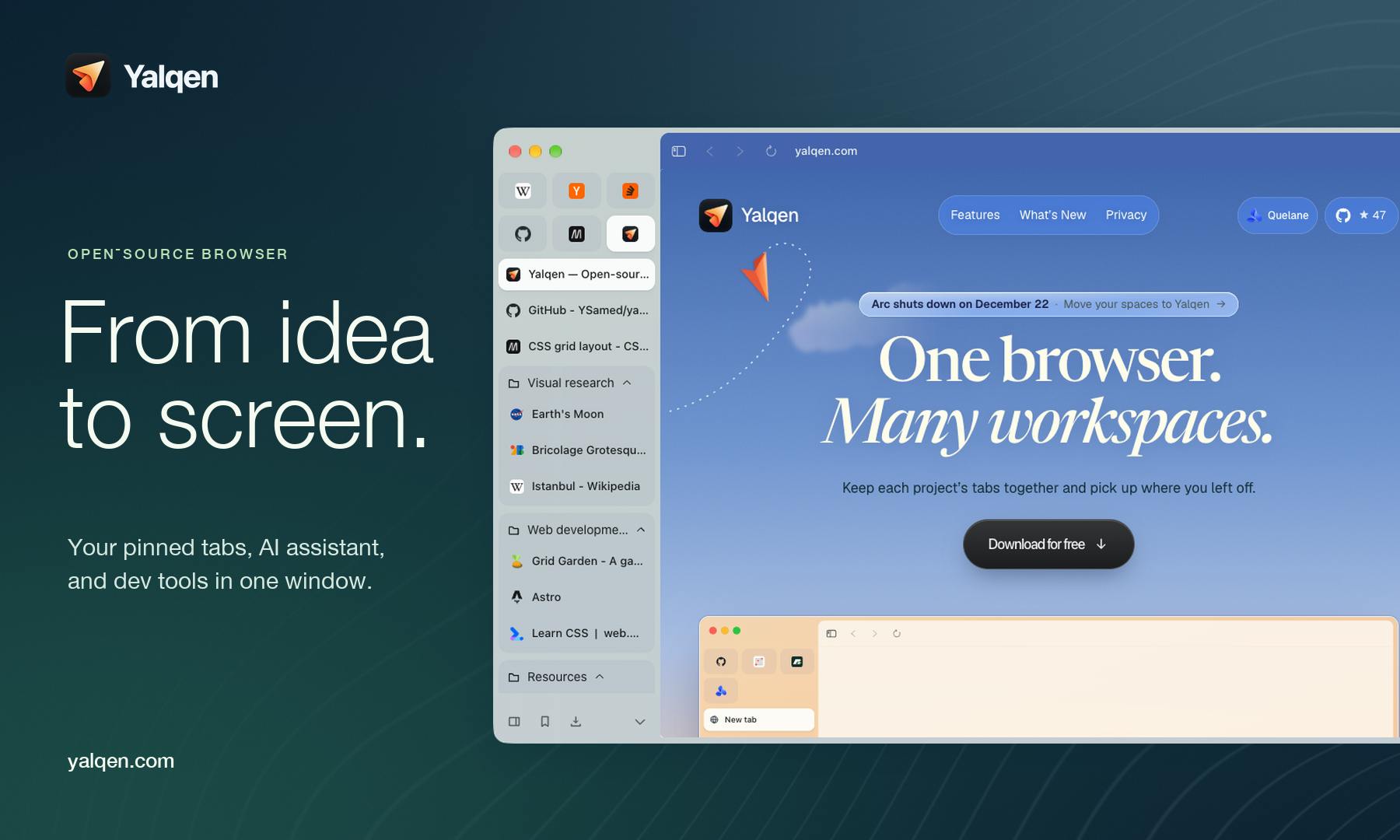
Open-source Chromium browser Yalqen aims to carry on Arc's vertical tabs and Spaces experience for developers.
With Arc shutting down, developers need a new workflow tool. Yalqen Browser is a free, open-source Chromium browser positioned as an Arc alternative, retaining vertical tabs, Spaces, split view, ad blocking, and an optional AI panel, and supporting import from Arc with no account required. It ranks 9th on Product Hunt with 76 votes, though long-term maintenance and ecosystem sync remain to be proven.
As Arc Bows Out, Developers Need a New Choice
With its unique vertical tabs and space management features, Arc browser once won the hearts of many developers. However, with news that Arc is about to shut down, users are forced to look for alternatives. Yalqen Browser was born in this context—a free, open-source Chromium browser aimed squarely at developers accustomed to the Arc workflow.
Yalqen received 76 upvotes and 8 comments on Product Hunt, ranking 9th, categorized under Productivity, Open Source, and Developer Tools. Its core promise is simple: keep the familiar Arc experience, but deliver it as open source with no account required.
Chromium is an open-source browser project led by Google, with the Blink rendering engine and V8 JavaScript engine at its core. Many mainstream browsers (such as Chrome, Edge, Brave, and Opera) are built on Chromium, so they share the same underlying rendering behavior and support for web standards. For developers, this means that in Chromium-based browsers, page rendering, the DevTools debugging experience, and extension compatibility are highly consistent. By choosing Chromium as its foundation, Yalqen is effectively reusing mature browser infrastructure while ensuring compatibility, allowing it to focus its efforts on differentiated upper-layer features.
Core Features: The Essence of Arc, an Open-Source Foundation
According to its Product Hunt page, Yalqen integrates several features optimized for developers:
- Vertical Tabs and Spaces: Following Arc's space management logic, helping users organize tabs by project or scenario.
- Split View: Supports side-by-side browsing, making it easy to compare documents or debug interfaces.
- Built-in Ad Blocking: Reduces distractions and improves page load efficiency.
- Developer Tools: Based on the Chromium engine, DevTools is naturally retained.
- Optional AI Panel: Provides extensibility for scenarios that need intelligent assistance.
- Seamless Migration: Supports importing Arc's Spaces and pinned tabs, lowering the switching cost.
This combination of features shows that Yalqen is not simply copying Arc, but attempting to carry forward its productivity philosophy within the open-source ecosystem.
Vertical tabs refer to changing browser tabs from a horizontal arrangement at the top to a vertical arrangement on the side, usually combined with grouping and collapsing features. This layout better suits the proportions of modern widescreen monitors, can display more tab titles, and reduces tab crowding. Spaces go a step further on top of vertical tabs by dividing tabs into different spaces based on projects or scenarios, with each space having its own independent tab collection and pinned pages. Arc was the first to popularize this concept, allowing users to create separate spaces for different workflows (such as "Development," "Design," and "Personal"), with the entire tab environment changing when switching spaces, thereby reducing the cognitive burden of context switching. Yalqen inherits this logic, aiming to let developers organize browsing sessions by project.
The Developer Perspective: Why It's Worth Watching
For developers, browser customizability and data autonomy are crucial. Yalqen emphasizes no account required, meaning users don't have to worry about their data being tied to a cloud service. At the same time, its open-source nature allows the community to review the code, contribute plugins, and even build their own forks.
The Chromium engine ensures compatibility with existing web standards and extensions, so developers don't need to re-adapt to the underlying rendering engine. The built-in ad blocking and split view directly reduce friction in daily work.
Interestingly, Yalqen's AI panel is an optional feature, which aligns with developers' demand for tool transparency—enable it when needed, ignore it entirely when not.
DevTools (Developer Tools) is a set of debugging and diagnostic tools built into the browser, typically including an element inspector, console, network panel, performance profiler, source code debugger, and more. For web developers, DevTools is an indispensable part of daily work. Because Yalqen is based on Chromium, it naturally inherits all the features of Chrome DevTools, so developers don't need to learn a new debugging interface or worry about missing tools. This is also one of the key reasons why Chromium-based browsers are developer-friendly—the continuity of the toolchain lowers the cost of migration.
Migration and Onboarding: A Smooth Transition from Arc
According to the official description, Yalqen supports importing Arc's Spaces and pinned tabs. For users who rely heavily on the Arc workflow, this is undoubtedly key to lowering the migration cost. Although the actual import results need further testing, at least in terms of product design, Yalqen clearly treats Arc users as its core audience.
As an open-source project, users can get the code from GitHub, compile it themselves, or follow updates. For developers who value privacy and control, this transparency is itself a selling point.
The Challenges and Opportunities of Open-Source Alternatives
Arc's shutdown has made many users realize that the lifecycle of closed-source products is not entirely under users' control. Yalqen's emergence as an open-source project responds precisely to this pain point. However, open-source browsers also face challenges: ongoing maintenance, security updates, and synchronization with the Chrome ecosystem.
Currently, Yalqen's popularity on Product Hunt (76 votes) shows it has attracted initial attention, but it still needs time to prove itself before reaching maturity. The continued commitment and community building of its maker, Yaşar Samed Erol, will determine how far the project can go.
If you're looking for an Arc alternative and value open source, no account required, and developer-friendly features, Yalqen is worth adding to your watchlist.
One-line Summary
Open-source Chromium browser Yalqen aims to carry on Arc's vertical tabs and Spaces experience, offering developers an account-free alternative.
Paragraph Summary
With Arc browser about to shut down, developers need a new vehicle for their workflow. Yalqen Browser is a free, open-source Chromium browser positioned as an Arc alternative, retaining features such as vertical tabs, Spaces, split view, built-in ad blocking, and an optional AI panel, and supporting import of Spaces and pinned tabs from Arc. It emphasizes no account required and data autonomy, and its open-source nature allows community review and customization. It currently has 76 votes and ranks 9th on Product Hunt, indicating initial interest. However, as an emerging open-source project, its long-term maintenance, security updates, and ecosystem synchronization remain challenges to be verified. For users who value open source and developer-friendly features, Yalqen is worth adding to the watchlist.
Related articles

Shokz OpenRun Pro 2 Drops to All-Time Low Price, $55 Off
Shokz OpenRun Pro 2 drops to $124.95 during Black Friday and Cyber Monday, $55 off and matching its all-time low. We break down the use cases, value, and buying advice for these open-ear sports headphones.

Why Does Radiation Cause Electronic Device Failures? New Study Offers an Explanation
A new study explains the mechanisms by which radiation triggers electronic device failures, exploring single event effects and total dose effects on semiconductor devices, and the implications for radiation-hardened chip design and aerospace electronics reliability.

Uber Teams Up with Nuro to Enter Waymo's Turf: The Robotaxi Battle Escalates
TechCrunch Mobility reports Uber and Nuro's partnership to enter the robotaxi market, directly challenging Waymo's dominance. This article analyzes the role division, the competition between platform-based and full-stack models, and the impact on the Robotaxi industry landscape.