Yandex Sona: How a Single Transformer Replaced 15+ Recommendation Components

Yandex Music's Sona replaces 15+ recommendation components with one Transformer, boosting listening time by 6.3%.
Yandex Music's research team released Sona, a generative recommendation model that replaces 15+ candidate generators, pre-ranking, and ranking models with a single Transformer. Sona processes up to 8,192 user behavior events and uses a History Compression mechanism — splitting history into 6,144 earlier and 2,048 recent events — to cut inference costs roughly in half while retaining long-term preference signals. The decoder and ranking module share a single encoder output, and candidates are generated via beam search as Semantic IDs, integrating recall and ranking into one forward pass. A 7-day A/B test on smart speakers showed +4.53% active users and +6.30% total listening time (both p<0.01), though catalog coverage remains below the existing production stack.
Yandex Music's research team has published an ambitious recommender system experiment: replacing 15+ candidate generators, pre-ranking models, and ranking models in production with a single Transformer model. The model, called Sona, delivered positive results in A/B testing, offering a new reference point for deploying generative recommender systems in the real world.
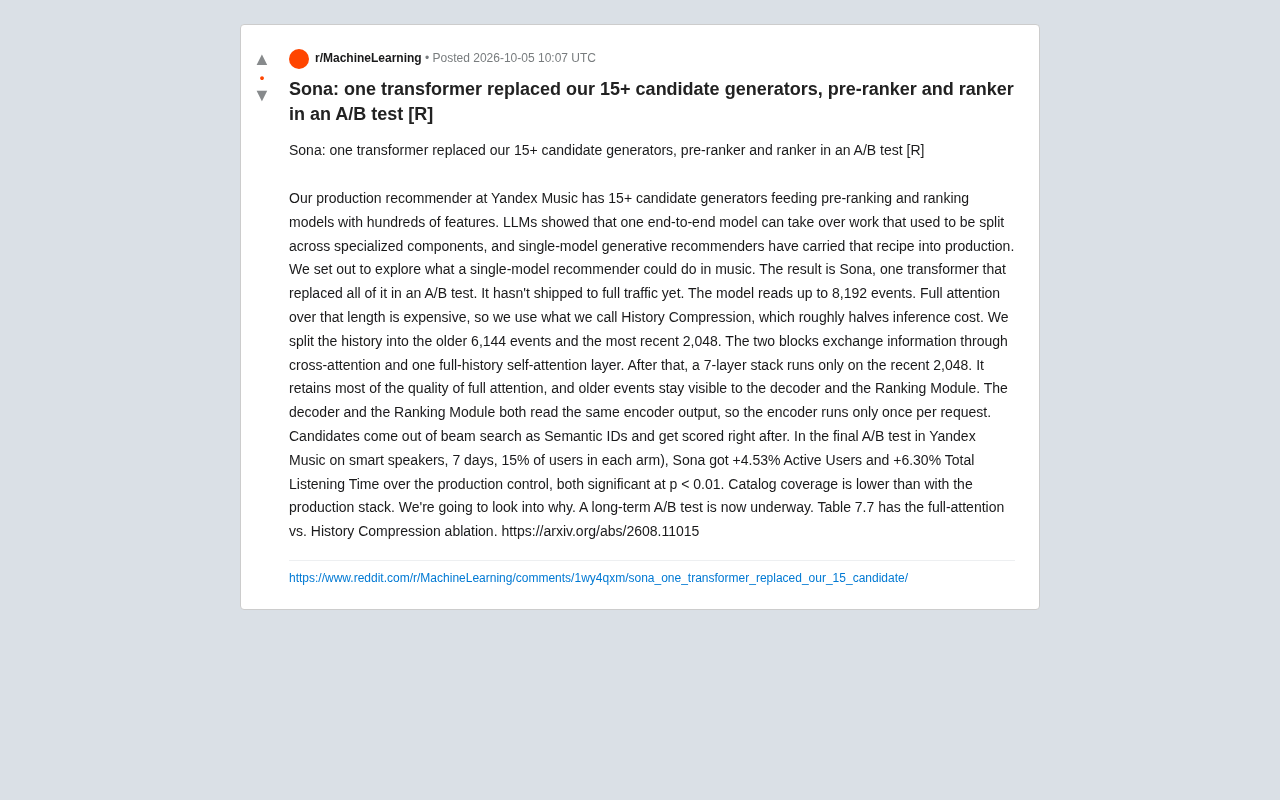
From Multi-Component Pipelines to a Single Model
Traditional recommender systems are typically complex pipelines. In Yandex Music's case, the production environment included 15+ candidate generators feeding hundreds of features into pre-ranking and ranking models, filtering results layer by layer before arriving at a final recommendation. This architecture offers clear separation of concerns and independent optimization per component, but comes at the cost of high maintenance overhead and complex inter-component coordination.
The rise of LLMs has shifted this thinking. The team points out that large language models demonstrated that a single end-to-end model can take over work previously distributed across multiple specialized components — and generative recommenders have already brought this methodology into production. Sona is a complete exploration of "single-model recommendation" in the music domain, collapsing an entire pipeline into one Transformer.
It's worth noting that Sona is not yet fully deployed and remains in the experimental validation stage — but its A/B test results are compelling enough to draw serious industry attention.
History Compression: The Cost-Quality Trade-off for Long Sequences
One of Sona's core capabilities is processing up to 8,192 user behavior events. Running full attention over such long sequences is computationally expensive — an unavoidable performance bottleneck in long-sequence modeling.
To address this, the team designed a mechanism called History Compression, which roughly halves inference costs. The approach splits user history into two segments: the earlier 6,144 events and the most recent 2,048 events.
How the Two History Segments Interact
These two blocks exchange information via two mechanisms: cross-attention and a single self-attention layer that spans the full history. After this information exchange, the remaining 7-layer Transformer stack operates only on the most recent 2,048 events.
The elegance of this design is that it dramatically reduces computation while preserving most of the quality of full attention — earlier history events remain visible to both the decoder and the Ranking Module. In other words, the model doesn't "forget" long-term user preferences due to compression. Table 7.7 in the paper provides a full ablation comparing full attention against History Compression.
Encoder Reuse and the Candidate Generation Flow
Sona includes another key efficiency optimization: the decoder and ranking module read from the same encoder output, so the encoder only runs once per request. This avoids redundant computation and is an important engineering detail that makes the single-model approach viable in production.
Candidate generation follows a beam search path, producing Semantic IDs that are immediately scored. The entire recall-then-rank process is integrated into a single forward pass of the same model, replacing the complex multi-system pipeline that previously required several independent systems in sequence.
A note on Semantic IDs: Semantic IDs are a core representation technique in generative recommender systems. Unlike traditional systems that use raw item IDs (e.g., a song's database primary key), Semantic IDs compress an item's content features or collaborative filtering embeddings into a sequence of discrete codewords via hierarchical quantization (e.g., RQ-VAE, Residual Quantization Variational Autoencoder). For example, a song might be encoded as a token sequence like [42, 17, 8], where these tokens capture semantic similarity — songs with similar content share common prefixes. This design allows the Transformer to "generate" recommended items just as it generates text, with beam search efficiently exploring the candidate space in this discrete token space. A key advantage of Semantic IDs is that the model can generalize to long-tail items that appeared infrequently during training, since they share some codewords with popular items rather than depending on high-frequency exposure to learn useful representations.
A/B Test Results and Open Questions
Sona's final A/B test ran for 7 days in Yandex Music's smart speaker scenario, with each experiment group covering 15% of users. The results are impressive:
- Active Users: +4.53%
- Total Listening Time: +6.30%
Both metrics reached p < 0.01 statistical significance relative to the production baseline. For a new architecture designed to replace an entire mature pipeline, achieving positive gains on core business metrics validates the single-model approach as genuinely competitive in real-world settings.
The Catalog Coverage Concern
The results aren't without caveats. The team openly acknowledges that Sona's catalog coverage is lower than the existing production stack. This suggests the model may favor popular content while underserving long-tail tracks — a classic exploration-exploitation challenge in recommender systems. The team says they are actively investigating the cause of the coverage drop.
A longer-term A/B test is currently underway, which will further validate Sona's stability and real-world value over a longer time horizon.
A note on catalog coverage: Catalog coverage is an important diversity metric for recommender systems, defined as the proportion of distinct items actually recommended out of the total catalog available. Low coverage means recommendation traffic is heavily concentrated on a small number of popular items — a so-called "Matthew effect" where popular content grows more popular and long-tail content gets almost no exposure. For a music platform, this not only degrades the user experience of discovering new content, but directly harms the platform's commercial relationships with independent artists and niche labels. Generative models are naturally disadvantaged on this dimension: the Semantic IDs of high-frequency items in training data are more thoroughly optimized, and the model tends to favor high-probability popular paths during beam search. Common mitigations include introducing diversity penalty terms during decoding, upsampling long-tail item Semantic IDs during training, and explicitly adding coverage constraints at the ranking stage — though these approaches often trade off against immediate engagement metrics like click-through rates.
Implications for Recommender System Engineering
The significance of Sona goes beyond the metric improvements — it validates a possible technical evolution path: unifying a traditional recommendation pipeline with a single generative model. This aligns with the broader LLM-era trend of replacing multiple specialized models with one large model.
For engineering teams, a single-model approach means lower system maintenance complexity and more consistent optimization objectives, but it also introduces new challenges — how to control inference costs for long-sequence modeling, and how to ensure diversity in content coverage. History Compression and encoder reuse demonstrate practical engineering approaches for deploying long-sequence generative recommendation within manageable cost constraints.
The full details of this work are publicly available in the arXiv paper (arxiv.org/abs/2608.11015). Readers interested in the technical details can consult ablation experiments such as Table 7.7 for more information.
Related articles

Chain of Thought Isn't Just for AI: How Humans Can Use CoT to Improve Thinking Quality
Chain of Thought isn't just a prompt trick for large models. Starting from a Hacker News discussion, this article analyzes why CoT works for human thinking too, breaks down actionable ways to transfer it, and highlights the key differences between human CoT and machine CoT.
Cloudflare Teams Up with OpenAI: Closi…
Cloudflare Teams Up with OpenAI: Closing the Loop from Vulnerability Discovery to Defense with AI
Cloudflare uses OpenAI Daybreak to investigate security vulnerabilities and generate reviewable remediation plans, while developers use Codex to boost coding efficiency and quality.

Orca Multi-Agent Orchestration in Practice: A Guide to Parallel Collaboration with Claude and Codex
Orca is Stable AI's free open-source agent workbench supporting 34 agents like Claude Code and Codex in parallel. Learn its Git worktree isolation, multi-model orchestration, and mobile management.