YC Head Garry Tan Spends $200K a Year on AI Tokens, Calls Himself 'Cyber Psychotic'

Y Combinator CEO Garry Tan spends up to $200K a year on AI tokens, a new cost normal for heavy agent users.
On Walter Isaacson's podcast The Builders, Y Combinator CEO Garry Tan disclosed for the first time that he spends up to $200,000 a year on AI tokens, driven by deeply embedding AI agents into daily coding, writing, and research workflows. Tan has joked that his obsession with agent collaboration gives him 'cyber psychosis,' sometimes barely sleeping. As head of a top incubator, his spending intensity signals that AI tokens have become a core operating cost for some heavy users—an opportunity for AI product companies and a caution for developers about balancing frequency, complexity, and output.
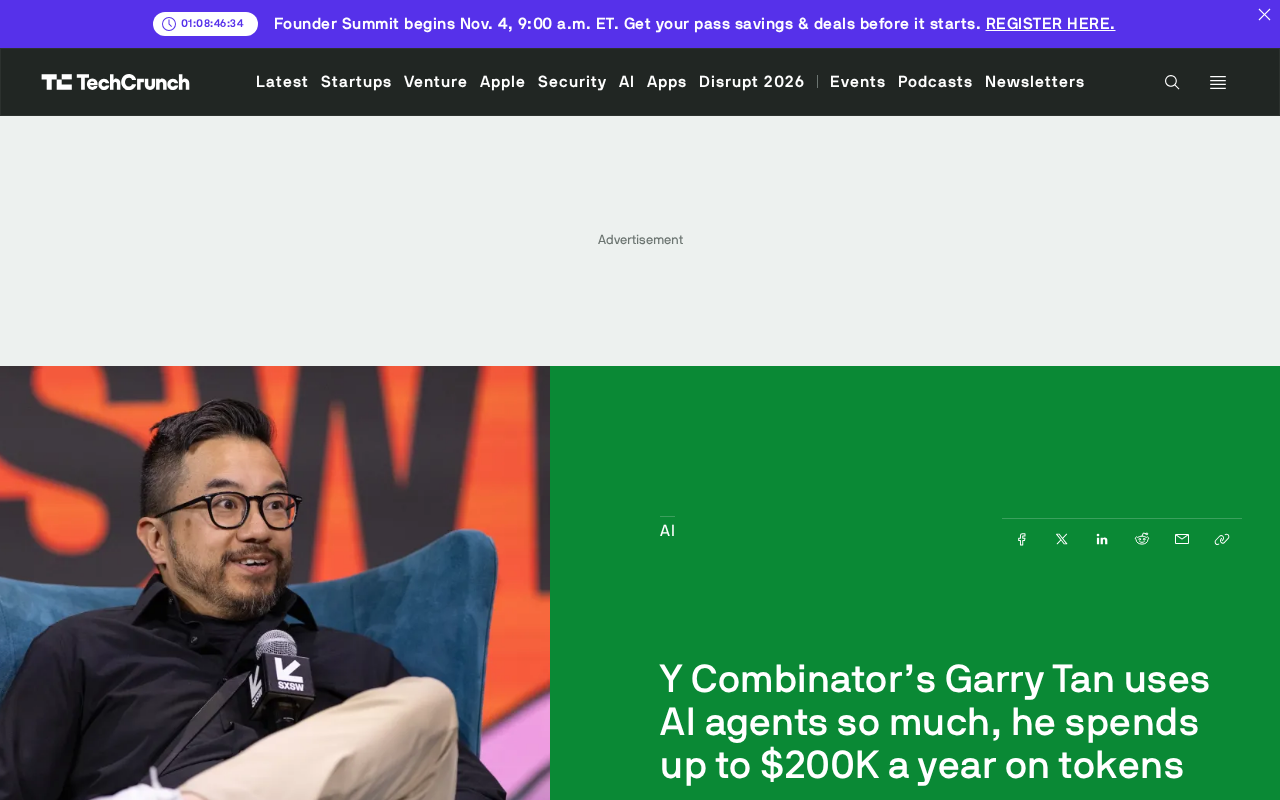
Y Combinator CEO Garry Tan's obsession with AI agents is no secret. He has joked that he suffers from "cyber psychosis," sometimes barely sleeping because working with AI agents is so exciting. On a new episode of Walter Isaacson's podcast The Builders, Tan put a price tag on that passion for the first time: up to $200,000 a year on AI tokens.
Behind the $200K Token Bill
According to Tan on the podcast, he spends up to $200,000 a year on AI tokens. That figure is striking for personal AI usage—hardly a trivial sum even for the head of a venture capital firm. It makes one thing plainly clear: the actual consumption of heavy AI agent users may far exceed what subscription-based products would suggest.
What drives this spending is Tan's habit of deeply embedding AI agents into his daily workflow. He doesn't treat agents as tools to call on occasionally; he has them continuously participate in coding, writing, research, and other tasks, and high-frequency use naturally drives up token consumption.
AI tokens are the basic unit of measurement for how large language models process text—both model input and output are split into tokens for billing. With mainstream models, an English word roughly corresponds to 1–2 tokens, while Chinese often requires more. API calls are typically billed separately at per-million-token input and output prices, with output generally priced higher than input. What's special about agent scenarios is the volume: a single task often involves multiple rounds of reasoning, tool calls, file reading, and self-verification, so token usage for one task can be dozens of times that of an ordinary conversation. As a result, heavy users' annual spending can reach the thousands to hundreds of thousands of dollars, and these costs usually come from pay-as-you-go API billing rather than fixed monthly subscription plans.
"Cyber Psychosis": A Heavy User's Self-Deprecation
Tan has previously half-jokingly admitted to symptoms of "cyber psychosis"—barely sleeping because he's addicted to collaborating with AI agents. The phrase is playful, but it reflects the state of a certain kind of heavy user: the productivity gains from AI agents are so significant that users voluntarily extend their working hours, immersed in the loop of human-AI collaboration.
This kind of self-deprecation is not uncommon among developers and entrepreneurs. When agents can take on more and more execution work, the user's role shifts to directing and reviewing—and the pace actually gets faster.
In the AI context, an agent refers to a form of large-model application that can autonomously plan steps, call external tools (such as code execution, web search, file reading and writing), and iterate based on results—distinct from chatbots that only handle single-turn Q&A. It typically works in a "think—act—observe" loop: the model first breaks down the task, then calls tools to get feedback, then corrects its next action until the goal is achieved. This multi-round autonomous execution is exactly why token consumption far exceeds ordinary conversations, and it explains why users who deeply embed agents into their workflows generate substantial bills.
Implications for Entrepreneurs and the AI Industry
Tan's identity gives this spending extra signal value. As the head of Y Combinator, one of the world's best-known startup incubators, his tool choices and usage intensity reflect, to some degree, how deeply top entrepreneurs are investing in AI agents.
From a cost-structure perspective, $200,000 a year means AI tokens have gone from an "add-on" to one of the core operating costs for some heavy users. For companies building AI products, this is both a revenue opportunity and a reminder of the tension between pricing and usage ceilings—the most aggressive users are willing to pay considerably for agent capabilities.
For ordinary developers, Tan's case is more of an extreme reference point: the value of AI agents scales with depth of use, but so does the cost. How to strike a balance among call frequency, task complexity, and actual output is a question every heavy user needs to face.
One-line Summary
Y Combinator CEO Garry Tan spends up to $200,000 a year on AI tokens, reflecting a new cost normal for heavy agent users.
Paragraph Summary
In Walter Isaacson's podcast The Builders, Y Combinator CEO Garry Tan disclosed for the first time that he spends up to $200,000 a year on AI tokens. The expense stems from deeply embedding AI agents into daily workflows like coding, writing, and research, with high-frequency use driving up consumption. Tan has joked that his obsession with agent collaboration gives him "cyber psychosis," sometimes barely sleeping. As head of a top incubator, his spending intensity is a signal: AI tokens have evolved from an "add-on" into a core operating cost for some heavy users. For AI product companies, this means both revenue opportunities from extreme users' willingness to pay and tension between pricing and usage ceilings; for ordinary developers, it means finding a balance among call frequency, task complexity, and output.
Related articles

GPT-6 Astra's Weight-Reading Trick: Only for Small Networks, Practical Value Comes from Writing Code
GPT-6 Astra can read network weights directly, but without tools it is limited to small networks of ~170K weights. Fixing QUEN 3.5 0.8b's reasoning loop required Python and 50 batches; game identification took nearly an hour. This article maps the capability's boundaries and two security reminders.

GPT-6 Astra Rewrites Qwen Weights: 7.9% to 48.1% — Did It Learn Math or Just Learn to Stop?
MIT researchers used GPT-6 Astra to edit Qwen's weights directly, raising math scores from 7.9% to 48.1% with no training. But reproductions show the gain mainly comes from fixing loops and teaching the model to stop, not new math ability.

Can Qwen 3.8 27B Really Read Neural Network Weights? A 16GB Hands-On Test
MIT claims LLMs can directly read neural network weights. We tested Qwen 3.8 27B on a 16GB GPU: the signal is real, but "native reading" is false.