Yedric.ai: Control SaaS with Natural Language — Make Your Product AI-Native in 30 Minutes

Yedric.ai layers natural language interaction onto SaaS products so users state intent instead of hunting for features.
Yedric.ai is an embeddable AI agent tool for SaaS developers that layers a natural language interface on top of existing products without rebuilding any business logic. Users express intent in plain language; Yedric maps it to actions the product already supports — reimagining the entrypoint rather than expanding feature scope. With a claimed 30-minute integration time, it replaces the costly in-house engineering required for intent recognition, tool calling, and context management. The product earned 163 upvotes and ranked #3 on Product Hunt. Key challenges include intent recognition accuracy and safety guardrails for irreversible operations, both of which directly determine long-term user trust.
Users Shouldn't Have to Learn Your Product
Every SaaS developer has run into the same problem: the more features you build, the harder it gets for users to find them. Settings buried three menus deep, batch operations that require jumping across multiple pages, and onboarding curves so steep they drive new users away. Yedric.ai aims to fundamentally rethink this interaction model — let users simply say what they want to do, and let AI handle the rest.
After launching on Product Hunt, the product quickly racked up 163 upvotes and landed in the day's top 3. Its positioning is crystal clear: embed an AI agent into existing SaaS products that translates users' natural language requests into actions the product already supports.
Core Logic: Not Rebuilding Features — Rebuilding the Entrypoint
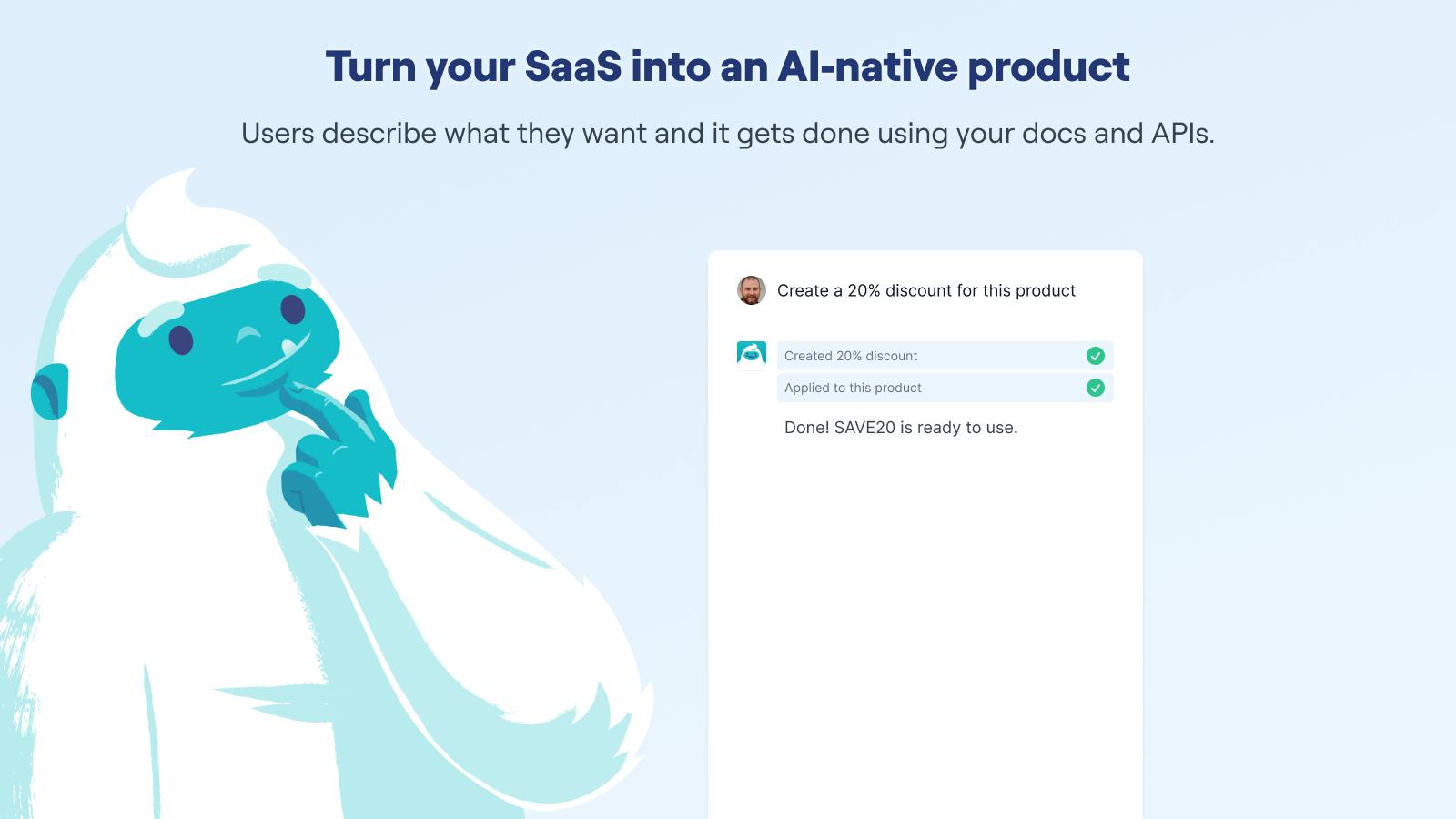
Yedric's product philosophy is worth unpacking carefully. It doesn't ask developers to reconstruct any business logic. Instead, it layers a natural language interface on top of an existing product. A user says "Export all unpaid invoices from last month as a spreadsheet," and Yedric handles the intent interpretation, then calls the functionality that already exists inside the product to carry it out.
In other words, the product's capability boundary stays the same — what changes is how users reach those capabilities. This is fundamentally different from plugging in a generic LLM chat window. The latter can typically only answer questions, whereas Yedric emphasizes executing actions — turning conversation into real operations that happen inside the product.
For mature SaaS platforms that have accumulated extensive features but struggle with complex interfaces, this "layer on top rather than rebuild" approach significantly lowers the barrier to adoption.
This architectural pattern is technically referred to as an "Orchestration Layer." The AI agent doesn't directly manipulate databases or underlying code — it completes actions by calling APIs or internal tool functions already exposed by the host product. This means Yedric is fundamentally dependent on the host product's API completeness. If a feature doesn't have a callable interface, the agent can't execute it on the user's behalf. This is the core distinction between this category of product and general-purpose AI assistants (like a chat window that calls GPT-4 directly): general assistants lack read/write access to a specific product's internal state and can only offer suggestions, while embedded agents are authorized to actually act within the product's boundaries.
30-Minute Integration: Cutting the Engineering Cost of Going AI-Native
Another key selling point Yedric leads with is integration speed — the company claims developers can make an existing product "AI-native" in 30 minutes. This promise is a direct response to a very real pain point.
Over the past year, virtually every SaaS company has been debating whether to build their own AI agent. But building a reliable agent experience in-house is expensive: you need to handle intent recognition, tool calling, error recovery, context management, and a host of other complex problems — and then maintain all of it indefinitely. Most teams lack the AI engineering resources, and few want to divert focus away from their core product.
Yedric essentially packages this entire capability stack into an embeddable component, so developers don't need to build and maintain their own agent experience from scratch. This aligns with the broader trend in the SaaS toolchain — infrastructure is being abstracted into plug-and-play services, letting developers focus on their own differentiated value.
The technical complexity of building an AI agent in-house far exceeds what most people assume. Intent recognition requires mapping ambiguous natural language to specific function calls (i.e., Function Calling). Tool-calling chains need to handle multi-step dependencies and intermediate states. Error recovery requires the agent to detect execution failures and produce sensible fallback strategies. Context management involves maintaining operational consistency across multi-turn conversations. While LLM providers like OpenAI and Anthropic offer foundational capabilities such as Function Calling, packaging these into a complete, reliable experience that's friendly to ordinary SaaS developers still requires enormous engineering investment. What Yedric does is bundle that engineering barrier into an embeddable SDK or service — similar to how Stripe relates to payments or Auth0 relates to authentication.
Developer-Focused Positioning and Potential Challenges
Based on its Product Hunt category tags, Yedric sits simultaneously under SaaS, Developer Tools, and Artificial Intelligence — and its target user is clearly the SaaS product builder, not the end consumer. This is a classic B2B2C model: Yedric serves developers, and developers' users ultimately benefit.
That said, products in this space face real challenges. Reliably mapping natural language to actions is non-trivial, especially when product features are complex or operations involve irreversible data changes — in those cases, intent recognition accuracy directly determines user trust. One mistaken bulk deletion could cause users to abandon the feature entirely. Beyond that, how an embedded agent deeply integrates with the host product's permission systems and data security policies is an unavoidable problem in real-world deployment.
Based on publicly available information, Yedric is still in its early stages, built by Ryan O'Donnell and his team. The direction it's targeting — moving SaaS from "click-driven" to "intent-driven" — represents an important branch of the current evolution in interaction paradigms.
The B2B2C model deserves particular attention in the AI tooling layer, because it introduces a unique chain-of-trust problem. End users hand their natural language requests to Yedric's agent for interpretation, yet users often have no visibility into the agent's capability boundaries, data flows, or failure fallback mechanisms. When operations involve irreversible changes (such as deleting records, sending emails, or submitting forms), the industry's standard mitigation strategies include: showing users an "Action Preview" before execution and requesting confirmation, setting an undo time window, and requiring secondary authorization for high-risk operations. Whether these safety designs are built into Yedric's framework directly affects which operation permissions SaaS developers are willing to open up to the agent.
Final Thoughts
Yedric.ai's value isn't in how cutting-edge its technology is — it's in how precisely it targets a problem that's widely felt but poorly solved: the tension between feature accumulation and interaction cost. When AI can understand and execute user intent, products no longer need users to learn their structure. That has direct implications for improving user experience and reducing churn.
Whether it can truly deliver on its "AI-native in 30 minutes" promise depends on the actual complexity of integration and the reliability of action execution. But at the level of product thinking, it offers an answer worth paying attention to.
Related articles

Workbuddy for Absolute Beginners: How a Desktop AI Agent Fits Into Real Workflows
A beginner's guide to the Workbuddy desktop AI agent: installation, claiming credits, file management, and building automated workflows—compared with CodeX for fit and cost, helping professionals shift from AI question-askers to AI managers.

OpenAI's New Agent Stack: Computer Use, Decisions API, and Ultra-Fast Workflows
OpenAI Dev Day unveiled a new agent stack: Computer Use outperforms humans, Decisions API delivers ultra-low-latency classification via Luna, Agents API opens the same Computer Use capabilities, and GPT-6.1 Sol costs only one-seventh of Astra. Core updates, benchmark data, and developer insights.

Liang Wenfeng Open-Sources DeepInfo Inference Framework, Takes On U.S. Ban
DeepSeek open-sources its DeepInfo inference framework after its models, featuring GPU/CPU cross-pipelining, small-model prediction with large-model verification, and full Huawei Ascend and NVIDIA chip support—facing the U.S. federal ban head-on. This article analyzes its significance for AI deployment and open-source strategy.