Yokoso: An In-Depth Review of the Japanese Learning App Built for Real Life in Japan

Yokoso is a Japanese learning app built for real daily life in Japan, not gamified engagement.
Yokoso is an indie iOS app that teaches Japanese through real-life scenarios like reading street signs, understanding prices, and contextual grammar—specifically for foreigners living in Japan. It rejects ads, streaks, and paywalls, supports WaniKani progress import and offline use, and dynamically adapts to what learners already know, carving out a focused niche distinct from Duolingo-style gamified platforms.
A Japanese Learning Tool Designed for Real-Life Scenarios
In an era of highly homogenized language learning apps, most products compete for user attention through gamification mechanics—daily streaks, experience points, leaderboards, and paid course unlocks. Gamification in language learning became widespread in the early 2010s, with products like Duolingo pioneering these mechanics and successfully growing daily active users to tens of millions. Duolingo's 2023 financial report revealed over 26.8 million daily active users, with the Streak mechanism considered the core driver of retention. However, academia remains divided: multiple studies suggest that extrinsic motivation may undermine intrinsic learning drive, with users often opening the app to maintain a number rather than truly master a language—a phenomenon known as "Phantom Engagement."
Yet Yokoso (Japanese "ようこそ," meaning "welcome"), recently launched on Product Hunt, has chosen a distinctly different path: it focuses on serving learners who are actually living in Japan, teaching them to read street signs, understand prices, and grasp grammar in real-world context.
The product was built by independent developer James Ketola and is positioned in the Education & Language category on iOS. After launch, it received 75 upvotes, ranking 15th on that day's leaderboard. While the numbers aren't blockbuster, its clear product philosophy warrants a deeper look.
How Yokoso Differs from Mainstream Japanese Learning Apps
Rejecting "Addictive" Design, Returning to Learning Fundamentals
The most striking aspect of Yokoso is its explicit rejection of ads, streaks, and paywall-locked courses—the three staples of mainstream language learning apps. Products like Duolingo have long relied on streak mechanisms to maintain user stickiness, which is fundamentally a design that leverages psychological anxiety to drive usage. The behavioral psychology principle of "Loss Aversion" is cleverly exploited here: users fear losing their accumulated consecutive days, so they open the app even when they have no desire to study, completing the bare minimum interaction.
Yokoso takes the opposite approach, embracing a more "restrained" product philosophy. It's free, ad-free, and doesn't hold users hostage through interruption anxiety. For serious learners whose goal is to "truly learn Japanese and integrate into Japanese life," this is undoubtedly more appealing—learning shouldn't be about maintaining a number game, but about solving real problems.
Dynamically Adapting Learning Paths Around What You Already Know
The product description mentions that Yokoso "adapts around what you know." This means it doesn't follow a fixed linear course structure but dynamically adjusts teaching content based on the learner's existing knowledge base, avoiding repetitive instruction on already-mastered material and focusing energy where improvement is truly needed.
This adaptive learning design philosophy has deep theoretical foundations in educational technology. Its core logic stems from Vygotsky's "Zone of Proximal Development" theory—the most effective learning occurs in the zone slightly above the learner's current ability level. By continuously assessing the learner's mastery and dynamically adjusting content difficulty and scope, the system ensures every minute of study time is spent where it matters most, rather than wasted on already-familiar content or material far beyond the current level.
This personalized learning path design can theoretically improve Japanese learning efficiency significantly, making it especially suitable for intermediate learners who have some foundation but have knowledge blind spots.
Practical Japanese Content Tailored for "Life in Japan"
Contextual Teaching: Signs, Prices, and Grammar
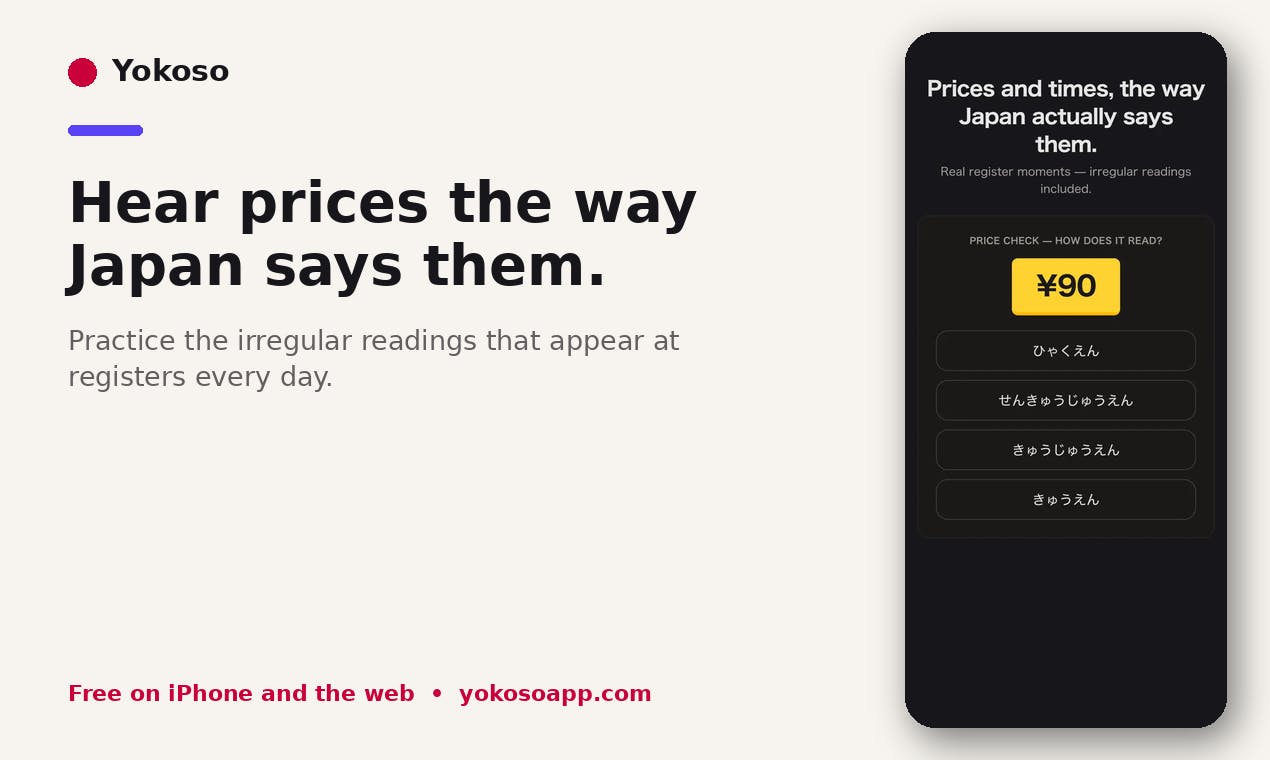
Yokoso's differentiation isn't just in its mechanics—it's also reflected in its choice of teaching content. It focuses on teaching Japanese that actually appears in daily life—street signs, product prices, and understanding grammar in context.
This directly addresses a pain point of traditional Japanese textbooks. The Japanese Language Proficiency Test (JLPT), the world's most authoritative Japanese proficiency certification system, is divided into five levels from N5 to N1. Yet even learners who pass N2 or even N1 frequently encounter comprehension difficulties in actual life in Japan. This is because Japanese society extensively uses abbreviations, dialect variations, and honorific language in ways far more complex than textbooks cover. For example, station signs reading "のりかえ" (transfer), convenience store cashiers asking "袋いりますか" (Do you need a bag?), and administrative terminology in city hall documents—these rarely appear in standard textbooks. Additionally, the Japanese writing system simultaneously uses four scripts—hiragana, katakana, kanji, and romaji—creating additional challenges for non-native speakers trying to instantly decode street-level information.
According to Japan's Ministry of Justice, as of June 2024, foreign residents in Japan exceeded 3.41 million, and this group's demand for practical Japanese learning continues to grow. Yokoso aims to bridge precisely this gap between "classroom Japanese" and "real-life Japanese."
WaniKani Progress Import: Respecting Existing Learning Assets
A noteworthy detail is that Yokoso supports importing WaniKani learning progress. WaniKani is an extremely well-known kanji and vocabulary memorization tool in the Japanese learning community, developed by the Tofugu team, using a Spaced Repetition System (SRS) as its core algorithm.
SRS is theoretically grounded in the "forgetting curve" from cognitive psychology, proposed by German psychologist Hermann Ebbinghaus in 1885. Its core finding is that human forgetting of newly learned content follows an exponential decay pattern, but if review occurs at the point just before forgetting, memory retention time extends significantly. WaniKani applies this algorithm specifically to Japanese kanji learning through a three-layer progressive structure of Radical → Kanji → Vocabulary, combined with mnemonics, helping learners systematically master approximately 2,000 commonly used kanji and over 6,000 vocabulary items. The platform enjoys an excellent reputation in the Japanese learning community, with users typically needing 1-2 years to complete all 60 levels.
By integrating with WaniKani, Yokoso demonstrates that it doesn't want to be an isolated island, but rather respects users' accumulated learning assets, positioning itself as one component within the broader Japanese learning ecosystem. This "collaborate rather than replace" mindset significantly lowers migration costs for experienced learners who are already deeply invested in other tools.
Offline Availability: Learn Anytime, Anywhere in Japan
Additionally, Yokoso emphasizes offline availability (works offline). For users actually living in Japan who may need to look up language information at any time—on the subway, in rural areas, or in environments with poor connectivity—offline capability is a pragmatic and important feature. Although Japan is a tech powerhouse, its public Wi-Fi coverage is actually far lower than many expect, and most sections of the Tokyo Metro still lack stable mobile network signals inside tunnels (though some lines have begun improving in recent years). In Tokyo Metro's signal dead zones or during trips through rural towns, offline functionality ensures learners can access needed content at any time.
Product Positioning Analysis: A Small but Beautiful Vertical Niche
From a product strategy perspective, Yokoso follows a classic vertical niche approach. Rather than competing head-on with giants like Duolingo and Rosetta Stone in the broad "general language learning" market, it precisely targets the specific demographic of "foreigners living in Japan."
While this group isn't enormous in size, their needs are extremely clear and their willingness to pay (or loyalty) is relatively high—they're not casually studying out of interest but have genuine, practical life needs. This positioning allows Yokoso to go "deep" rather than "broad" in content design, establishing differentiation barriers that are difficult for larger companies to replicate.
Of course, as an independent developer's product, Yokoso faces obvious challenges: whether content depth and maintenance updates can be sustained, how a free model can support long-term operations, and how to maintain user activity without retention mechanisms like streaks. The core contradiction independent developers face in the educational app market is this: educational content requires continuous investment in maintenance and updates, but small teams have extremely limited resources. Successful independent education products typically follow several sustainable models: one-time purchase (like Anki's desktop version), subscriptions, or community-driven content contributions. Yokoso's choice of being completely free and ad-free is advantageous in the short term for building user trust and word-of-mouth, but long-term it needs to find sustainable operational support—whether through the developer's personal passion, future introduction of optional paid features (such as premium content packs), or community donations. While 75 votes on Product Hunt isn't top-tier, for an extremely vertical niche product, the real value lies in precisely reaching the target user group rather than pursuing generalized exposure. These are key questions it will need to validate going forward.
Conclusion: Which Japanese Learners Should Pay Attention to Yokoso
Yokoso represents a noteworthy trend in language learning products: shifting from "making you addicted" back to "helping you truly learn and use the language." Anchored in real-life scenarios in Japan, it serves a clearly defined niche through pragmatic features including contextual teaching, dynamic adaptation, WaniKani ecosystem integration, and offline support.
For learners planning to live in Japan long-term, or those already in Japan but frustrated that "textbook Japanese is useless," Yokoso offers a distraction-free, practical-focused option. It may not become the next viral app, but its commitment to product philosophy is itself a valuable reflection on the excessive gamification trend in the current language learning space. In an industry where more and more products deviate from educational fundamentals in pursuit of retention metrics, this "less is more" philosophy of restrained design may point precisely to what language learning tools should look like.
Related articles

Felix Rieseberg Personal Homepage
Felix Rieseberg's personal homepage sparks attention on Hacker News. This article covers the Slack engineer's technical background, the rise and fall of nativefier, and the value of a developer homepage as a tech calling card.

@ai-sdk/vue 3.0.306 Patch Release Syncs with [email protected] Update
@ai-sdk/vue 3.0.306 released, synced with [email protected]. A routine patch release for the Vercel AI SDK ecosystem with no public API changes; the Vue adapter layer stays version-aligned with the core package.

Gemini 4 Argon API Launches: The Era of Million-Token Output Begins
Google launches Gemini 4 Argon with sparse MoE architecture, up to 1M output tokens, and a 68.90% Vals Index score, available across API, AI Studio, and the Gemini app.