Yoshua Bengio on AI Safety: LawZero Receives Support from Canadian and German Governments

Bengio's LawZero secures Canadian and German government backing as he calls for public and policy engagement on AI safety.
Turing Award laureate Yoshua Bengio has announced that his nonprofit AI safety organization LawZero has secured support from both Canada and Germany, and will appear on Canadian TV program TLMEP to discuss AI safety with the public. Using the recent Hugging Face cyberattack as a case study, he highlighted critical vulnerabilities in AI infrastructure and criticized the commercial race driving rapid capability gains without adequate safety guarantees. He argues that solving this requires both technical solutions and meaningful public and policy engagement.
Turing Award laureate Yoshua Bengio recently announced on social media that he will be appearing on the popular Canadian television program Tout le monde en parle (TLMEP) to discuss the government support his nonprofit AI safety venture LawZero has received, as well as the industry risks exposed by recent AI security incidents. Behind this brief post lies a sharpening tension between safety and commercialization in today's AI development landscape.
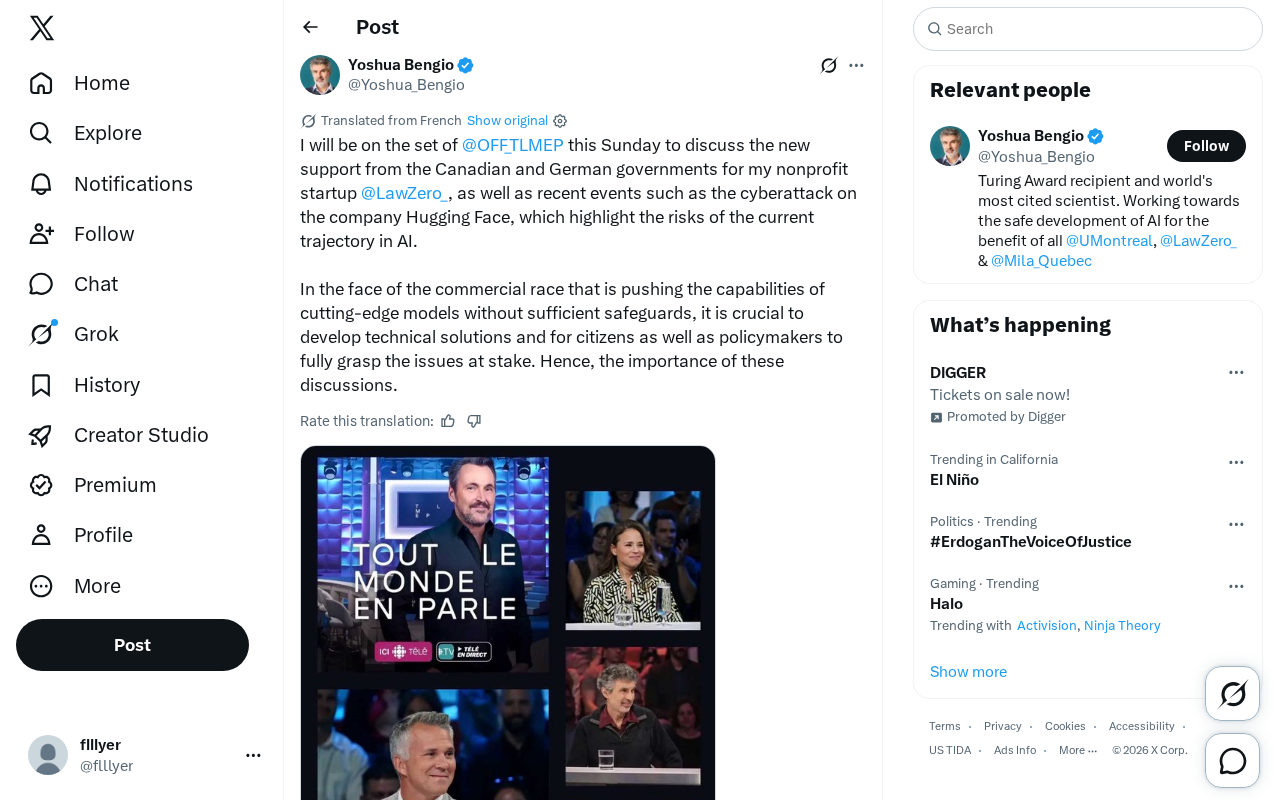
LawZero Earns Backing from Canada and Germany
Bengio revealed that LawZero, the nonprofit organization he founded, has received a new round of support from both the Canadian and German governments. As one of the founding figures of deep learning, Bengio has in recent years devoted considerable energy to AI safety research. LawZero is the central vehicle through which he advances this agenda — an organization oriented toward the public interest rather than commercial returns.
Government involvement carries symbolic weight. It signals that AI safety is no longer just an academic exercise, but is gradually entering the national policy arena. When a leading scientist chooses to pursue safety research through a nonprofit structure and secures cross-border government funding, that choice itself represents a response to — and a counterweight against — the purely commercialized model of AI development.
LawZero was established in 2024 under the full name "Law Zero for AI Safety." Co-founded by Bengio and several AI safety researchers, the nonprofit research institute is headquartered in Montreal. Its name conveys the idea that AI safety should function as a "zeroth law" — superseding all other rules, much like Asimov's zeroth law of robotics, which places the protection of humanity's collective welfare above all else. The organization focuses on verifiable AI alignment methods, monitoring mechanisms, and policy frameworks, aiming to provide safety assessments and recommendations that are independent of commercial interests. Unlike institutions such as OpenAI and Anthropic, which fund safety research through commercial models, LawZero's nonprofit status allows it to speak without being subject to investor return pressures — a key reason it has earned government trust.
The Hugging Face Cyberattack Sounds the Alarm
Bengio specifically referenced a recent cyberattack targeting Hugging Face. As one of the world's largest open-source AI model hosting platforms, Hugging Face hosts an enormous collection of models, datasets, and developer communities. An attack on such a foundational infrastructure platform exposes the fragility of AI ecosystem security.
He framed this incident as a microcosm of "the risks of the current AI development trajectory." As more capabilities are open-sourced, hosted, and integrated into various applications, a security vulnerability at any single point can be amplified. Bengio's concern is well-founded: the rapid expansion of model capabilities consistently outpaces the security measures designed to contain them.
Hugging Face was founded in 2016, originally as a chatbot company before pivoting to become an open-source AI community platform. It now hosts over 900,000 pre-trained models and 180,000 datasets, earning the nickname "GitHub for AI." In 2024, the platform's Spaces service suffered a security breach in which attackers obtained access tokens for some users, potentially enabling unauthorized access to private models or datasets. The deeper risk here is that a large number of enterprises and developers use Hugging Face as a core node for model distribution and integration. If malicious actors were to embed backdoored models or tamper with model weights on the platform, downstream applications would unknowingly inherit those vulnerabilities — constituting a supply chain attack. This logic closely mirrors the SolarWinds incident in the software world, except that it operates on AI infrastructure rather than traditional IT systems.
The Imbalance Between Commercial Competition and Safety
At the core of Bengio's argument is a critique of the current "commercial race." He points out that fierce market competition is driving frontier model capabilities ever higher, yet without sufficient safety guarantees (sans garanties suffisantes). This is a classic pattern of capability-first, safety-second development.
In his view, breaking this deadlock requires a two-pronged approach: developing genuinely effective technical safety solutions on one side, and ensuring the public and policymakers fully understand and engage with these issues on the other. This is precisely why he is willing to appear on a mainstream television program to address a broad audience — AI safety should not be discussed only in laboratories and boardrooms, but requires a wider social consensus.
Why Public Engagement Is Critical
Technical experts' warnings rarely translate into real-world constraints without corresponding policy responses and public engagement. Bengio's choice to discuss these issues on a mass media platform rather than at a specialized conference reflects his commitment to "democratizing AI governance." Only when citoyens (citizens) and décideurs politiques (policymakers) truly se saisissent (take hold of) these issues will it become possible to form an effective counterweight to commercial impulses.
The "capability-first, safety-second" phenomenon has structural roots in the AI field. Leading frontier labs — including OpenAI, Google DeepMind, and Anthropic — all face what might be called a "competition curse": releasing a more capable model first attracts users, capital, and talent, while safety evaluations and red-teaming require time, creating a first-mover disadvantage for those who prioritize safety. Some researchers liken this dynamic to a "prisoner's dilemma" — even if every organization agrees that slowing down to do safety properly is the right call, unilaterally doing so risks losing market share. One of the solutions Bengio and others advocate is introducing external coordination mechanisms — such as government-mandated pre-release safety evaluation standards — that internalize safety costs as a uniform industry baseline rather than a competitive burden for any single company.
A Scientist's Shift in Stance
From a pioneer who pushed the boundaries of deep learning to a vocal advocate for AI safety, Bengio's evolution is itself a footnote to the industry's transformation. Rather than resting on technological optimism, he has taken concrete action — founding a nonprofit, securing government support, stepping onto public platforms — to advance a more responsible paradigm for AI development.
This brief social media post offered few details, but the signal it sends is clear: as AI capabilities surge forward at breakneck speed, the question of how to build safety guardrails that keep pace has become a challenge that academia, government, and the public must face together.
Related articles

Kimi K3.1 Hands-On Test: Open-Source Model Nears Opus, Video Generation Steals the Show
Kimi K3.1 completed motion graphics, 3D rendering, mini-games, and video generation in a live test. Analysis of its 2.8T MoE architecture, gap vs Opus/GPT, and hidden video generation.

Sam Altman: Why Life's Biggest Advice Should Still Come from Humans
OpenAI CEO Sam Altman on the limits of AI advice: AI can talk you out of an impulsive email, but life's biggest advice should still come from humans.

"Black October": Did AI Uncover 3% of All Critical Vulnerabilities Ever?
A Reddit post claims 3% of all critical software vulnerabilities ever were found in the past month, dubbed 'Black October.' We break down the statistical issues, how AI-assisted code auditing accelerates discovery, and how developers should respond.