You Can't Buy Texas for $200 Million: Why Musk's Political Gamble Failed

Texas Senate race ad spending hit a record $573 million, and Musk's $200 million failed to change the outcome.
The article centers on Democrat James Talarico's upset victory over Republican Ken Paxton in the Texas Senate race, noting that combined ad spending by both sides and their affiliated PACs exceeded $573 million—the most expensive Senate race to date. It highlights that Elon Musk spent about $200 million yet failed to "buy" Texas. The article explains this on three levels: when funding levels are comparable, a single donor's marginal influence is diluted; Texas's political fundamentals are not monolithic, and money can't buy automatic vote conversion; and super PACs' large-scale dispersed spending creates money-efficiency problems and voter ad fatigue. It further discusses how tech billionaires' individual-level mega political donations are becoming the new normal and their potential impact on tech policy agendas such as AI regulation.
A Record-Breaking Money-Soaked Election
According to an RSS source, Democratic Texas Senator-elect James Talarico didn't just flip a seat in the midterms—he won what is now the most expensive Senate race to date. He and his Republican opponent Ken Paxton, along with their affiliated PACs, spent more than $573 million on advertising combined. The report specifically notes that a large portion of that money came from a single source—and the headline directly names Elon Musk's role: even $200 million couldn't help him "buy" the outcome he wanted in Texas.
The numbers alone tell the story: when advertising spending in a single state-level Senate race climbs into the hundreds of millions, the funding structure of electoral politics has undergone a qualitative shift.
Super PACs are a peculiar product of the U.S. political fundraising system. In 2010, the Supreme Court's Citizens United v. FEC ruling held that corporations and unions could spend unlimited amounts on independent political advocacy. The D.C. Circuit's subsequent SpeechNow case further allowed for committees that engage only in "independent expenditures" without directly coordinating with candidates—i.e., super PACs. Super PACs can accept unlimited contributions from individuals, corporations, and unions, but the law prohibits them from directly coordinating with candidates' campaign teams, theoretically preserving "independence." It is precisely this institutional channel that allows a single mega-donor to inject hundreds of millions of dollars into a single election in a short period—and that keeps driving total campaign spending to new records.
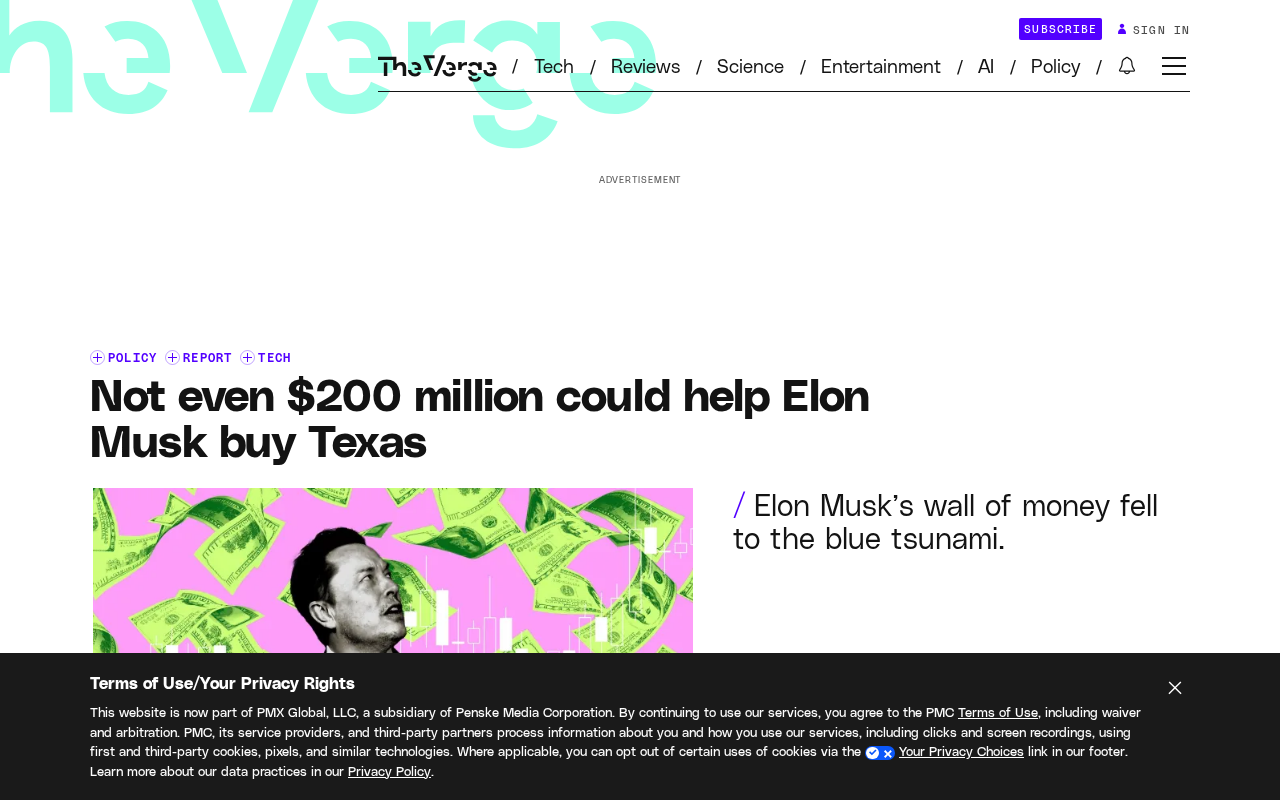
Why Musk's $200 Million Went Down the Drain
The headline's conclusion is straightforward: $200 million wasn't enough to change the Texas race. There are several layers of logic worth unpacking here.
First, there is a ceiling effect on the scale of money. When both camps can organize hundreds of millions of dollars in advertising, a single donor's marginal influence gets rapidly diluted. Talarico's side also had massive PAC backing—a total pot of $573 million means this wasn't a "rich vs. poor" contest but a "rich vs. rich" hedge.
Second, Texas's political fundamentals are not monolithic. The very fact that Talarico pulled off a "flip" shows that the state's voter composition or voting behavior shifted enough to offset a massive advertising barrage. Money can buy exposure, but it can't buy automatic vote conversion.
Third, the operating model of super PACs creates money-efficiency problems. Hundreds of millions spread across statewide TV, digital ads, and mobilization efforts means limited penetration for any single message—and voter fatigue and immunity to political advertising are rising.
Diminishing marginal influence is the key economic concept for understanding large political spending. When ad volume goes from zero to a certain scale, each additional dollar produces the most visible exposure and persuasion effect; but as spending continues to climb and the target audience repeatedly encounters the same type of message, attention saturation, information fatigue, and a "persuasion ceiling" quickly depress the incremental effect of each dollar. In a hedging scenario where both sides' funding levels are comparable, one side's extra spending is also partly offset by the other side's simultaneous spending, creating an arms-race-like attrition—and the final outcome depends more on fundamental voter structure, candidate persona, and issue trends than on the sheer spending gap.
The Signal Value of Tech Billionaires Entering Politics
Musk's deep involvement in races like this reflects a new phase in the relationship between tech capital and political power. In the past, tech companies influenced policy more indirectly through lobbying and industry associations; today, individual-level mega political donations are becoming the norm—with two direct consequences.
On one hand, public sensitivity to "money politics" has risen markedly. When media reports describe a political investment with phrasing like "buying Texas," that itself reflects public wariness about billionaires intervening in elections.
On the other hand, the uncertainty between input and output is amplified. Musk's case here will become a sample for future analysis: in a highly polarized electoral environment, huge sums of money don't necessarily translate into the expected political outcomes.
Political action committees (PACs) and individual political donations in the U.S. are governed by Federal Election Commission (FEC) rules. Traditional PACs have contribution limits on direct donations to a single candidate in a single election, but individuals can amplify influence by donating to super PACs, party committees, and various independent expenditure organizations. In recent years, tech billionaires have increasingly tended to bypass traditional lobbying channels and inject huge sums directly into super PACs under their own names, creating what is called "individual-level political capital." The advantage of this model is a short decision chain and high volume of publicity; the disadvantage is that it is highly tied to individual judgment and lacks the risk-spreading mechanism of industry organizations—so once election results fall short of expectations, the investment is hard to recoup and easily triggers public backlash against "money politics."
Implications for AI and the Tech Industry
The lessons from this election aren't limited to politics. The tech industry's policy environment increasingly depends on election outcomes—from AI regulation, data privacy, to platform liability, the direction of legislation is tied to the political landscape at both state and federal levels. Tech leaders pouring personal capital into elections on a large scale is essentially an attempt to shorten the transmission chain of "policy influence."
But the Texas result suggests that the risk-reward ratio of this strategy is unstable. For practitioners focused on AI governance, what matters more isn't whether a particular billionaire wins or loses, but how changes in the structure of election funding affect the future technology regulation agenda—when campaign costs run into hundreds of millions, the degree of policymakers' dependence on donors and the mobilization capacity of countervailing forces both become variables in the industry environment.
The electoral sensitivity of the AI regulation agenda has risen significantly in recent years. The U.S. currently has no unified federal AI legislation; rulemaking is scattered across state-level efforts (Colorado, California, and Texas each advancing different bills) and guidance from federal agencies (FTC, NIST, etc.). The outcomes of elections for state senators, governors, and federal legislators directly determine whether a given state passes strict AI transparency, algorithmic auditing, or data privacy requirements—and also affect the speed and direction of federal legislation. As a result, tech companies view elections as an upstream link in policy influence and try to shape the legislative environment in advance through financial investment; but this also means that if election results diverge from investment expectations, compliance costs and regulatory uncertainty for the relevant industries will rise accordingly.
Frequently Asked Questions
Where exactly did the $200 million go? According to the original report, the money went mainly to advertising. Talarico, Paxton, and their affiliated PACs spent more than $573 million on ads combined, and Musk-related funding was a significant component.
Why is this called the most expensive Senate race? The report explicitly states that total advertising spending in this race exceeded $573 million, making it the most expensive Senate race to date.
What reference value does this have for future elections? It provides a sample of a high-money-density election: when both sides' funding levels are comparable, a single donor's investment struggles to create a decisive advantage.
One-line Summary
Texas Senate race ad spending topped $573 million in a record-breaking contest, and Musk's $200 million failed to change the outcome.
Related articles
 Tech Frontiers
Coldframe: A Honeypot Disguised as a Supermarket Freezer Controller
Coldframe is a honeypot disguised as Danfoss AK-SM 800A and Dixell XWEB freezer controllers, built as a single Python file that detects CVE-2025-41450 attempts and is identified as real devices on Shodan.
 Tech Frontiers
GRFNet: A Lightweight PyTorch Model Designed for Multichannel Time-Series Classification
GRFNet is a lightweight PyTorch model for multichannel time-series classification, originating from EEG decoding research. With only 3,847 parameters, it is based on the ROCKET architecture, combining random convolution kernels with learnable spatial filters, supports arbitrary input lengths, and will soon be evaluated on the PhysioNet dataset.
 Tech Frontiers
CUDA-Accelerated Rocket League Simulator: A Player-Made Hardcore Experiment
A Reddit post shows a "100% Accurate" Rocket League simulator accelerated with CUDA. We analyze its technical context, CUDA's value in game physics simulation, and the significance and limitations of such community projects.