Your AI Games Are Bad — and That's on You, Not the AI

AI can generate everything in a game except fun — polishing it is still entirely on you.
A viral Reddit post argues that the rash of low-quality AI-assisted games isn't the AI's fault — it's the developers' "generate and ship" mentality. AI can handle code, art, and audio, but it can't judge whether a game is fun, balanced, or well-paced. The post's minimum ask: since you're not even coding, at least play your own game and iterate. AI has dramatically lowered indie dev barriers and should be sparking a wave of great work; instead, that potential is being wasted. The broader lesson: when content generation costs approach zero, what's scarce is the willingness to polish — and that's what separates real creators from the noise.
In an era where AI tools can handle code, art, and sound effects — practically everything — a sharp question has emerged: why do so many AI-assisted games still fall flat? A Reddit post that sparked heated discussion offers a blunt answer: the problem isn't the AI. It's the people using it.
AI Can Generate Everything Except "Fun"
The post's central argument is pointed: today's developers have access to a complete toolchain capable of generating code, art, and audio — yet many of them simply "type in a prompt, package up whatever comes out, and release it as a finished game."
The results speak for themselves. These projects are "dripping with AI slop" and play terribly. And the ones that look promising often aren't actually playable at all — behind the screenshots, there's no real game.
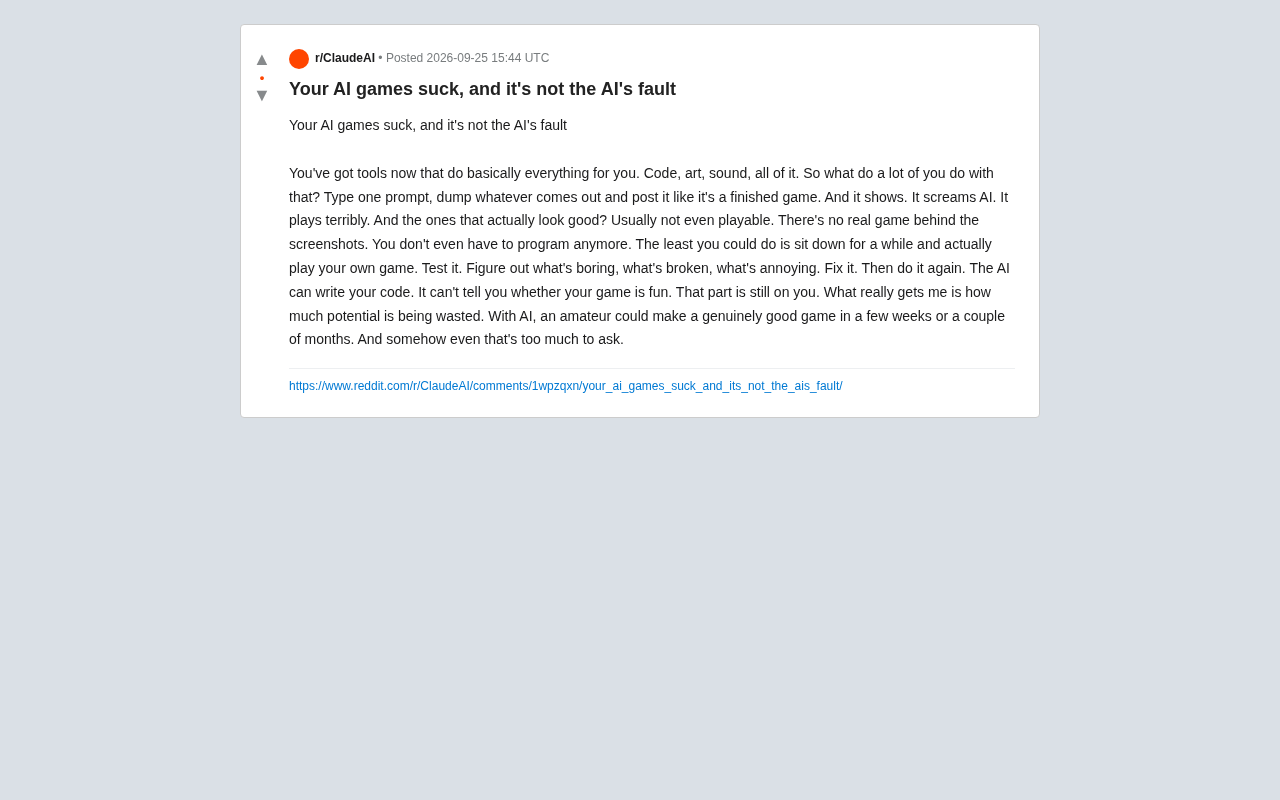
This points to a truth that often gets overlooked in the AI age: AI can write your code, but it can't tell you whether your game is fun. The experiential qualities — enjoyment, pacing, balance — still require a human to judge.
"No Coding Required" Doesn't Mean "No Polishing Required"
The post's author sets a minimum bar: since you're not even doing the programming yourself, the least you can do is sit down and actually play your own game.
This is just basic game development practice:
The Essential Test-and-Iterate Loop
- Actually play it: Get hands-on with the experience, don't just publish based on screenshots
- Find the problems: Figure out what's boring, what's broken, what's frustrating
- Fix and refine: Address those issues directly
- Repeat: Play again after fixing, then fix again — keep iterating
The author's point is that AI has already saved you the heaviest lifting — the actual coding. That saved time should go into polishing the experience, not skipping every quality control step entirely. The "generate and ship" mentality squanders the biggest benefit AI has to offer.
A Massive Wasted Potential
What bothers the post's author most is the sheer waste of possibility. With AI assistance, a hobbyist could realistically build a genuinely great game in a matter of weeks to months.
That's worth taking seriously. Before AI, indie developers had to clear multiple skill hurdles — programming, art, audio — and countless ideas died at those barriers. AI has dramatically lowered them, which should, in theory, trigger an explosion of high-quality indie work.
Instead, even a basic investment like "spend a few more weeks polishing" proves too much to ask. The more powerful the tools, the easier it is to get lazy — because something that "kind of works" is just too easy to produce.
This phenomenon has an informal name in the game dev community: "vibe coding" — where developers rely on AI to generate code, barely read or understand the output, and consider it done as long as the program superficially runs. The problem is that AI-generated code often lacks internal logical consistency, breaks down at edge cases, and is hard to iterate on. When developers have no understanding of the underlying logic, any deep refinement becomes nearly impossible — they can't diagnose what's wrong, so they just keep asking the AI to regenerate, stuck in a loop where quality never improves.
The Real Dividing Line for Creators in the AI Age
This post focuses on game development, but the lesson applies across all AI-assisted creative work. When the cost of generating content approaches zero, what becomes scarce is no longer "can you make something" — it's "are you willing to make it good."
What truly separates creators is the judgment, taste, and patience they layer on top of AI. AI turns ideas into drafts; humans turn drafts into finished work. Skip the second half, and what you get is a flood of things that look complete but are hollow — polished shells with nothing inside.
For anyone serious about using AI to make games or create anything else, this reminder from the community is worth holding onto: no matter how powerful the tools, the thing that ultimately determines quality is the person willing to sit down, test repeatedly, and revise until it's right.
There's a relevant concept from economics worth noting here: when the supply cost of a resource drops sharply, markets tend to fill rapidly with low-quality products — a "lemons market" effect, where bad products drive out good ones because consumers can't distinguish quality before purchasing, ultimately eroding trust in the market as a whole. AI-assisted creative platforms are facing exactly this risk right now. Steam, app stores, and content platforms are flooded with batch-generated AI content, raising the cost for users to find quality work and making it harder for genuinely crafted projects to be discovered. This is why "being willing to polish" isn't just a quality issue — strategically, it's increasingly the core of meaningful differentiation.
Related articles

@ai-sdk/vue 3.0.306 Patch Release Syncs with [email protected] Update
@ai-sdk/vue 3.0.306 released, synced with [email protected]. A routine patch release for the Vercel AI SDK ecosystem with no public API changes; the Vue adapter layer stays version-aligned with the core package.

Gemini 4 Argon API Launches: The Era of Million-Token Output Begins
Google launches Gemini 4 Argon with sparse MoE architecture, up to 1M output tokens, and a 68.90% Vals Index score, available across API, AI Studio, and the Gemini app.

DukaanAI: Turning Product Photos into Inventory Lists with Open-Source AI
DukaanAI is an AI inventory tool for small retailers that turns product photos into inventory entries using the open-source Gemma 3 model, with local inference, editable fields, and CSV export.