Yourcast 2.0: AI Podcast Summaries in Telegram with Clickable Timestamp Jumps
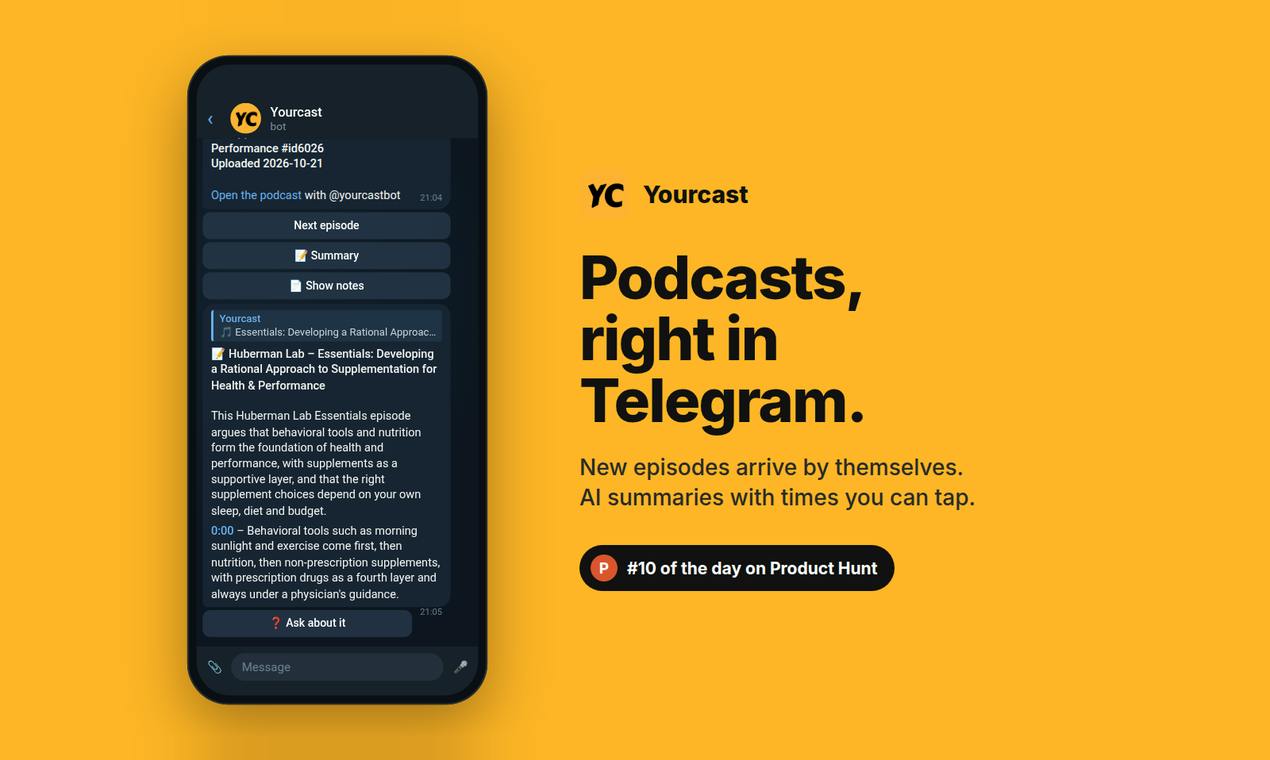
Yourcast 2.0 brings podcast subscriptions and listening into Telegram with jumpable AI summaries.
Yourcast 2.0 is a Telegram-based podcast bot that lets users search, subscribe, and listen in-chat. It links AI summaries to clickable timestamps so users can scan a summary and jump to specific audio segments, cutting time cost on long episodes. It adds self-healing feeds, 2 GB files, OPML import, per-episode Q&A, and Telegram Stars payments; it is GPL v3 open source, free for 10 episodes weekly, with six interface languages but no Chinese.
Title
Yourcast 2.0: AI Podcast Summaries in Telegram with Clickable Timestamp Jumps
Meta Description
Yourcast 2.0 is a Telegram podcast bot with AI summaries and clickable timestamp jumps, per-episode Q&A, self-healing feeds, 2 GB file support, and OPML import. GPL v3 open source, free 10 episodes per week.
Article Content
Podcast listeners have long faced an awkward problem: too many subscribed shows, limited commute time, and no way to quickly judge whether an episode is worth hearing without first spending ten minutes sampling it. Yourcast 2.0's solution is to move the entire podcast consumption workflow into Telegram, and to use AI summaries with clickable timestamps to make the very decision of "what to listen to" jumpable.
From subscription to listening, all inside the chat window
Yourcast takes the form of a Telegram bot. Users search for shows and tap to subscribe within the conversation, and new episodes are pushed directly into the chat as audio files, with no need to jump to a standalone podcast client. The advantage of this design is that it eliminates the friction of app switching, which is especially well suited to users who already process a large information stream inside Telegram.
Version 2.0 adds several practical updates on top of the original: AI-generated episode summaries, a follow-up question feature for any single episode, self-healing subscription feeds, support for files up to 2 GB, OPML import, and in-app purchases completed via Telegram Stars. The free tier allows 10 on-demand episodes per week, the code is open source under GPL v3, and the interface supports six languages: English, Russian, Portuguese, Spanish, German, and Hebrew.
A Telegram bot is an automated account built on the Telegram Bot API; users interact with it through conversational commands or inline buttons, with no extra app to install. Bots can push messages, files, and audio, and support rich interactions such as inline keyboards and callback buttons. Telegram Stars is an in-app virtual currency that Telegram launched in 2024; users buy Stars with real money and then use them to pay for digital goods and services within bots or mini apps, and developers can exchange them for fiat currency. Because Stars payments are handled uniformly by Telegram, developers do not need to build their own payment channel or bind a credit card system, which lowers the barrier to monetizing within the bot ecosystem. Yourcast's choice of Stars as its payment method exploits the advantages of closed-loop payments within the Telegram ecosystem, but it also means payment capability is limited by Telegram's coverage.
Clickable timestamps are the most substantial feature of this update
AI summaries themselves are no longer novel in podcast tools; what sets Yourcast 2.0 apart is the binding of summaries to audio playback positions. Each point in the summary carries a timestamp, and clicking it jumps directly to the corresponding position in the audio.
This design changes listening behavior: users can scan the summary first and listen only to the segments they care about, rather than playing linearly from start to finish. For interview-style shows that run one or two hours, this "look at the table of contents first, then pick chapters" model can significantly reduce time cost. Combined with the "ask questions about any single episode" feature, users can also ask the AI about an episode's core arguments before listening, and then decide whether to go deeper.
From a product-logic perspective, Yourcast pushes podcasts one step from "linear media" toward "searchable content." This aligns with the trend toward chapterization in video and AI summarization in text, except that in the audio context, timestamp jumps are the more natural interaction.
Clickable timestamps in audio and video products are typically implemented via "chapters" or "deep links." Podcast audio files themselves are continuous and contain no chapter information, so a tool must transcribe and segment the audio, then have AI determine which segments constitute a point and annotate the start and end time of each point. When a user clicks a timestamp, the player jumps the playback position to the corresponding second. This process requires accurate transcription and reasonable segmentation; otherwise the timestamps will be misaligned with the content. In the podcast context, because audio lacks the visual cues of video, timestamp accuracy depends heavily on speech recognition quality and the AI's judgment of semantic boundaries, which is also the key variable in the feature's actual experience.
Self-healing feeds and 2 GB files address long-term operational pain points
Podcast RSS feeds failing is a shared headache for listeners and tool developers alike. Shows changing hosting platforms or migrating feed addresses both cause subscription interruptions. The "self-healing" feed mechanism introduced in Yourcast 2.0 targets exactly this kind of long-standing problem that troubles podcast clients.
The 2 GB file limit covers high-bitrate long episodes; previously, many clients would simply fail when encountering very large audio files. OPML import means users can migrate their subscription list from an existing podcast client wholesale, lowering switching costs. These features are not flashy, but they determine whether a tool can be used long term.
Podcast subscriptions rely on RSS feeds, an XML-format subscription source containing show metadata and audio file links for each episode. Podcast clients periodically pull the feed to discover new episodes. When a show changes hosting platforms, the feed address may change, and the old address returns a 404 or a redirect, so the client can no longer fetch updates. A so-called "self-healing" feed usually means the tool, after detecting that the original feed has failed, attempts to automatically discover a new feed address via the show's webpage, directory services, or redirect chains, and updates the subscription record. Because the podcast ecosystem lacks a unified feed migration notification mechanism, such auto-discovery logic needs to combine multiple signals, and its accuracy and coverage are important indicators of a tool's operational capability.
The combination of open source and Telegram Stars payments
Yourcast is open source under GPL v3, meaning the subscription logic, feed handling, and AI summary pipeline can all be audited and self-deployed. For users who care about data flows, this is a plus—podcast listening records and AI-processed content need not pass through an opaque third-party service.
Payment uses Telegram Stars, a virtual currency within the Telegram ecosystem that lets users upgrade their subscription without binding a credit card. The free tier is set at 10 episodes per week, enough for light listeners, while heavy users need to pay. This "free is enough, pay to unlock" model is already fairly common in the Telegram bot ecosystem.
GPL v3 (GNU General Public License version 3) is a strong copyleft open source license that requires derivative works to be distributed with source code under the same license. This means that if someone deploys their own service based on Yourcast's code, they must also open source their modifications. For users, GPL v3 ensures that the subscription logic, feed handling, and AI summary pipeline can be independently audited, and can also be self-deployed to avoid data passing through third parties. But open source does not mean the summary model is public—the model called by the AI summary may be an external API, whose weights and training data are not within the scope of the open source, so "auditable" mainly refers to the business logic rather than the model itself.
A few limitations worth noting
Currently available public information does not disclose which model the AI summary calls, whether the language coverage of summary generation matches the interface languages, or the specific decision logic of the self-healing feed. The six interface languages do not include Chinese, which is a practical barrier for Chinese-speaking users.
In addition, the product heat data of 71 votes and 1 comment indicates it is still at an early stage, and actual summary quality and timestamp accuracy still need more user validation. Putting podcast consumption entirely inside Telegram also means users need to accept the habit of managing their media library within this chat app.
Summary
Yourcast 2.0's approach is clear: use Telegram to lower the barrier to use, use jumpable AI summaries to lower decision costs, and use open source and self-healing feeds to lower long-term maintenance costs. It may not replace mainstream podcast clients, but for listeners who are already heavy Telegram users and subscribe to a large number of shows, this "summary first, jump on demand" listening style offers a new possibility.
One-line Summary
Yourcast 2.0 moves podcast subscription and listening into Telegram, using jumpable AI summaries to lower decision costs.
Paragraph Summary
Yourcast 2.0 is a podcast bot running inside Telegram, letting users search, subscribe, and listen within the chat window without jumping to a standalone client. Its core update binds AI-generated episode summaries to clickable timestamps, so users can tap a summary point to jump to the corresponding audio position, scanning the summary first and then listening selectively to reduce the time cost of long episodes. The product also adds self-healing feeds, a 2 GB file limit, OPML import, per-episode follow-up questions, and Telegram Stars in-app purchases. The code is open source under GPL v3, the free tier is 10 episodes per week, and the interface supports six languages but not Chinese. The AI model and summary language coverage have not been disclosed, and the product is still early stage.
Related articles

AI Wearables Worth Watching: Muse Charm, Bee, Friend, and More
A roundup of the hottest AI wearables—Muse Charm, Bee, Friend, Plaud—why the market is booming, and how companion vs. tool products differ.

r/opensource Bans AI Projects, Deepening Open Source Community Rift
r/opensource moderators issue new rules banning projects that use, are generated by, or are oriented toward AI, while also banning non-English posts. This article analyzes the ban's details, community controversy, and the growing tension between open source and AI.

The Rise of Agentic Commerce: How AI Agents Are Rewriting the Payment and Wallet Wars
a16z and VGS discuss agentic commerce: AI agents gain payment credentials and shift from bystanders to actors, the wallet wars restart, Amazon blocks Muse over ads, and card network agentic token standards rebuild trust and dispute mechanisms.