YouTube Launches AI Creative Tools: Nearly Full Coverage from Topic Selection to Publishing

YouTube launches end-to-end AI creative tools, shifting from opaque algorithms to active creator guidance — with homogenization risks.
At its annual Made on YouTube event, YouTube released a suite of AI-powered tools spanning topic selection, content optimization, and publishing decisions, marking a strategic shift from black-box algorithms to proactive creator guidance. While these tools bring platform data insights directly into the creative stage and could significantly lower barriers for smaller creators, they also raise concerns: as more creators follow the same AI recommendations, content homogenization and erosion of creative autonomy become real risks. With YouTube now acting as both distributor and creative advisor, the power balance between creators and the platform tilts further toward the latter.
YouTube Is Changing How Creators Work
For content creators, getting their work in front of more viewers has always been one of the central challenges of the job. Cracking — or fighting against — recommendation algorithms has long been a headache. YouTube's latest moves suggest the platform is shifting from "making creators guess the algorithm" to "telling creators directly what to do."
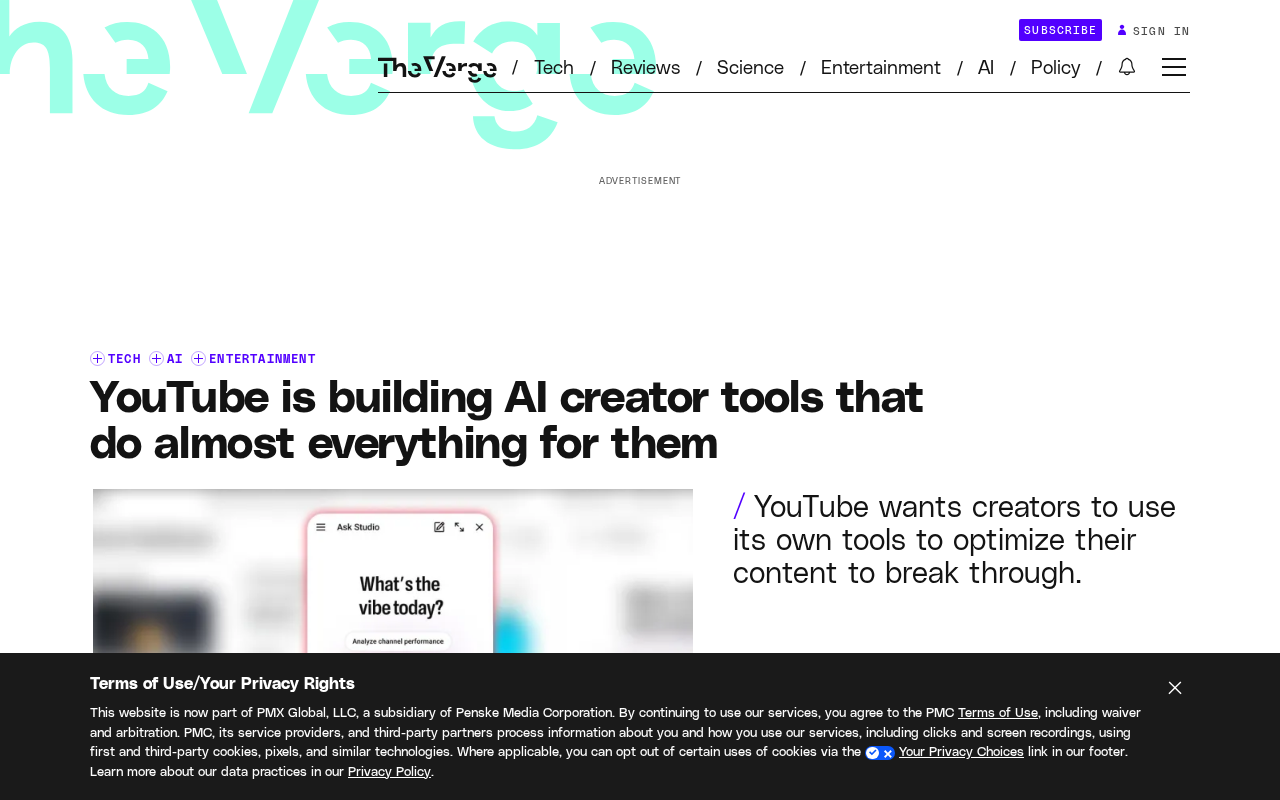
At its annual Made on YouTube event, YouTube unveiled a suite of AI-powered creative tools designed to automate or semi-automate large portions of the content production pipeline, covering nearly every aspect of a creator's daily workflow.
From "Guessing the Algorithm" to "Being Guided"
In the past, creators had to experiment repeatedly to understand the platform's distribution logic: what kind of title drives more clicks, what time of day is best to publish, how to design a thumbnail. That knowledge took years to accumulate — and constantly became outdated as the algorithm evolved.
YouTube's approach this time is to channel the platform's data advantage directly back to creators, using AI tools to proactively offer recommendations rather than leaving creators to grope around outside a black box. This model of "platform-led guidance" essentially moves the algorithm's judgment criteria upstream into the creative stage itself.
For small and mid-sized creators, this could significantly lower the barrier to entry. But it also means that decision-making authority over content is tilting away from individual creator experience and toward AI-driven platform suggestions.
YouTube's recommendation algorithm is fundamentally a multi-objective ranking system that weighs metrics like Watch Time, Click-Through Rate (CTR), and satisfaction signals (such as likes and "not interested" feedback) to determine a video's exposure weight on the homepage, sidebar, and search results. Historically, the platform kept this logic tightly guarded, leaving creators to reverse-engineer it through A/B testing thumbnails and monitoring data fluctuations. In recent years, YouTube has gradually opened up YouTube Studio dashboards with some traffic source and audience retention data — but the core distribution logic has remained a black box. The introduction of AI tools represents the first time the platform has externalized its internal data judgments in the form of "suggestions," allowing creators to anticipate how well their content will perform on the platform during the creation stage, rather than only analyzing results after the fact.
AI Tools That Cover Nearly the Entire Workflow
Based on information released at the event, YouTube's AI creative tools aim to intervene at multiple critical points in the content production process, helping creators handle tasks that previously required extensive manual iteration. The goal is to offload as much of the work involved in topic planning, content optimization, and publishing decisions as possible.
This reflects the real competitive pressure platforms face. In an era where short-form video, live streaming, and other formats are all competing for attention, whoever can help creators produce more popular content more efficiently and at lower cost wins the battle for a quality creative ecosystem. AI is becoming a key asset platforms use to lock in creators.
Convenience and Trade-offs
Handing large chunks of work over to AI brings obvious efficiency gains — but it also raises concerns worth taking seriously. When more and more creators follow the same set of AI recommendations, will content on the platform trend toward homogeneity? Will creators' distinctive styles and experimental spirit be diluted in the pursuit of "algorithm-friendly" optimization?
The deeper issue is creative autonomy. When the platform serves as both distributor and creative advisor, creators may find their control over content further eroded — what you produce increasingly conforms to the platform's expectations rather than springing from personal expression.
Whether these tools function as empowering assistants or as instruments that embed creators more deeply into platform logic will likely depend on how YouTube balances the tension between "automated convenience" and "creative diversity."
The risk of content homogenization is not a new problem in algorithmic recommendation ecosystems. Academics describe this as the supply-side version of the "Filter Bubble" — when creators collectively optimize for the same algorithmic signals, the platform fills up with structurally similar, stylistically convergent content, a phenomenon known as "algorithmic convergence." Research into content strategies at platforms like Netflix and Spotify has shown that data-driven creative guidance does improve the reach efficiency of individual pieces of content in the short term, but over time there is a diminishing marginal effect on overall platform content diversity. For YouTube, if AI recommendations are adopted by the majority of creators, the platform is effectively using its own historical data to train creators to replicate "proven content patterns" — which creates a structural tension with encouraging innovation.
Closing Thoughts
YouTube's AI creative tools represent a clear trend in content platforms: using AI to lower the barrier to creation, improve output efficiency, and translate the platform's data insights directly into creative guidance. For creators, this is both a welcome convenience and a signal that warrants a clear head. What remains truly scarce is something AI recommendations cannot replace — original perspective and distinctive expression.
Related articles

Chain of Thought Isn't Just for AI: How Humans Can Use CoT to Improve Thinking Quality
Chain of Thought isn't just a prompt trick for large models. Starting from a Hacker News discussion, this article analyzes why CoT works for human thinking too, breaks down actionable ways to transfer it, and highlights the key differences between human CoT and machine CoT.
Cloudflare Teams Up with OpenAI: Closi…
Cloudflare Teams Up with OpenAI: Closing the Loop from Vulnerability Discovery to Defense with AI
Cloudflare uses OpenAI Daybreak to investigate security vulnerabilities and generate reviewable remediation plans, while developers use Codex to boost coding efficiency and quality.

Orca Multi-Agent Orchestration in Practice: A Guide to Parallel Collaboration with Claude and Codex
Orca is Stable AI's free open-source agent workbench supporting 34 agents like Claude Code and Codex in parallel. Learn its Git worktree isolation, multi-model orchestration, and mobile management.