YouTube Music Launches AI Music Labels: Transparency or a New Battleground?

YouTube Music labels AI-generated or partially AI-assisted songs, using transparency to address the AI music flood.
YouTube Music is adding labels to song player pages, distinguishing between 'fully AI-generated' and 'partially AI-assisted' (such as composition or vocals). This comes as tools like Suno and Udio flood streaming platforms with AI music, raising issues of copyright ambiguity, imbalanced traffic distribution, and listeners' right to know. The platform chose transparent labeling without banning or throttling, but effectiveness depends on enforcement. For human creators, labels are both an opportunity and a risk. The industry is expected to move toward cross-platform standards and recommendation weight adjustments.
New Platform Rules Amid the AI Music Flood
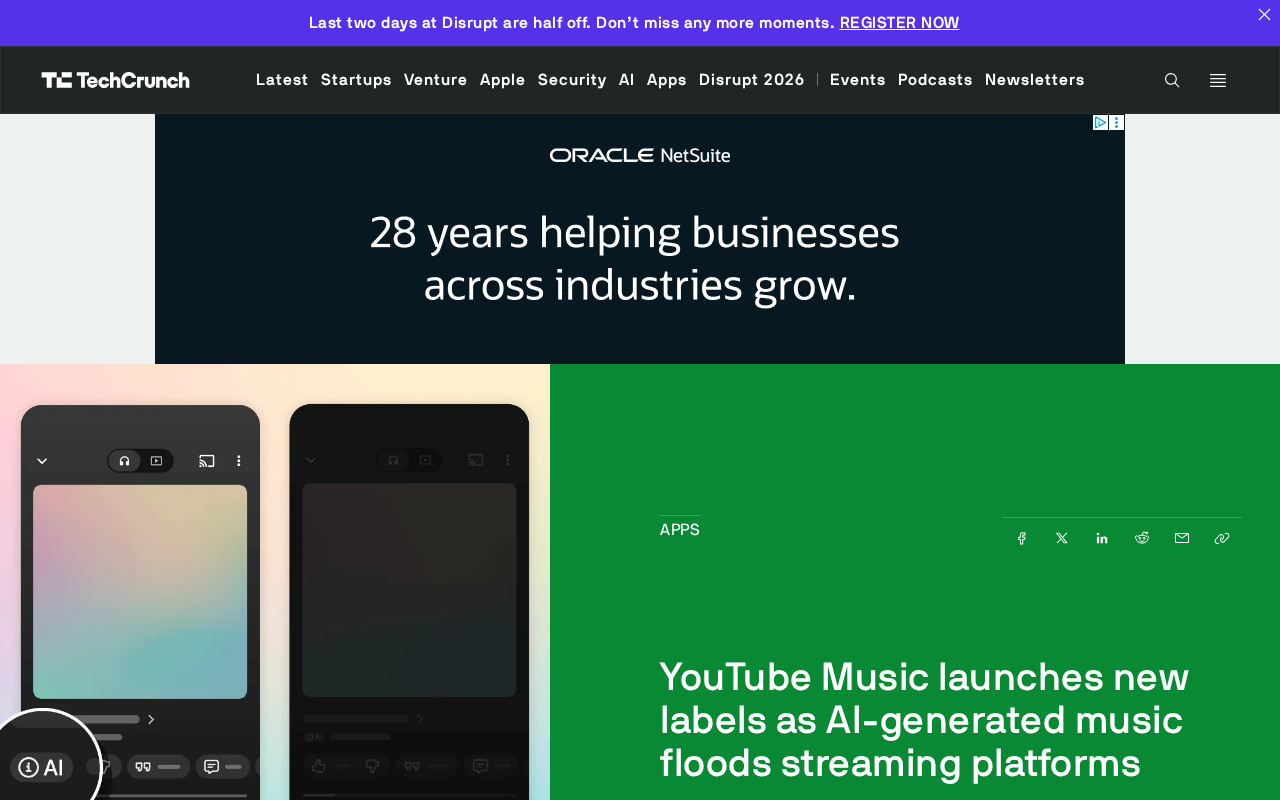
When you listen to music on YouTube Music, you may soon notice a new change: some songs' playback pages will display a dedicated label indicating whether the track was entirely AI-generated or partially assisted by AI technology, such as for composition or vocal synthesis.
This news comes from a report by an RSS source, with a headline that gets straight to the point—YouTube Music is labeling AI-generated music, against the backdrop of AI music "flooding" major streaming platforms.
This seemingly simple product update actually touches the most sensitive nerve in today's music industry: when AI can mass-produce melodies, mimic vocals, and even independently complete entire songs, the trust relationship between platforms, creators, and listeners is being redefined.
What Does the Label Actually Look Like?
According to currently disclosed information, this label will appear on player pages and cover two categories:
- Songs entirely generated by AI
- Songs that partially use AI, such as AI participating in composition or vocals
In other words, YouTube Music is attempting to establish a transparency spectrum from "fully human" to "fully AI." Listeners won't need to guess whether AI was involved in a song—the platform will tell them directly.
This approach is consistent with YouTube's earlier requirement for creators to label "synthetic content" in the video space. Bringing the same logic to music streaming means Google is advancing AI content transparency as a unified cross-product strategy.
Why Now?
AI music has experienced explosive growth over the past period. From the rise of AI music generation tools like Suno and Udio, to the flood of AI covers and AI original songs pouring into major platforms, the pressure on streaming platforms is no longer just "should we regulate this" but "how do we regulate it."
On one hand, AI music has indeed lowered the barrier to creation, enabling people without musical backgrounds to produce complete songs. On the other hand, it brings several thorny problems:
Ambiguous copyright ownership—AI training data often includes copyrighted works, and the copyright status of generated results remains unclear in most jurisdictions.
Imbalanced traffic distribution—AI can produce content in unlimited quantities. If platforms don't differentiate, human creators' exposure opportunities may be diluted by大量 low-cost AI works.
Listeners' right to know—many listeners care about whether the music they hear is human-created, and labels give them the power to choose.
YouTube Music has chosen to respond with labels rather than bans or throttling, taking a middle path: not preventing AI music from entering the platform, but ensuring information symmetry.
Suno and Udio are AI music generation tools that rapidly gained popularity between 2023 and 2024. Users only need to input lyrics or style prompts, and the model can generate a complete song including vocals and accompaniment within seconds. Both are trained on large-scale audio data, which has triggered copyright lawsuits from record companies. The popularity of Suno and Udio has brought the cost of "generating a song that sounds professionally produced" close to zero, directly causing a surge in AI tracks on streaming platforms in a short period. This is the direct driving force behind why YouTube Music must directly address the "how to regulate" question.
What Can Labels Solve, and What Can't They Solve?
Frankly speaking, a label can only do so much.
What it can do: Provide listeners with basic transparency, making "does this song involve AI" no longer a guessing game; it also leaves room for the platform's potential future content policies—label first, then decide next steps based on data.
What it can't do: It cannot resolve the fundamental issues of copyright disputes, cannot determine whether AI training data is legal, and cannot prevent people from deliberately not labeling. The effectiveness of labels ultimately depends on enforcement and review mechanisms.
There's also a deeper question: when AI involvement is "partial," how fine should the labeling granularity be? Does AI only participating in mixing count? Does AI providing chord suggestions but humans rearranging the melody count? These boundaries will be extremely difficult to define in practice.
Labeling granularity for AI content refers to how detailed the platform can be when requiring disclosure of AI involvement. Common categories range from "fully AI-generated" to "AI-assisted mastering," "AI-suggested chords," "AI-synthesized vocals," and more. The finer the granularity, the higher the transparency, but review costs and false positive rates also rise; the coarser the granularity, the easier it is to implement, but it becomes difficult to reflect the true human-AI collaboration ratio. In the video space, YouTube adopts a "synthetic content disclosure" framework that allows creators to self-report, which provides a reference starting point for music labels. However, the music production process involves far more AI intervention points than video, making boundary-drawing even more challenging.
What It Means for Creators
For independent musicians and human creators, this labeling system is a double-edged sword.
On the positive side, listeners can more easily identify and support purely human-created music, and the identity of being a human creator itself may become a differentiating advantage.
But on the other hand, if AI music can still gain substantial plays and recommendations after being labeled, the label may instead become a "category tag" rather than a "warning label"—just like "indie music" or "electronic music," merely another genre classification.
What truly matters isn't the label itself, but what the platform does after labeling. Will it adjust recommendation algorithms? Will it treat AI content differently in revenue distribution? These are the core questions that determine whether AI music and human music can fairly coexist on the same platform.
The Future Direction of AI Governance on Streaming Platforms
YouTube Music's move is unlikely to be an isolated case. Platforms like Spotify and Apple Music face the same issue of AI music influx, and the industry is forming a consensus: complete prohibition is unrealistic, complete laissez-faire is inadvisable, and transparent labeling is currently the most viable compromise.
But labeling is only the first step. Predictable next directions include: copyright registration and revenue distribution rules for AI music, adjustments to platforms' recommendation weights for AI content, and unified cross-platform labeling standards.
For ordinary listeners, the change may be subtle—just an extra small label on the player page. But behind this label is the beginning of the entire music industry redrawing boundaries in the AI era.
Recommendation weight adjustment refers to platforms changing the probability of AI content appearing on homepages, playlists, or algorithmic recommendations when ranking songs. Compared to "banning," this is a more subtle governance tool: songs can still be searched, but won't be actively pushed to users. Platforms like Spotify have previously used similar logic to handle "white noise" and "low-cost bulk content." If YouTube Music sets different recommendation weights for different labeling statuses after labeling, it means the label is not just an informational tool but also a distribution regulator, which will directly affect the traffic distribution of AI music and human music on the platform.
One-line Summary
YouTube Music labels AI-generated or partially AI-assisted songs, using transparency to address the AI music flood.
Paragraph Summary
YouTube Music has begun adding labels to song player pages, distinguishing between "fully AI-generated" and "partially AI-assisted" (such as composition or vocals). This move comes amid AI music flooding streaming platforms due to tools like Suno and Udio, bringing issues like copyright ambiguity, imbalanced traffic distribution, and listeners' right to know. The platform has chosen a middle path of transparent labeling—neither banning nor throttling—but its actual effectiveness depends on enforcement and review mechanisms. For human creators, labels are both a differentiation opportunity and a risk that AI music becomes just another genre category. The industry is expected to move toward cross-platform labeling standards, copyright rules, and further adjustments to recommendation weights.
Related articles

Workbuddy for Absolute Beginners: How a Desktop AI Agent Fits Into Real Workflows
A beginner's guide to the Workbuddy desktop AI agent: installation, claiming credits, file management, and building automated workflows—compared with CodeX for fit and cost, helping professionals shift from AI question-askers to AI managers.

OpenAI's New Agent Stack: Computer Use, Decisions API, and Ultra-Fast Workflows
OpenAI Dev Day unveiled a new agent stack: Computer Use outperforms humans, Decisions API delivers ultra-low-latency classification via Luna, Agents API opens the same Computer Use capabilities, and GPT-6.1 Sol costs only one-seventh of Astra. Core updates, benchmark data, and developer insights.

Liang Wenfeng Open-Sources DeepInfo Inference Framework, Takes On U.S. Ban
DeepSeek open-sources its DeepInfo inference framework after its models, featuring GPU/CPU cross-pipelining, small-model prediction with large-model verification, and full Huawei Ascend and NVIDIA chip support—facing the U.S. federal ban head-on. This article analyzes its significance for AI deployment and open-source strategy.