YouTube Studio Launches New AI Features: Idea Generation and Thumbnail Analytics

YouTube Studio adds AI-powered idea generation and thumbnail performance monitoring to support creator workflows.
YouTube has announced new AI features for its Studio app, covering two core areas: generating content ideas based on platform data to help creators overcome creative blocks, and providing thumbnail performance monitoring to shift cover optimization from intuition to data-driven decision-making. The move extends YouTube's strategy of systematically embedding generative AI into its creator toolchain and builds on existing capabilities like A/B testing. For the platform, it serves the dual goal of boosting creator output and platform content activity; for creators, maintaining content originality while leveraging AI efficiency remains the key challenge to watch.
YouTube Brings AI Tool Upgrades to Creators
YouTube has announced a new set of AI features coming to its Studio app, with a focus on two key areas: content idea generation and thumbnail performance monitoring. This move continues the platform's ongoing strategy of gradually integrating generative AI into creator workflows — aiming to provide a more complete support loop that spans from ideation all the way through post-publish performance tracking.
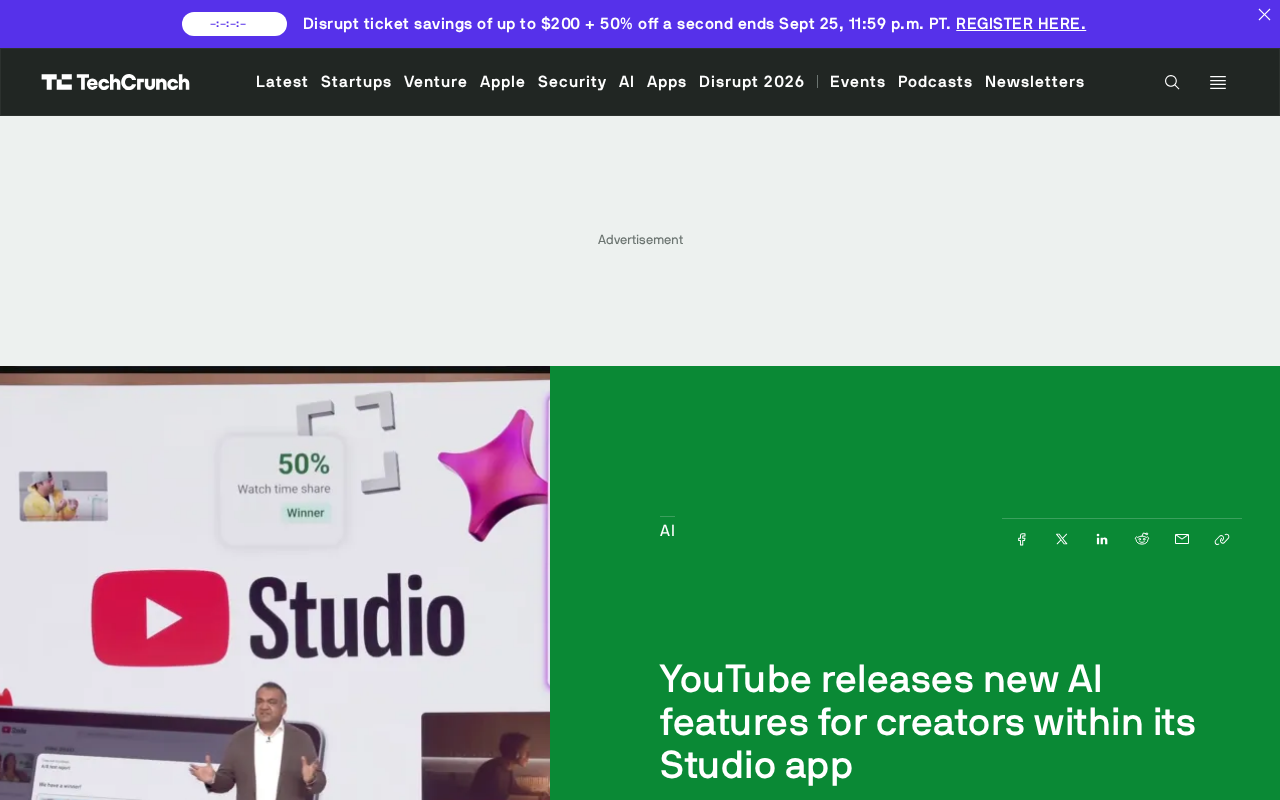
For creators who depend on YouTube for their livelihood, choosing the right topic and thumbnail are often the most critical decisions that determine a video's success. By embedding AI capabilities directly into the official Studio tool, the platform means creators no longer need to jump to third-party software — they can handle key decisions within the native environment. This has real value in lowering the barrier to entry.
Idea Generation: Breaking Free from Creative Blocks
One of the new features helps creators generate content ideas. Sustaining consistent output is one of the biggest pain points in the content industry, and small to mid-sized creators especially tend to fall into cycles of repetitive topics or creative exhaustion.
The value of an AI idea generation tool lies in its ability to quickly surface relevant topic directions based on a channel's existing content, audience preferences, and platform trends. At its core, this feature translates YouTube's massive data advantage into actionable suggestions for creators — giving them data-backed direction before they decide what to film, rather than relying on gut instinct and trial and error.
That said, tools like this typically only serve as a starting point. The quality of any video still comes down to the creator's execution and expression. AI provides directional guidance, not finished answers.
Thumbnail Performance Monitoring: Making Cover Decisions More Data-Driven
The other new feature focuses on thumbnail performance monitoring. In the YouTube ecosystem, thumbnails and titles together determine a video's click-through rate (CTR) — making them an extremely critical variable in how traffic is distributed.
In the past, creators largely relied on experience and retrospective data to evaluate how well a thumbnail was performing. The new monitoring feature gives creators a more intuitive way to understand the real-world performance of different thumbnails, so they can refine their cover strategies. This aligns closely with YouTube's previously introduced thumbnail A/B testing approach — replacing guesswork with data to help creators find the visual presentation that best attracts viewers.
For professional creators managing multiple videos who need granular operational control, this kind of monitoring capability can significantly improve decision-making efficiency and reduce the cost of ineffective experimentation.
YouTube's previously launched thumbnail A/B testing feature (Test & Compare) allows creators to upload up to three different cover images simultaneously. The platform randomly shows them to different user segments, then automatically selects the best-performing version as the final thumbnail based on CTR data after a set period. This mechanism shifted thumbnail optimization from "subjective judgment based on experience" to "controlled experimental validation" — though the feature was previously only available to qualifying channels and required lengthy testing cycles. The newly added monitoring feature is expected to build on this foundation by providing finer-grained data visibility, allowing creators to track CTR changes for individual thumbnails across different time periods and traffic sources in a more real-time, granular way, rather than only seeing aggregated final results.
A Continuation of the Platform's AI Strategy
YouTube's decision to embed AI features directly into the Studio app reflects a systematic effort to integrate generative AI across the creator toolchain. From creative planning to post-publish analysis, AI assistance is now covering an ever-growing range of stages.
This strategy delivers dual benefits for the platform: it boosts creators' output efficiency and retention, while driving higher overall platform activity through more frequent, higher-quality content. For creators, the challenge is to embrace these efficiency tools while maintaining the uniqueness and personal voice of their content — and avoiding the risk of homogenization that can come from over-relying on AI suggestions.
Official information released so far is fairly limited; the specific scope of the features, regional availability, and real-world effectiveness remain to be validated by creators in practice.
YouTube's AI feature rollout is not an isolated move — it's part of the broader AI strategy of Alphabet (Google's parent company). Google has been progressively integrating its Gemini large language model across its product lineup, and the AI ideation tools in YouTube Studio likely draw on the same underlying capabilities. For creators, this means the quality of suggestions is closely tied to YouTube's own search and recommendation algorithm data — theoretically making it more attuned to the platform's actual traffic dynamics than a generic AI writing assistant. Meanwhile, competing platforms like TikTok and Instagram Reels are also rapidly advancing their creator-side AI tools. YouTube's accelerated rollout of these features carries clear defensive strategic considerations.
Related articles

Chain of Thought Isn't Just for AI: How Humans Can Use CoT to Improve Thinking Quality
Chain of Thought isn't just a prompt trick for large models. Starting from a Hacker News discussion, this article analyzes why CoT works for human thinking too, breaks down actionable ways to transfer it, and highlights the key differences between human CoT and machine CoT.
Cloudflare Teams Up with OpenAI: Closi…
Cloudflare Teams Up with OpenAI: Closing the Loop from Vulnerability Discovery to Defense with AI
Cloudflare uses OpenAI Daybreak to investigate security vulnerabilities and generate reviewable remediation plans, while developers use Codex to boost coding efficiency and quality.

Orca Multi-Agent Orchestration in Practice: A Guide to Parallel Collaboration with Claude and Codex
Orca is Stable AI's free open-source agent workbench supporting 34 agents like Claude Code and Codex in parallel. Learn its Git worktree isolation, multi-model orchestration, and mobile management.