YouTuber Builds DIY License Plate Recognition Camera to Track Police, Gets a Visit from Cops

A YouTuber built a DIY license plate tracker aimed at police cars and promptly received a visit from officers.
A YouTube creator replicated commercial ALPR technology to track police vehicles, only to have officers show up at his door. The incident went viral on Hacker News, exposing a sharp tension: law enforcement using ALPR to track citizens is considered routine, but a citizen doing the same to police touches a raw nerve. While filming vehicles on public roads is generally legal in the U.S., the police visit itself raised questions about intimidation. The tech community remains divided — some see it as legitimate civic oversight, others warn that private tracking systems carry their own misuse risks. At its core, the story reflects a larger trend: as AI vision and edge computing grow cheaper, surveillance is spreading from institutions to individuals.
What Happened
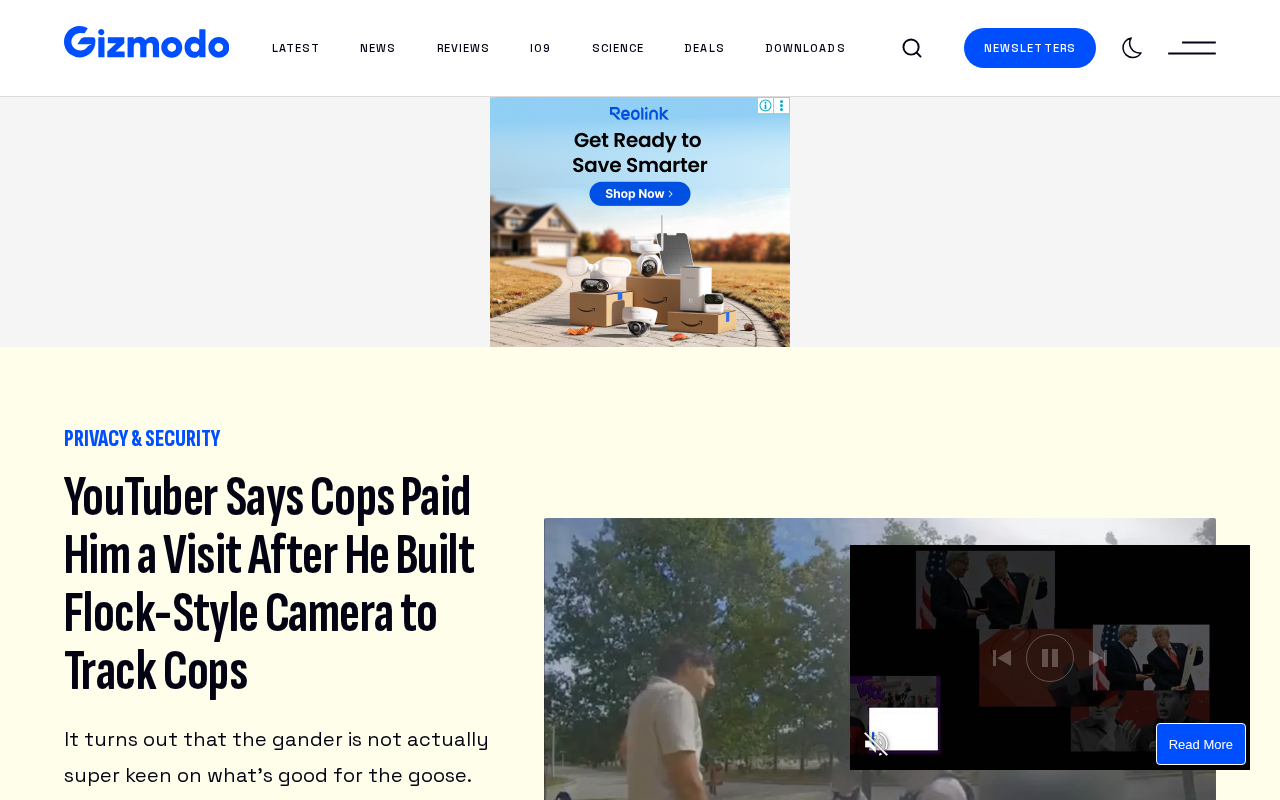
A YouTube creator attempted to replicate the technology behind commercial license plate recognition system Flock, building his own camera rig capable of tracking vehicles. The twist: he pointed it at law enforcement — using the system to record and track police vehicle movements. According to a Hacker News discussion (143 upvotes, 67 comments), the move quickly prompted a police visit to his door.
The incident drew widespread attention in the tech community because it cuts to a sharp question: when surveillance technology becomes cheap enough and easy enough to replicate, can citizens turn the same tools used by law enforcement back on law enforcement itself?
What Is a Flock-Style Camera?
Flock Safety is a U.S. company that provides Automatic License Plate Recognition (ALPR) systems, widely deployed in neighborhoods, on streets, and by law enforcement agencies to automatically capture license plates, vehicle colors, and model information, storing it all in a searchable database.
The core technology isn't particularly complex: a night-vision-capable camera, a license plate recognition algorithm, and timestamped logging. With the proliferation of open-source computer vision libraries like OpenCV and affordable edge computing devices like Raspberry Pi or the Jetson series, individual developers are fully capable of building a functionally similar system.
This lowered barrier to entry is precisely what makes "surveillance democratization" possible — capabilities once exclusive to institutions are now within reach of any technically inclined individual.
The ALPR pipeline generally works in three steps: the camera captures an image of the vehicle; image preprocessing (distortion correction, brightness normalization) locates the license plate region; and an OCR (Optical Character Recognition) engine parses the plate characters and cross-references them against a database. Commercial systems like Flock Safety go further by extracting a vehicle's "feature vector" — color, body type, visible stickers or accessories — to handle cases where plates are obscured or damaged. It's worth noting that commercial ALPR systems typically achieve accuracy rates above 95%, while DIY replicas can have significantly higher error rates depending on hardware quality, lighting conditions, and algorithm tuning. In practice, this means a homemade system may generate substantial false positives — and any decisions based on misidentified plates risk wrongly flagging innocent vehicles.
The Tension Brought by Technological Democratization
The central conflict in this incident isn't really about the technology itself — it's about the reversal of who is pointing it at whom. Law enforcement deploying cameras to track citizens is generally treated as routine policing, but when a citizen uses the same technology to track law enforcement, it immediately strikes a nerve in the power dynamic.
From a legal standpoint, photographing vehicles — including police cars — on public roads in the United States is generally lawful. There is no reasonable expectation of privacy in public spaces. This is precisely why the police "visit" itself has sparked controversy: if the filming was legal, does showing up at someone's door constitute a form of pressure or intimidation?
Tech community discussions tend to focus on this point: when surveillance becomes bidirectional, the discomfort displayed by those who hold enforcement power upon being monitored reveals a foundational assumption baked into surveillance systems — that they were designed with a predetermined answer to who gets to watch whom.
The legal principle underpinning the legality of filming in public spaces in the U.S. is the Third-Party Doctrine: information voluntarily exposed to others in a public setting is not protected by the Fourth Amendment's privacy guarantees. However, the Supreme Court's 2018 ruling in Carpenter v. United States meaningfully qualified this principle: the long-term, systematic aggregation of fragmented location data — even if each individual data point was collected lawfully — can constitute a substantive invasion of privacy in the aggregate. ALPR systems sit squarely in this legal gray zone. A single capture is legal, but whether continuously tracking the complete movement history of a specific vehicle is lawful remains unsettled. The legal basis for the police visit likely centers on questions about the act of building a database rather than any single act of filming.
How the Community Is Divided
In the Hacker News comments, opinions split sharply. One camp sees this as a legitimate exercise of citizen oversight — technology should equally serve the purpose of holding public authority accountable. Another camp worries that privately built tracking systems carry their own risks of data misuse and privacy violations, and shouldn't receive a moral free pass simply because the target is police.
A deeper thread in the discussion points to a broader concern: the mass deployment of ALPR technology and the pervasive surveillance it enables is a troubling social trend regardless of who operates it. This incident simply forced a problem that has long existed — but been largely ignored — into the public spotlight in dramatic fashion.
Implications for Tech Developers
For developers who have the skills to replicate systems like this, the incident serves as a reminder: technical feasibility and ethical legitimacy are two entirely separate dimensions. Being able to build a tracking system does not mean deploying it carries no legal or ethical risk in every context.
At the same time, it illustrates a broader trend — as the costs of AI visual recognition and edge computing continue to fall, surveillance capabilities are diffusing from institutions to individuals. This diffusion may reshape the information asymmetry between citizens and institutions of power, but it also risks generating new forms of surveillance chaos. Finding the balance between technological democratization and privacy protection will be a persistently simmering debate in the years ahead.
Given the limited information available, specific technical details of this incident — the hardware used, recognition accuracy, and the precise legal grounds for the police visit — remain unclear. Following the creator's own subsequent statements is recommended for the full picture.
Related articles

@ai-sdk/vue 3.0.306 Patch Release Syncs with [email protected] Update
@ai-sdk/vue 3.0.306 released, synced with [email protected]. A routine patch release for the Vercel AI SDK ecosystem with no public API changes; the Vue adapter layer stays version-aligned with the core package.

Gemini 4 Argon API Launches: The Era of Million-Token Output Begins
Google launches Gemini 4 Argon with sparse MoE architecture, up to 1M output tokens, and a 68.90% Vals Index score, available across API, AI Studio, and the Gemini app.

DukaanAI: Turning Product Photos into Inventory Lists with Open-Source AI
DukaanAI is an AI inventory tool for small retailers that turns product photos into inventory entries using the open-source Gemma 3 model, with local inference, editable fields, and CSV export.