YuE2 Local Music Model Review: The Open-Source Suno Rival That Actually Delivers on Covers
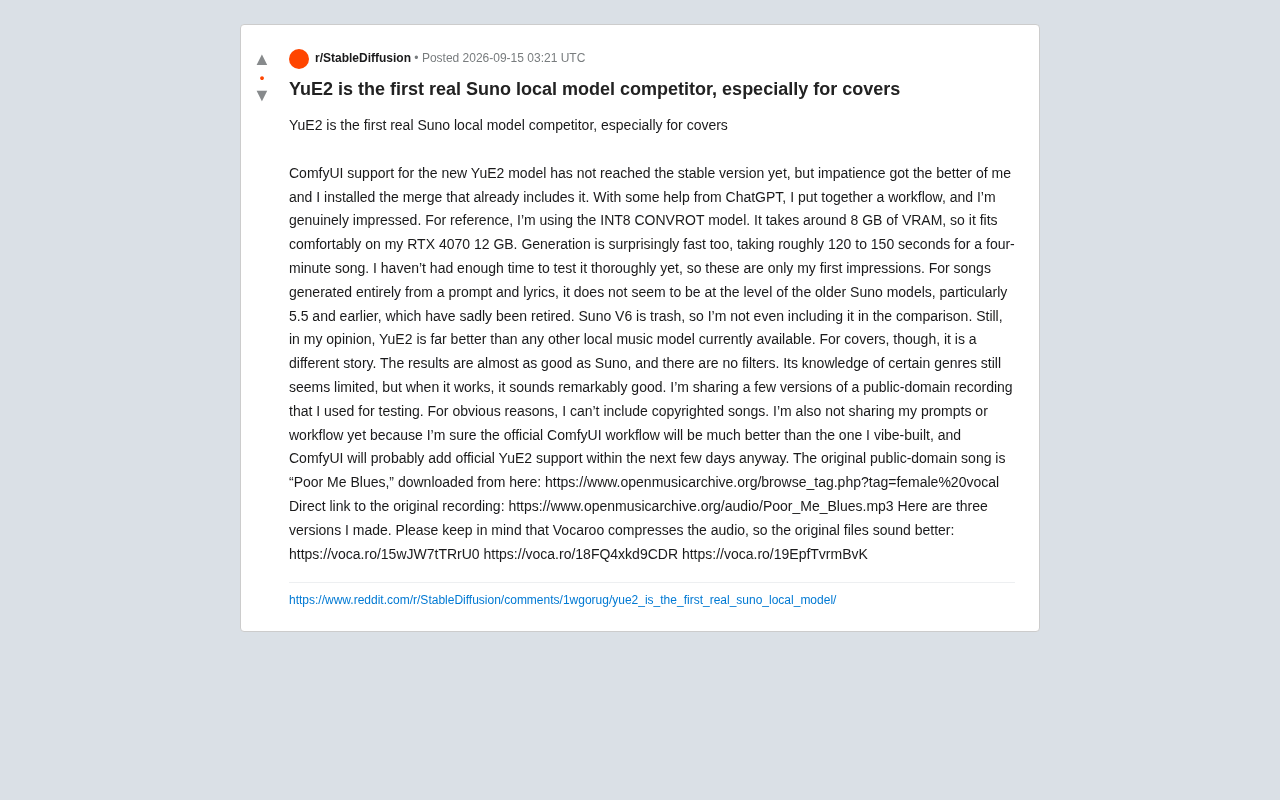
YuE2 runs on 8GB VRAM and delivers near-Suno cover quality — a new milestone for local open-source music generation.
A Reddit user's early hands-on testing of the newly released YuE2 model shows this local open-source music generator excels at covers, nearly matching commercial cloud service Suno with no content filtering. The INT8-quantized version requires only ~8GB VRAM, runs on consumer cards like the RTX 4070, and generates a four-minute song in 120–150 seconds. While pure text-to-song generation still falls short of older Suno versions, YuE2 is rated the best local music model currently available. The tester's workflow was improvised, so users are advised to wait for official ComfyUI support before diving in at scale.
The AI music generation space has long been dominated by cloud services like Suno and Udio, with local deployment options consistently falling short on quality. But early hands-on feedback from a Reddit user on the newly released YuE2 model has given local AI music generation a genuine reason for optimism — especially when it comes to covers.
YuE2's Hardware Requirements and Generation Speed
This user got ahead of the curve by installing YuE2 through a merged branch that already included the model, before ComfyUI's stable release officially added support — setting up the workflow with help from ChatGPT. They ran the INT8-quantized CONVROT model variant, which uses around 8GB of VRAM and runs comfortably on a consumer card like the RTX 4070 12GB.
What's particularly noteworthy is the generation speed. According to their testing, a four-minute song takes roughly 120 to 150 seconds to generate. For a locally deployed music generation model, that's remarkably efficient — meaning everyday users on mid-range hardware can enjoy a near-real-time creative experience without relying on paid cloud services or waiting in queues.
INT8 quantization is a model compression technique that reduces neural network weights from 32-bit or 16-bit floating point to 8-bit integer representation. This slightly sacrifices precision but dramatically cuts VRAM usage and compute requirements — typically by more than 50% — enabling large models that once required professional GPUs to run on consumer hardware. CONVROT is a specific architectural variant of YuE2, tuned with structural adjustments for music generation tasks. ComfyUI is an open-source, node-based AI workflow tool that lets users build generation pipelines for images, audio, and more by connecting functional nodes — no coding required. It's currently the most popular graphical frontend in the local AI creative space.
Pure Text-to-Music Generation: Still Behind Older Suno
On the core capability of generating a full song from prompts and lyrics alone, the tester offered a measured assessment. In their view, YuE2 doesn't yet reach the level of older Suno models — particularly the retired Suno 5.5 and earlier versions.
Interestingly, they were openly critical of Suno's version trajectory, flatly calling Suno V6 "trash" and refusing to include it in the comparison at all. This reflects a broader frustration among AI music tool users with model "regression" or style drift — newer versions don't always mean a better experience, and can actually lose qualities that made earlier versions special.
That said, the tester still emphasized that among all available local music models, YuE2 is the best they've encountered. That positioning matters: YuE2's significance isn't about dethroning top-tier cloud models — it's about raising the ceiling of what open-source local solutions can achieve to an entirely new level.
Cover Generation: Nearly on Par with Suno, No Filters
Where YuE2 truly stands out is in cover generation. The tester says it performs "almost as good as Suno" in this use case — and crucially, without any content filters.
The absence of filters is especially meaningful for local deployment users. Cloud services typically impose strict restrictions for copyright and compliance reasons, while local models give creators considerably more freedom. The tester was candid about YuE2's limitations too: its "knowledge" of certain musical genres still seems limited, but when it hits a style it's comfortable with, the results "sound pretty great."
To sidestep copyright concerns, the tester used a public domain recording — Poor Me Blues from the Open Music Archive — as source material for cover testing, sharing three generated versions. They noted that Vocaroo compresses audio, so the actual raw files sound better than what comes through the shared links.
The Open Music Archive is an online repository dedicated to public domain audio recordings, primarily housing early recordings from the 1920s through the 1950s whose copyrights have expired or been explicitly waived — free for anyone to use and adapt. Using such material for cover testing is a common practice among AI music researchers looking to avoid copyright disputes. Even if the AI model itself raises no legal issues, using a commercially copyrighted recording as a style or melodic reference could still trigger legal challenges. This reflects a core obstacle for commercial deployment of AI music cover features: current copyright frameworks haven't established clear rules around AI using existing recordings as style or melody references.
Why the Workflow Isn't Being Shared Yet
The tester was upfront that their workflow was "vibe-built" — cobbled together by feel — so they're holding off on sharing the prompts and workflow details. Their reasoning: ComfyUI will likely add official YuE2 support within days, and any official workflow will almost certainly outclass a hastily assembled personal setup.
This attitude speaks to the pace of iteration in the open-source ecosystem — a model can go from release to mainstream toolchain integration in just a few days, with community exploration getting there even sooner. For users wanting to try it out, waiting for official support is probably the more sensible path.
Takeaway: A Turning Point for Local AI Music
Putting this first-hand account together, YuE2's value comes down to three things: a low barrier to entry on consumer-grade GPUs, solid generation speed, and cover quality that approaches commercial products. It may not crush cloud models on pure generation capability, but as "the first real Suno competitor you can run locally," it has drawn a new starting line for open-source music generation.
A word of caution: these are early impressions from a single user, not large-scale validated testing. As ComfyUI's official support arrives and more users put YuE2 through its paces, a clearer picture of its real strengths and weaknesses will emerge.
Related articles

Building an AI Sci-Fi Short with LTX + MiniMax H3: Restrained Cinematography in ComfyUI
Sci-fi short REMAINDER uses LTX, MiniMax H3, and ComfyUI with restrained cinematography and flat aesthetics to solve visual consistency in AI filmmaking.

LangChain Deep Agents vs. MDA: Clearing Up the Confusion for Developers
What's the difference between LangChain's Deep Agents and MDA (Managed Deep Agents)? We break down create_deep_agent vs. define_deep_agent and help developers choose.

Why Is AI Agent Development So Fragmented? The Real Causes and How to Work Around Them
Why does AI Agent development feel so fragmented? Logic scattered across prompts, configs, and frameworks makes portability nearly impossible. Here's why — and how to cope.