YuE2 Studio: An All-in-One Local AI Music Creation and LoRA Training Tool
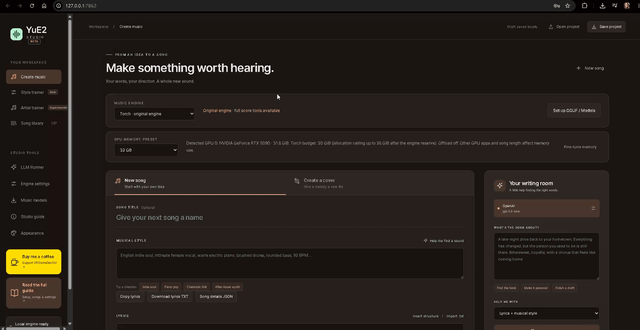
YuE2 Studio brings a local web UI to YuE2, unifying music generation, covers, LoRA training, and batch creation.
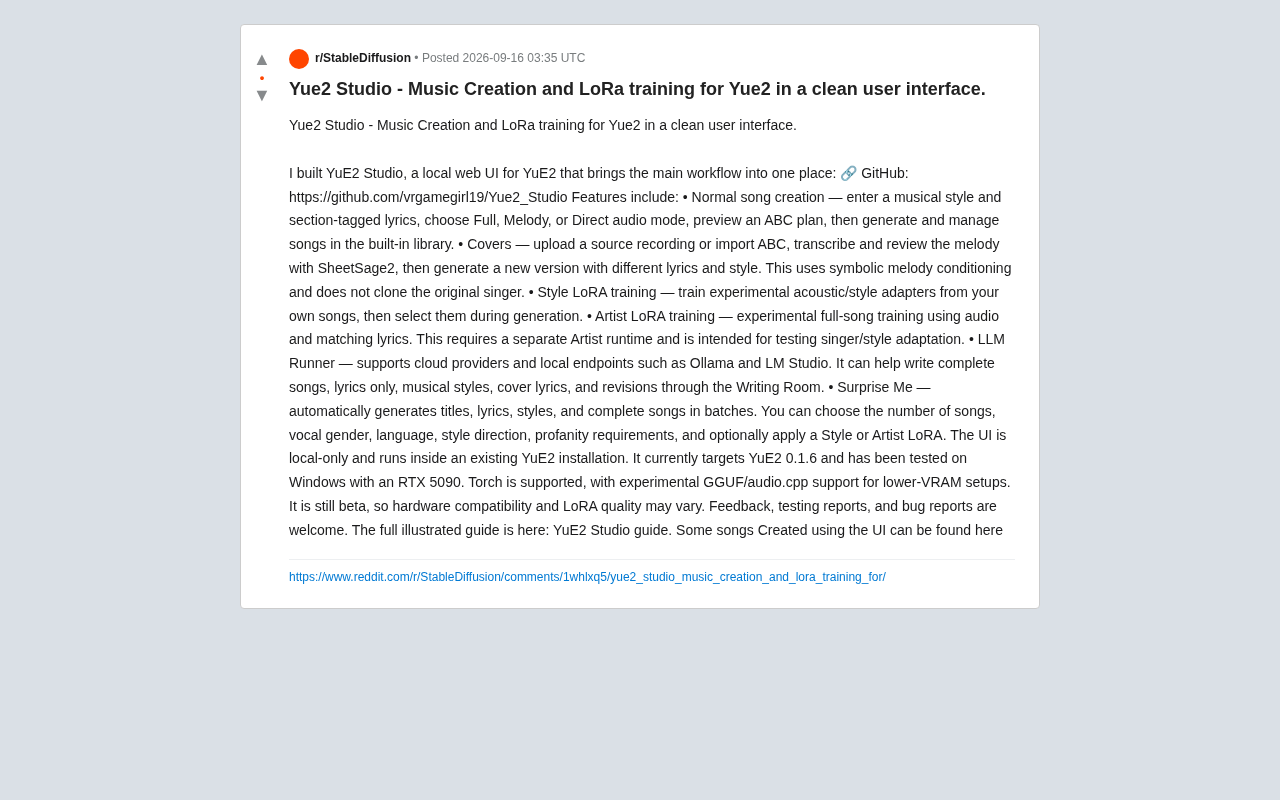
YuE2 Studio is a local graphical interface built by developer vrgamegirl19 for the open-source music generation model YuE2, consolidating scattered, high-barrier workflows into a unified visual environment. Core features include style- and lyric-driven song generation, cover arrangements using symbolic melody conditioning (not voice cloning), experimental Style and Artist LoRA training paths, LLM-assisted lyric writing via LLM Runner, and a Surprise Me batch generation mode. The tool is currently in beta, tested on Windows with an RTX 5090, with experimental GGUF/audio.cpp support for lower-VRAM setups.
The open-source music generation model YuE2 now has a much friendlier way to operate. Developer vrgamegirl19 has released YuE2 Studio, a locally-run web interface that integrates YuE2's core workflows into a unified visual environment — covering song generation, cover arrangements, LoRA training, and batch creation.
Bringing Scattered Workflows Under One Roof
YuE2 itself is a powerful open-source music generation model, but its native usage barrier is quite high. YuE2 Studio's value lies in surfacing common operations as graphical interactions: users input a music style and lyrics with section tags, choose one of three audio modes — Full, Melody, or Direct — preview the ABC notation plan, then generate with a single click and manage the results in a built-in library.
This "plan first, generate second" design reduces the cost of blind trial-and-error. The ABC plan preview lets users get a rough sense of the melodic structure before actually consuming compute — a genuinely practical trade-off for local inference.
Covers: Symbolic Melody Conditioning, Not Voice Cloning
The Covers module deserves its own discussion. Users can upload a source recording or import an ABC file, transcribe and review the melody using SheetSage2, then generate a new version with different lyrics and style.
The developer explicitly emphasizes that this workflow uses symbolic melody conditioning — it does not clone the original singer's voice. At a time when AI music copyright and voice cloning controversies are increasingly sensitive, this technical approach both sidesteps the ethical risk of directly replicating a human voice and frames covers more as "re-arrangement" than "voice theft."
Symbolic melody conditioning refers to expressing a melody in symbolic form (such as sheet music, MIDI, or ABC notation) rather than as an audio waveform, and using that as the conditioning input for the generative model. Unlike using raw audio for voice cloning, the symbolic approach extracts only the pitch and rhythmic skeleton of the melody, completely discarding timbre, resonance, and vocal fingerprint — the very elements that distinguish one singer from another. SheetSage2 acts as a "score transcriber" in this workflow, automatically converting uploaded audio into an editable symbolic melody, which YuE2 then re-sings with new lyrics and style. From a copyright perspective, melody itself remains protected under copyright law in most jurisdictions, but this workflow at least sidesteps the most contentious recent issue — AI voice cloning that reproduces a specific artist's vocal characteristics without consent.
Two LoRA Training Paths
YuE2 Studio offers two experimental LoRA training routes:
Style LoRA
Users can train acoustic/style adapters from their own songs and load them on demand during generation, imparting a specific tonal color or stylistic bias to the output.
Artist LoRA
A more advanced option, trained on full tracks with matching lyrics to test singer/style adaptation. Note that Artist LoRA requires a separate Artist runtime environment and is positioned more as an experimental feature. The developer repeatedly labels these capabilities as "experimental," meaning training quality is currently inconsistent.
LoRA (Low-Rank Adaptation) is a parameter-efficient fine-tuning technique originally proposed by Microsoft Research in 2021. The core idea is to freeze the original weights of a pre-trained large model and insert low-rank matrices into specific layers for training, achieving targeted adjustments to model behavior with very few additional parameters. Compared to full fine-tuning, LoRA requires significantly less VRAM and compute, and the resulting adapter files are typically only tens to hundreds of megabytes — easy to distribute and swap. In music generation contexts, Style LoRA typically adapts acoustic texture and harmonic tendencies, while Artist LoRA attempts to capture both timbral characteristics and vocal style simultaneously — the latter requires higher quality and quantity of training data and is therefore less stable.
LLM Assistant and Batch Creation
Beyond audio generation, YuE2 Studio integrates an LLM Runner, supporting both cloud providers and local endpoints like Ollama and LM Studio. Through the built-in Writing Room, the LLM can assist with writing complete songs, lyrics only, music style descriptions, cover lyrics, and revisions.
Another highlight is the Surprise Me batch generation feature: it automatically produces titles, lyrics, styles, and complete songs. Users can specify the number of songs, vocal gender, language, stylistic direction, explicit content preferences, and optionally layer in Style or Artist LoRA. For creators who need to rapidly audition a large number of creative directions, this kind of batch output capability can significantly accelerate the workflow.
Hardware Requirements and Current State
YuE2 Studio runs entirely locally and needs to be embedded within an existing YuE2 installation, currently targeting YuE2 version 0.1.6. The test environment is Windows with an RTX 5090 — which hints at fairly demanding VRAM and compute requirements.
The tool supports Torch and provides experimental GGUF/audio.cpp support for lower-VRAM configurations, though the developer candidly acknowledges that hardware compatibility and LoRA quality may vary by setup. The project is still in beta overall; the author is actively soliciting test feedback and bug reports. The project is open-sourced on GitHub with an illustrated usage guide.
GGUF is a quantized model file format developed by the llama.cpp community, designed to allow large neural networks to run on consumer-grade hardware or even CPU-only environments. Its core approach compresses model weights from 32-bit or 16-bit floating point down to 4-bit, 5-bit, or 8-bit integers, trading a small amount of precision for dramatically reduced VRAM usage. audio.cpp is an attempt to extend similar ideas to audio generation models. YuE2 Studio's experimental GGUF/audio.cpp support means users with less than 16GB of VRAM — or even less — can theoretically run the model, though the developer explicitly notes that compatibility is not guaranteed and output quality may degrade noticeably depending on the quantization level.
Summary
YuE2 Studio represents an attempt to make open-source AI music tools more accessible: rather than reinventing the wheel, it connects YuE2's powerful capabilities through a clean interface, forming a closed loop from creation and covers to LoRA fine-tuning. For AI music enthusiasts willing to set up local deployments and equipped with a capable GPU, this is an open-source project worth watching. That said, it's still early-stage beta — stability and training quality will need time to mature.
Related articles
AI Agent Fundamentals: The Three Core Components — Brain, Memory, and Tools
A beginner's guide to AI Agents: covering the three core components (brain, memory, tools), four stages of LLM deployment, and why Agents matter for real business use cases.

Boycotting Software That Doesn't Support Linux: One Developer's Philosophy of Choice
A Linux-only developer shares his philosophy of boycotting non-Linux software — without sacrificing productivity — and explains how coding agents like Claude Code are closing the gap with commercial tools.
Why Do All AI-Generated Projects Look the Same? The Aesthetic Homogenization Problem in Vibe Coding
Why do vibe coding projects all use purple gradients and dark glassmorphism? We break down the technical roots of AI aesthetic homogenization and how to escape it.