Z.ai Clarifies GLM-5.5 Is Not Delayed; December Launch Plan Unchanged
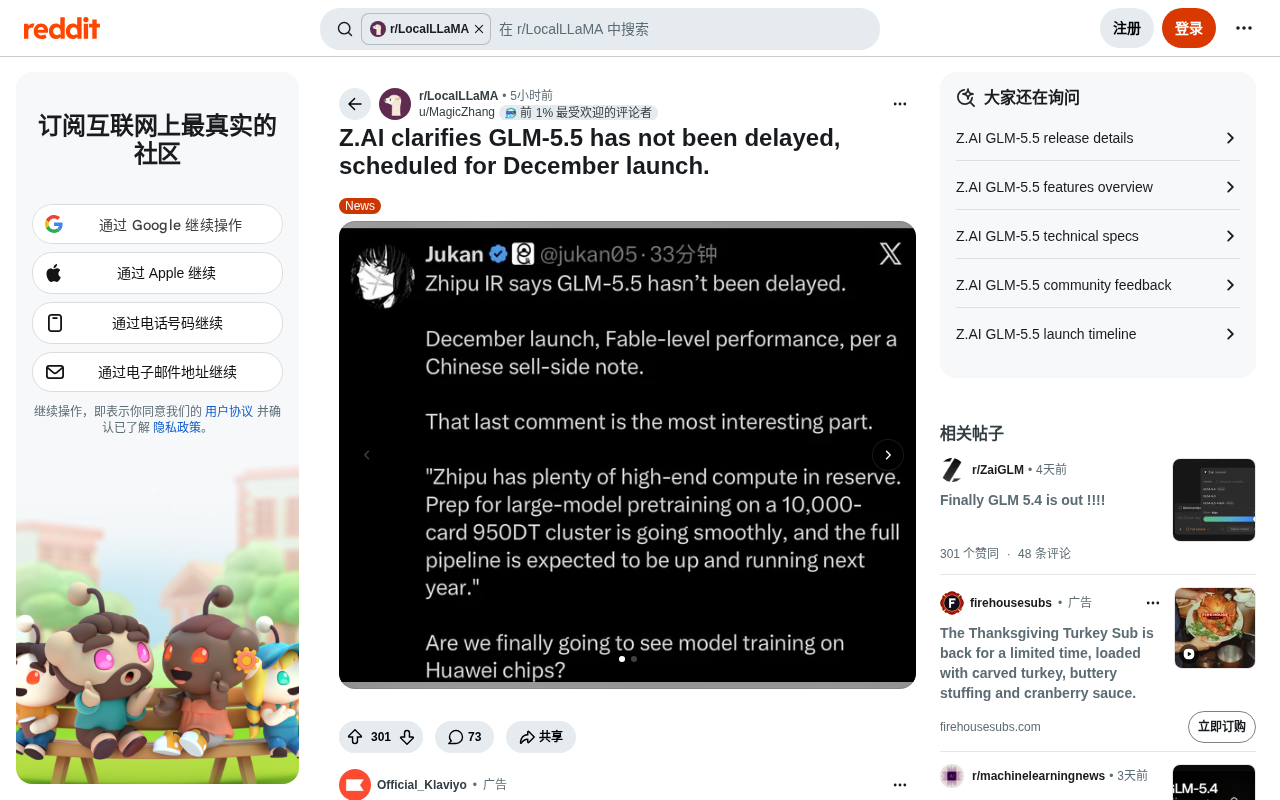
Z.ai clarifies GLM-5.5 is not delayed and remains on schedule for a December release.
Responding to community speculation that Zhipu AI's next-generation model GLM-5.5 might be delayed, Z.ai has explicitly clarified in a Hacker News discussion that the model is not delayed and remains on schedule for a December release. The article notes that large model release cadence is often seen as a barometer of technical roadmap health, and Z.ai's proactive response rather than silence reflects its attention to developer expectations while suggesting development has entered final stages. For teams planning year-end tech stack upgrades, a clear timeline means GLM-5.5 can be factored into scheduling. However, only the timing has been confirmed so far—details on capability improvements and parameter scale remain undisclosed; the ".5" in the version number suggests an incremental iteration rather than an architecture-level overhaul, and developers should verify actual task performance and inference costs after release.
Rumors and Clarification: GLM-5.5 Timeline Unchanged
Recently, speculation emerged in the community that Zhipu AI's (Z.ai) next-generation model GLM-5.5 might be delayed. According to a discussion on Hacker News, Z.ai has explicitly clarified that GLM-5.5 has not been delayed and remains on schedule for a December release. This statement directly addresses concerns that development progress has been hindered.
For developers tracking the iteration cadence of domestic large models, this news eliminates short-term uncertainty. In an increasingly competitive model landscape, a stable release schedule is itself a reflection of R&D organizational capability.
Why the "Delay" Rumor Matters
Large model release cadence is often viewed as a barometer of the health of a technical roadmap. Once a flagship model from a leading vendor slips, outsiders tend to associate it with training resources, data bottlenecks, or alignment challenges. Z.ai's proactive clarification this time indicates the team has clear confidence in the December window and suggests that GLM-5.5 development has entered its final stages.
From the community reaction, while discussion heat was modest (Points 6, Comments 0), the information itself carries signal value: Z.ai chose to respond quickly through public channels rather than stay silent, demonstrating its attention to developer expectations.
Large model training is typically divided into stages including pre-training, post-training (instruction fine-tuning and alignment), and evaluation/acceptance. Flagship model release dates are often locked in after these stages are completed. Common reasons behind so-called "slippage" include insufficient training resource scheduling, data mixtures falling short of quality targets, and repeated tuning in RLHF/alignment stages. Therefore, a clear release window is itself an external signal of R&D progress: when a vendor is willing to make a public commitment, it usually means key milestones have been largely achieved, with remaining work focused on engineering wrap-up and internal evaluation.
Industry Implications of the December Release Window
The GLM series has long been a representative model family in China that runs open-source and commercial tracks in parallel. If GLM-5.5 lands on schedule in December, it will directly affect developers' evaluation cycles when choosing models at the application layer. For teams planning year-end tech stack upgrades, a clear timeline means they can factor it into their scheduling rather than turning to alternative solutions.
One additional note: current public information only confirms the timing. Z.ai has not yet disclosed further details about GLM-5.5's specific capability improvements, parameter scale, or application scenarios. What's worth watching next is whether the official team will release technical blog posts or benchmark information before launch.
The GLM series, launched by Zhipu AI (Z.ai), adopts a strategy of running open-source and commercial APIs in parallel. Developers can either deploy on their own using open weights or call the official API. This dual-track model makes version iterations more directly impactful on the ecosystem: the open-source side affects local deployment and fine-tuning approaches, while the API side affects application-layer costs and migration plans. For enterprise model selection, whether a model family maintains a stable release cadence often reduces long-term maintenance risk more than any single version upgrade.
A Pragmatic View of Release Cadence
The ".5" in a model version number typically represents an incremental iteration rather than an architecture-level overhaul. Z.ai emphasizing "not delayed" rather than "ahead of schedule" suggests GLM-5.5 is more likely an optimized version built on GLM-5. For developers, rather than over-focusing on version numbers, it's more valuable to verify actual task performance and inference costs after release.
At this stage with limited information, staying tuned to official channels is the safest strategy. The December release window is now confirmed—all that remains is waiting for specific capabilities to be revealed.
In large model version naming, major version numbers (such as 5) usually correspond to significant adjustments in architecture or training paradigm, while intermediate versions like ".5" are mostly used to carry data updates, capability enhancements, and inference efficiency optimizations, with API and ecosystem compatibility generally remaining stable. For developers, the real value of an incremental iteration should be measured through specific task benchmarks, latency, and per-token cost—not judged by version number alone.
Related articles

Can AI Crack the Riemann Hypothesis? Starting from an Interdisciplinary Encounter
Grant Sanderson recounts how Montgomery and Dyson's chance encounter over a formula linked number theory and random matrix theory, and uses it to analyze why LLMs have a structural edge in cross-domain analogy—and the limits of that breadth in mathematical research.

The US Government Is Facing AI Cyberattack Threats
The US government faces AI-driven cyberattack threats. This article analyzes how AI is reshaping the attack-defense balance, the unique challenges for government agencies, and response strategies and future outlook.
Self-Hosted GitHub: Take Control of Your Code and AI Agents with Gitea
NetworkChuck shows how to self-host GitHub with Gitea: Docker deployment, SSH auth, AI agent MCP integration, GitHub mirror sync, and security hardening for full code control.