Zapier Automation in Practice: Building a Gym Client Follow-Up System from Scratch

An automation consultant used Zapier and AI to build a gym client onboarding system, charging $500 per month for maintenance.
An automation consultant built a complete client onboarding system for a gym and charges $500 per month for maintenance. The system uses forms to capture leads and immediately send confirmation texts, automatically sends a limited-time discount after 7 days, and then cleans the sales pipeline through a 23-hour check and 1-hour countdown reminder. AI generates 12 months of email marketing content in bulk, greatly reducing delivery costs. This system fills group classes for the gym, brings new leads, and generates monthly recurring revenue, so pricing depends not on build difficulty but on client value. When replicating it, pay attention to SMS compliance, Zapier delay limitations, and human review of AI content.
What a $500/Month Automation System Looks Like
An automation consultant shared his real-world case on YouTube: he built a complete client onboarding process for a gym and charges $500 per month for maintenance. The system covers the entire chain from lead registration, trial activation, discount-driven conversion, to churned customer management.
The core logic isn't complicated: use forms to collect leads, use SMS for automated outreach, use conditional branching to distinguish customer intent, and then use AI to generate long-term marketing content in bulk. The entire system requires almost no manual intervention, yet continuously brings the gym new members and repeat revenue.
This video comes from YouTube and is a complete hands-on tutorial. Below, we break down each part of this system and how to replicate it with Zapier.
Step 1: Capture Leads with a Form and Auto-Respond
The gym owner posts a registration link on social media, and users who fill in their personal information get a 7-day free trial. Every registrant automatically enters the lead list and immediately receives a confirmation text.
The text contains a unique verification code that users can show at the front desk to activate the trial.
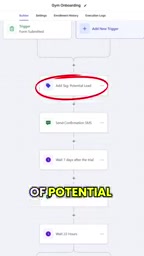
The key to this step is "instant response." When a lead receives a text within seconds of submitting the form, their psychological engagement increases significantly. Zapier's trigger can be set to "form submission," and the action can be "send SMS," with no manual operation in between.
From a technical implementation standpoint, you need to connect a form tool (such as Typeform or Google Forms) and an SMS service (such as Twilio), then use Zapier's Filter feature to ensure that only valid phone numbers trigger the text.
What Zapier is: Zapier is a no-code automation platform that connects different SaaS tools through "Trigger + Action." Users don't need to write code; they just choose "when event A happens, automatically perform action B," and Zapier will continuously poll in the background or receive events via Webhook and execute them. Its core concepts include Zap (an automation workflow), Trigger (the triggering event, such as form submission), Action (the operation performed, such as sending an SMS), Filter (conditional filtering, only continuing if conditions are met), and Paths (conditional branching, taking different paths based on user behavior). The Delay mentioned in the article is used to insert a time wait. Zapier's plan tier determines the number of executable steps, delay precision, and multi-step branching capabilities. The free version usually supports only two-step Zaps and shorter delays, so the 7-day wait and 23-hour check mentioned in the article often require a paid plan.
Twilio and SMS compliance: Twilio is a company that provides cloud communication APIs, allowing developers to send SMS, voice, and WhatsApp messages through it. In the article, Twilio is used as the SMS service, and Zapier connects to a Twilio account to send confirmation codes and promotional texts. However, in actual use, SMS marketing is strictly regulated. For example, the U.S. TCPA requires that marketing texts obtain prior explicit consent from users, and every message must provide an opt-out method (such as replying STOP). Different countries also have different restrictions on sending times, frequency, and content. Therefore, the article's emphasis that "users have already agreed to receive SMS when registering" is not only a compliance requirement but also a necessary prerequisite for avoiding account bans and message blocking.
Step 2: The Discount Conversion Logic After the 7-Day Trial
After the user activates the trial, the system waits 7 days and then automatically sends a 20% discount full-membership promotional text. The copy roughly says: we hope you enjoyed your first week, we're offering a limited-time 24-hour exclusive 20% discount, and we welcome you to join as a full member.
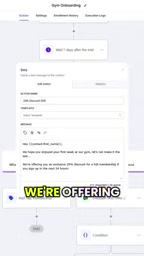
There is a design detail here that many people overlook: wait 23 hours and then do a second outreach. That is, after the first promotional text is sent, the system waits another 23 hours to check whether the user has replied or completed registration. If the user has already converted, they are moved to the full-member list; if there is no reply, another reminder text is sent saying "the offer ends in 1 hour."
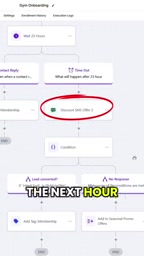
This combination of a "23-hour check + 1-hour countdown" is essentially clearing out leads in the sales pipeline who are "still hesitating" or "have already forgotten." Users who still do not respond after two outreach attempts are placed in a cold lead list, used only for seasonal promotions.
Zapier's Delay and Paths features can fully implement this branching logic. Delay handles the time wait, and Paths handles taking different branches based on user behavior.
Sales Pipeline and lead segmentation: A sales pipeline is a visual model of the stages in the sales process from lead to close, usually including new lead, contacted, in trial, converted, churned, and so on. The automation system in the article is essentially automatically advancing the pipeline: after form submission, the user enters "new lead"; after trial activation, they enter "in trial"; after 7 days, a discount is sent and they enter "conversion push"; if there is still no response after the 23-hour check, they are classified as a "cold lead." This segmentation allows the gym to adopt different strategies for users in different states. Cold leads are used only for seasonal promotions to avoid excessive interruption. The value of automation tools lies in eliminating the need for manual case-by-case judgment; the system automatically updates the stage based on user behavior, keeping the pipeline clean and follow-up timely.
Step 3: Use AI to Generate 12 Months of Marketing Content in Bulk
The place where this system truly opens up a premium pricing gap is the involvement of AI. The specific approach is: open ChatGPT, input the gym's background information and a detailed description of the automation workflow, and then ask it to write a plan for the next 12 months of email marketing campaigns.
This content covers themes such as Christmas, New Year fitness goals, and summer body-shaping motivation.
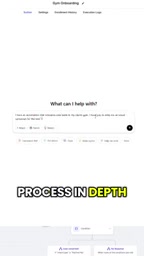
From the perspective of the service provider, this step greatly reduces delivery costs — you don't need to write dozens of marketing emails from scratch; AI can produce a year's content framework in minutes. What the gym owner receives is not just an automation workflow, but a full year of marketing ammunition.
When using AI tools, the quality of the prompt directly determines the output. It is recommended to clearly state in the prompt the gym's positioning (high-end or affordable), target audience (fat loss or muscle gain), brand tone (motivational or gentle), and the marketing moments corresponding to each month.
Why This System Can Charge $500/Month
Pricing for automation services never depends on build difficulty; it depends on how much value it creates for the client. The significance of this system for the gym can be broken down into three points.
It fills group classes. The system continuously converts trial users into full members, directly increasing class occupancy.
It brings new leads. The combination of forms + SMS lowers the registration barrier, allowing traffic from social media to quickly settle into trackable sales leads.
It generates monthly recurring revenue while running automatically. The gym does not need to hire additional staff to follow up with every trial user; the system automatically completes the entire process from outreach to conversion push.
For automation consultants, this is a replicable, scalable business model — build once, charge monthly, and serve multiple clients at the same time.
Technical Points for Replicating This System
If you want to build a similar workflow yourself, the following technical details require special attention.
SMS compliance is the first threshold. Different countries have strict regulations on the timing and frequency of marketing texts. You need to ensure that users have agreed to receive SMS when registering and provide an opt-out method.
The precision of delayed outreach depends on your Zapier plan tier. The free version usually allows only shorter delays. Implementing a 7-day wait and 23-hour check may require a paid plan.
The stability of data flow is also critical. It is recommended to run through the entire process with test data before going live, confirming that every branch executes correctly and avoiding situations where users receive the wrong text or are contacted repeatedly.
AI-generated content needs human review. Especially the parts involving pricing, promotional terms, and legal statements should be reviewed before being sent directly to clients.
The core value of this system is not its technical complexity, but that it turns a proven sales process into an automatically executable digital asset. For people who want to enter the field of automation services, this is a starting point worth referencing.
One-line Summary
An automation consultant used Zapier and AI to build a gym client onboarding system, charging $500 per month for maintenance.
Paragraph Summary
An automation consultant built a complete client onboarding system for a gym and charges $500 per month for maintenance. The system uses forms to capture leads and immediately send confirmation texts, automatically sends a limited-time discount after 7 days, and then cleans the sales pipeline through a 23-hour check and 1-hour countdown reminder. AI generates 12 months of email marketing content in bulk, greatly reducing delivery costs. This system fills group classes for the gym, brings new leads, and generates monthly recurring revenue, so pricing depends not on build difficulty but on client value. When replicating it, pay attention to SMS compliance, Zapier delay limitations, and human review of AI content.
Related articles

JobRunner MCP Server: AI Agents Can Now Fix Failed Java Jobs
JobRunner launches an open-source MCP server enabling AI agents to view cluster status, diagnose failures, and recover Java jobs—incident response from any cloud coding environment or existing agent.

MLAI Digital Launches 9 Security Agents: MCP Server Safeguards the Full Lifecycle of Agentic AI
MLAI Digital launches Security MCP Server with nine built-in specialized security agents covering vulnerability discovery, attack simulation, prompt injection detection, API and infrastructure assessment, and accelerated remediation—embedding security validation across the full Agentic AI lifecycle from development to production.

Running Isaac Lab on H100 GPUs: Exploring Better Approaches
Exploring optimization methods for running Isaac Lab on NVIDIA H100 GPUs, including MIG configuration, mixed precision, TensorRT acceleration, and community experience to improve robotics simulation and reinforcement learning efficiency.