Zapier MCP Review: The Hidden Cost of Turning AI Conversations into Automated Actions

Zapier MCP lets AI agents take action across 9,000+ apps, but task quota consumption is the hidden cost.
This article analyzes Zapier MCP's capabilities, pricing, and community feedback. Zapier MCP lets AI agents like Claude, ChatGPT, and Cursor auto-search 9,000+ apps and call tools, with 500K+ MCP servers and 25M tool calls. MCP isn't billed separately—it shares the task pool with Zaps and AI steps. Each tool call consumes two tasks, so the free plan's 100 tasks cover only ~50 calls. The core issue: MCP runs on your task budget, and costs depend on agent consumption.
Zapier MCP promises to let Claude, ChatGPT, and Cursor actually "do things" inside your apps. I dug deep into its capabilities, pricing, and community feedback—and found a critical issue that rarely gets mentioned: just how many tasks your AI agent will actually consume.
What Zapier MCP Can Actually Do
The core idea behind Zapier MCP is simple: you tell it your goal, and your AI agent automatically searches across the 9,000+ apps on the Zapier platform to find the right tools to complete the task. That means you don't have to manually pick every single action step.
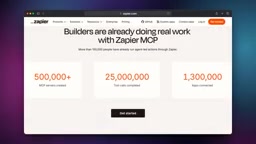
The adoption numbers suggest there's real demand for this approach. According to Zapier's official data, over 500,000 MCP servers have been created, completing 25 million tool calls. For enterprise users, IT departments can centrally manage which apps and credentials agents can access in one place—this kind of centralized control is what makes enterprises feel relatively safe.
MCP (Model Context Protocol) is an open standard introduced by Anthropic in late 2024 to let AI models connect to external tools and data sources in a unified way. Think of MCP as the "USB-C port" of the AI world: before it existed, every AI application needed its own custom integration to connect to external services; with MCP, any AI client that supports the protocol (like Claude, ChatGPT, or Cursor) can call external tools through the same specification. Zapier MCP is a "server-side" implementation within this ecosystem—it packages the API capabilities of 9,000+ apps on the Zapier platform into MCP tools exposed to AI agents.
Tool Call is the basic unit of an AI agent executing a task. When the agent determines it needs an action (such as "create a Notion page" or "send a Gmail"), it initiates a tool call to the MCP server, which executes the action and returns the result. That's why billing is typically based on the number of tool calls rather than conversation turns—a single complex conversation can trigger multiple tool calls, which is the root reason task quotas get consumed so quickly.
Pricing Structure and Hidden Costs
Zapier's pricing page shows: Free plan $0, Professional $19.99/month, Team $69/month.
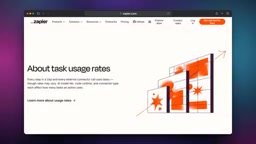
The key takeaway: MCP is not billed separately. Zap workflows, AI steps, code, MCP, and SDK all draw from the same task pool—there's no separate budget. Sounds clean, but that's exactly where the problem hides.
According to LateNote's pricing analysis, each successful tool call consumes two tasks. In other words, the free plan's 100 tasks per month is only enough for about 50 tool calls. Fifty. That's extremely limited in real-world use.
What Community Feedback Reveals
The real-world experience for free plan users isn't great. Some users report that cloud connections that were working fine suddenly throw an error saying "operation execution was aborted."
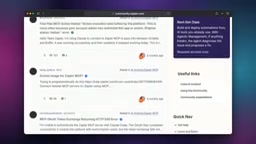
Some community forum users also expressed skepticism about Zapier's leadership position in the MCP market. One forum user wrote: "While Zapier's expertise in API integration is impressive, I'm skeptical about whether they can lead the MCP market."
Task is Zapier's core internal unit of measurement. In Zapier's classic model, every successful execution of a Zap consumes one task—for example, "new email received → write to spreadsheet" counts as one task per email. AI steps, code steps, and MCP tool calls are all essentially treated as one action in Zapier's execution engine, so they all draw from the same task pool. Understanding this makes it clear why MCP can't be billed independently: it's just another source of task consumption, competing for resources with existing workflows.
The Most Overlooked Core Issue
ToolRadar's list of drawbacks points out a key problem: Zapier MCP requires you to already have a Zapier task quota. In other words, MCP is essentially a feature that runs on top of your task budget, not a standalone product.
This means the real cost variable is how many tasks your AI agent will consume. If your agent needs to call tools frequently to complete complex workflows, task consumption will far exceed expectations. For users already on Zapier, this is a natural capability extension that gives AI actual "hands." But if you're cost-sensitive, you need to do the task math before using it.

Final Verdict
Zapier MCP isn't for everyone. If you're already deeply embedded in the Zapier ecosystem, it's a solid way to give AI agents real operational capabilities, and IT governance and enterprise-grade credential management provide enough peace of mind. But its pricing logic means you need to closely monitor your agent's task consumption—otherwise your bill could grow faster than you expect.
One-line Summary
Zapier MCP lets AI agents take action across 9,000+ apps, but task quota consumption is the hidden cost.
Paragraph Summary
This article provides an in-depth analysis of Zapier MCP's capabilities, pricing, and community feedback. Zapier MCP lets AI agents like Claude, ChatGPT, and Cursor automatically search across 9,000+ apps on Zapier and call tools to complete tasks, with over 500K MCP servers and 25 million tool calls. Enterprises gain peace of mind through centralized credential management. On pricing, MCP isn't billed separately—it shares the same task pool with Zaps, AI steps, and code. Each successful tool call consumes two tasks, meaning the free plan's 100 tasks only cover about 50 calls. Community reports mention free plan connections suddenly dropping, and some users question whether Zapier can lead the MCP market. The core issue: MCP is essentially an add-on running on your task budget, and costs depend on how many tasks your agent consumes—cost-sensitive users must do the math first.
Related articles

Workbuddy for Absolute Beginners: How a Desktop AI Agent Fits Into Real Workflows
A beginner's guide to the Workbuddy desktop AI agent: installation, claiming credits, file management, and building automated workflows—compared with CodeX for fit and cost, helping professionals shift from AI question-askers to AI managers.

OpenAI's New Agent Stack: Computer Use, Decisions API, and Ultra-Fast Workflows
OpenAI Dev Day unveiled a new agent stack: Computer Use outperforms humans, Decisions API delivers ultra-low-latency classification via Luna, Agents API opens the same Computer Use capabilities, and GPT-6.1 Sol costs only one-seventh of Astra. Core updates, benchmark data, and developer insights.

Liang Wenfeng Open-Sources DeepInfo Inference Framework, Takes On U.S. Ban
DeepSeek open-sources its DeepInfo inference framework after its models, featuring GPU/CPU cross-pipelining, small-model prediction with large-model verification, and full Huawei Ascend and NVIDIA chip support—facing the U.S. federal ban head-on. This article analyzes its significance for AI deployment and open-source strategy.